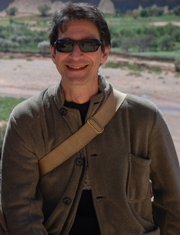
The Tony Wheeler Interview

Ranulph Fiennes

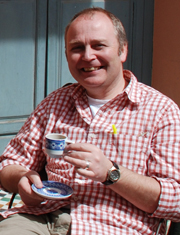
Tony Wheeler founded Lonely Planet in late 1973 after a six-month overland trip across Asia that resulted in “Across Asia on the Cheap”. Today the company has become the world’s largest independent guidebook publisher with more than 500 titles in print and over 400 employees. He came to Stanfords to talk about his most recent book, Bad Lands, part travelogue, part social and political commentary.

You seem to have covered vast swathes of the globe even as a child. Where and why did you venture and what was it like at such a young age?

My childhood travels were strictly business, there are embassy-kids, armed forces-kids, airline-kids etc, and I was the latter. So I grew up in Pakistan, the Bahamas and the USA, until I was 16 and finally got back to the UK. I had some great times.

Did you make the trip across Asia with the guide in mind or was it Continue reading The Tony Wheeler Interview

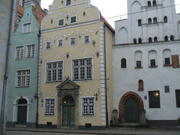
Riga, Latvia

Sitting astride the banks of the river Daugava, the city of Riga is one of mystery, beauty and contradiction. Latvia gained its independence from the last death throes of the Soviet Empire in 1991 and with this newfound freedom Riga has in recent years emerged as an increasingly popular destination. Spurred on by its inception to the EU and recent Eurovision ‘success’, Riga symbolises a Latvia intent on building a reputation as a vibrant, modern city open to the west once more.

Dubbed the ‘Paris of the north’, Riga is a hauntingly beautiful city. While the ghosts of Soviet and Nazi occupation still linger beneath the surface, there is a real sense of purpose and intent on building a new legacy for itself after the dark days of the 20th century. This is enforced through the keen contrast between old and new, best symbolised in the imposingly tall, modern, glass TV tower that blinks unflinchingly across the Daugava to Riga Castle and the heart of the old city; a bridge of time that most accurately defines the conundrum at the heart of Rigan life.

Staying outside the walls of the old city, a 15-minute walk from our hotel illustrates the steps the city has made since independence. Brand new boutiques, coffee shops and an intriguingly large number of hairdressers are housed within the newly restored facades of Soviet buildings. Meanwhile, faded blue, Sixties trams silently roam the streets like a team of ants, still the lifeblood of a city where nearly 70% of the inhabitants are Russian.

Riga’s spiritual centrepiece is her Freedom Monument, a 100-foot female figure holding aloft three gold stars, built to commemorate Latvian freedom in the early ’90s and still guarded by impressively attired ceremonial soldiers. The monument sits among carefully landscaped gardens, populated by traditional folk bands and chess grand masters, the area a legacy worthy of one of Europe’s first garden cities. These gardens, bisected by a seemingly deserted canal, act as a natural entry point into the carefully preserved old city, where Riga’s greatest treasures lie.

The old city itself is remarkably preserved considering its turbulent and violent history. Easily navigable by foot it lies a short distance from the river, where dramatic masses of ice glide ominously in from the Baltic, a reminder of the city’s bitter winters. Along the waterfront stands The ‘Latvian Riflemen’, a starkly bleak monument built to commemorate those fallen in war, which aptly stands guard outside one of Riga’s must-see sites, the Museum of Latvian Occupation. Housed in an unattractive, gleaming black building (deliberately to suit its purpose) the museum remembers the twentieth century occupations of the Soviets and Nazis. Shocking in its depiction of the Baltic countries’ struggle against various outside aggressors, it is equally revealing of Latvia’s determination to document her past struggles. Our young guide was unrelenting in our two hour tour; mindful of keeping their memories fresh but also in looking to the future.

Riga has one of the largest art nouveau heritages in Europe, comprising of a web of streets to the north of the old town, though still in easy walking distance. After dining on a lunch of caviar, kidneys in a pot and the obligatory vodka, we ventured into adjoining Art Nouveau maze of streets. The results were surprising. Doubting that a city ravaged by war could still boast any extensive architectural memory, the first street we ventured upon, Alberta Iela, had an unspoilt grand parade of buildings dating back to the 1900s, complete with ornate buttresses, gilded facades and seemingly all individually designed by Mikhail Eisenstein, father of the film director Sergei; famous for Battleship Potemkin. Ranulph Fiennes These flamboyant architectural gestures somehow belie their modern purpose, providing social housing and shelter for the poorer elements of Rigan society. The grandiose nature of the entire Art Nouveau district appears temporarily forgotten by the majority of the city. However, its close proximity to the heart of Riga’s old city suggests that could soon be fully renovated to serve as expensive designer boutique hotels for Russian oligarchs and the increasing numbers travelling from Western Europe.

It was in our determination to sample the Latvian beverage of choice; Black Balsams, (a bitter mixture of roots, herbs, fruit), that we stumbled on a relic of Riga’s proud 17th century mercantile past. Located next to the Swedish Gate build by Gustavus Adolphus to commemorate the Swedish annexation of Latvia into its empire, Torna Iela exudes the spirit of medieval wealth that made Riga a valuable crossroads for the exchange of goods between Scandanavia and Russia. Although it is no longer used for its original purpose, the street’s original merchant housing and cobbled stones is particularly atmospheric; one almost expects to be accosted by a bearded Swede peddling his wares from across the Baltic. Apparently one restaurant is now a haunt of the American ambassador, though the most glamorous frequenters we saw were scowling Russian dignitaries clad in black guarding the oaken bar.

In our quest to sample the bitter ‘balsams’ we discovered an underground bar that attracted an increasingly Westernised yet staunchly patriotic younger crowd of Rigans. This included a spectacular drinking ‘fire show’, consisting of a fire extinguisher, fireman’s helmets and liquid flame powered by a Bunsen burner from behind the bar. Jaws agape, we watched as the barman poured liquid flame over the sides of a reveller’s helmet from on high, yet appearing not to scorch their ears to turn them into ash. I could imagine the ring of fire such an act would elicit in the Health and Safety bureau in England.

As with many of the eastern European capitals that have opened up for mass tourism, Riga now stands at a crossroads. Caught between the lure of the easy ‘Lats’ in the form of clubs and bars geared towards the stag night industry and preserving an old town peppered with beautiful churches and soaring architecture, the paradox is evident. A relatively small city, Riga currently balances the historical and the modern quite dramatically, but it is in its rich cultural traditions and hard won independence that its main attractions lie. A recent newcomer to the EU, only time will tell whether the capital city of this young independent nation will continue to bloom.

As we wended our reluctant way slowly back to our hotel on our last night, hundreds of Riot Police formed a human chain around the Freedom Monument. Cornered on one side of the heavy police presence, a group of late middle aged Russians chanted, their unfurled banners proclaiming that Riga says ‘No to Nazis’. As the light gradually dimmed, a torch bearing party numbering a thousand, young and old, carried extravagantly coloured flowers of red and white to the monument, celebrating the withdrawal of Soviet forces from Riga but also to commemorate the spirit of independence so long cherished by its people. Having carefully placed their flowers and flags on the monument’s steps, they joined together in a circle and in ghostly voices intoned their national anthem, ‘Dievs, Sveti Latviju’ in the gathering gloom.

The Bradt Travel Guide to Latvia is excellent for detail on the nation’s history and general information. For navigation, take the Jana Seta Street Plan of Riga.

Browse our collection of travel guides and maps to Riga >

Author: Thom Wood

The Anthony Sattin Interview

James Innes Williams went to Marrakech in the company of Travellers’ Tales, the travel writing and photography training company.

After exploring the souks of the Medina and the vibrant Jemaa El Fna, they then travelled up and over the High Atlas, and made in roads to the desert, all the time practising their writing and photography techniques.

At the end of the week, James caught up with the three tutors, Jon Lorie the director and ex-editor of Traveller magazine, distinguished travel and history writer Anthony Sattin and the force behind the BBC Unforgettable series, photographer Steve Watkins. Here, in the third of a series of interviews, James talks with Anthony Sattin.

How did you become a travel writer?

Quite by chance. I’ve always travelled and I’ve always been a writer but I had no ambition to be a travel writer at all. Then quite by chance, I had an idea. I was a fiction writer and I had an idea about writing a book about travellers in Egypt – the history of the European advance into Egypt. So I travelled around in Egypt and was loving that and then quite out of the blue The Sunday Times called and asked if I would write a travel story for them. And I had no idea that people did such things. I don’t think I’d ever read a travel story at that point. But they were just creating the travel section in the paper; there was a travel page before. And they were looking for writers rather than journalists, they actually made that distinction. So they were particularly looking for novelists who would stand out. So I said, “Yeah, sure, why not?”

And you’ve been doing it ever since. But you’re writing a lot of history too, why is that?

Yeah, more history now than travel. It was partly a response to reviewing so many travel books and being so disappointed with so many of them! But also travel writing goes in cycles, I think, and you know there was this huge boom in the nineties and there was a huge amount of indiscriminate publishing. Every publisher suddenly had to publish travel books and they were selling, especially in the early nineties, late eighties, and that has more or less petered out. You ask the big publishers now and they’ll say travel doesn’t sell. But I am planning a travel book but it’s just a question of in which order I do the things I plan to do.

How did you then get into teaching and what are you getting from it?

I’d always been completely against teaching; it had never interested me at all. I did this creative writing course at East Anglia, and there were eight of us on it, and I think of the eight two of us went on to publish fiction and four went into teaching and the other two just dropped out completely from that world. And there was that line, ‘Those that can, do; those that can’t, teach.’ So that had always been part of my thinking too. If I can write, then why not write? But here in Marrakech last year I was running a literary salon for a weekend, talking about my work. It was a charity event. Part of the deal was that I would give a writing talk in the morning and so there were some people who had paid a huge amount of money to come along to this but there were also some kids from the American school here in Marrakech, Moroccans, and they were so wonderful and it was such a thrill to have these kids who’d never thought of writing something like that before. And just to open that door for them, I came away completely excited by it.

You’ll carry on?

Yes, I don’t want to do too much of it. I remember the boredom of my lecturers at university going over the same old stuff. I wouldn’t want to do too much, but I enjoy it for that.

What’s the difference in technique between writing articles and writing books?

It’s completely different. And I think generally it does appeal to one person or the other. Do you have the stamina to write a travel book? You know it takes a lot of time and, let’s be practical about it, a lot of money as well. You know, we live in an expensive country. And how are you going to do it? So lot’s of people immediately rule themselves out from writing travel books because it’s not something they could do. And I encourage everybody to be realistic about their aims and, I think, if you’re going to start something you owe it to yourself to finish, so you owe it to yourself to be realistic about whether you can finish it or not. But it’s a lot easier to break into travel writing as a travel journalist writing for newspapers and magazines.

What’s your top tip for writing description?

The top tip for writing description, as for writing anything, is finding significant detail. Finding something that expresses something, that will say something general within that specific. You know, the little detail, the little thing that immediately says you’re in Marrakech.

And your top tip for impressing an editor or publisher?

Know who you are talking to, do your research. Let them know that you know who they are, that you have bothered to find out. I get into trouble still.

What’s the benefit of being in Marrakech, do you think, for training?Travellers' Tales student notetaking

Being able to be in a place that’s particularly inspiring. You know, there’s so much to write about here. And being able to go out, walk around, come back and get everyone to write about what we’ve all just seen and in a group of ten, get ten completely different takes on the same little walk you did through the souk. It’s wonderful. It’s not something you can do so easily if you’re sitting in a room in Hampstead.

What’s your favourite aspect of travel?

I love the beginning of every trip. I still get excited going to the airport or to the port, my life just reduced to one bag and I’m off. Who knows what will happen? It’s the possibilities, the anticipation and the possibilities – on a good trip the possibilities are endless. I think if I didn’t have that sense I wouldn’t travel anymore. I would hate to go in to thinking, “Oh God, I wish I wasn’t leaving home.”

What’s the worst thing about travel?

Oh, airlines obviously. Usually it’s the most expensive part of your travel and the least pleasant part of the experience. Why is the food so bad? Why as someone of 6’2” do I have to sit with my knees up around my ears? Why, why, why. Why is the air so bad? Why don’t they pressurise the cabin properly? It’s quite easily achieved.

When will see you at Stanfords again? And what will make up the contents of the book you’ll be signing?

When you invite me! It’ll be Egypt again, Egypt in the winter of 1849. The winter we would all have loved to be in Egypt sailing up the Nile.

So, do you have a publication date you’re aiming for?

Yes, but it would be embarrassing to tell you because I’m obviously not going to hit it!

Author: James Innes Williams
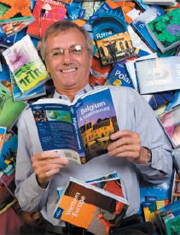
The Jon Lorie Interview

Ranulph Fiennes

James Innes Williams went to Marrakech in the company of Travellers’ Tales, the travel writing and photography training company. Exploring the souks of the Medina and the vibrant Jemaa El Fna, they then travelled up and over the High Atlas, and made in roads to the desert, all the time practising their writing and photography techniques.

At the end of the week he caught up with the three tutors, Jon Lorie the director and ex-editor of Traveller magazine, distinguished travel and history writer Anthony Sattin and the force behind the BBC Unforgettable series, photographer Steve Watkins.

Here, in the first of a series of interviews, James talks with Jon Lorie.

What was the driver behind forming Travellers’ Tales and leaving Traveller Continue reading The Jon Lorie Interview

Marrakech

Marrakech – the streets have no name, the maps are a picture of noodle soup and the whole city is an assault on all the senses.

Single-serving friends pop up around every corner and yet it seems that round the next bend there’s danger lurking.

Moustafa, a teenager in a dusty, orange tracksuit, complete with a single yellow toothy grin found me by the Marché des Épice. Here, spice sellers congregate to the rumble of mopeds and twittering birdsong. In the centre of the square traders pile their stock in tall neat stacks, careful to keep them inside their designated zone marked with yellow paint on the new grey brick floor.

The square is apparently authentic but those in the centre take aim at the tourist – all keen to take a little bit of Marrakech home. Unsurprisingly the spice sellers that encircle them are happy to prosper from them too.

Moustafa led me away to see the truth of the city. Tripping along the pink alleyways and skipping over the open drains, dodging donkeys, cyclists and piles of cement we made our way to the real market. Veiled women size up chickens, men haggle over fish and carpenters throw dust up over the fruit sellers in the stall next door.

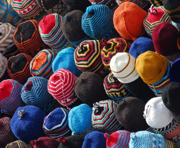
The senses take another knock when Moustafa leaves me at a doorway. Another man approaches in a white skull cap, a flowing, if slightly short, brown jalaba and sandals. His socks sport the badge of some European football team.

He offers me some mint sprigs and I take them gladly to mask the smell of the tannery I’m entering. Men splash up to their waists washing goat skins in the carcinogenic replacements to what used to be animal fats and vegetable dyes. Beyond them, other men toil alone in darkened crumbling buildings, scraping at the drying leathers.

Back out on the street Moustafa meets me again to lead me back to the Medersa Ben Youssef. He leaves early to get back to his mosque for the call to prayer. My offer of thanks by way of money is met by animosity – it was not enough.

A city of friends then, but a city of strangers too.

Take with you the Time Out Guide to Marrakech, Essaouira and The High Atlas, I found it to be by far the best. The Hedonist’s Guide to Marrakech is a good one too, to find the really chic bars, plus it has great maps of the souks – you may actually be able to navigate with these.

I took the Laura Kane map of Marrakech with me. It’s good to see where you’re staying and where you’re going but don’t expect to be able to use it to navigate or show it to locals and expect them to know the way – they don’t. They will help you though, for a few dirham, or a pen if you’re lucky.

The Rough Guide map of Morocco was great for going out over the High Atlas and towards the desert.

Also you should read Desert Divers by Sven Lindqvist – whether you’re going there or not as it’s one of the best pieces of travel writing ever written.

Browse our collection of travel guides and maps to Marrakech >

Author: James Innes Williams

Wroclaw

Here’s a story which you won’t find in many guidebooks, and not even in the highly acclaimed history of Wroclaw, Microcosm by Norman Davies. I found it in a little guide available in the city’s numerous bookshops and pass it on, if in a somewhat enlarged format from the original brief comment!
Before the war, Breslau – as the city was then called – had a fine zoo, opened in 1865, with its first animals donated mainly by local burghers. One of its most important early additions was an elephant bought in 1875 from the London Zoo with funds organized through raffles.

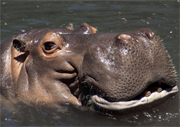
When, during the last war the eastern front started getting closer and the city began preparing itself to become Festung Breslau (Fortress Breslau – one of a string of cities which, it was hoped, would delay, if not prevent, the Russian Army reaching Berlin), some of the zoo’s animals were evacuated to the surrounding villages, among them its hippopotamuses. Whilst the animals which remained in the zoo were shot on the orders of the commandant of Festung Breslau, the hippopotamuses survived – the little guide does not mention just what the victorious Red Army soldiers thought of such fine examples of German livestock. And, sometime between the city’s final surrender on 6 May 1945 (three days after Berlin) and the reopening of the zoo in July 1948, the hippopotamuses returned to the place they had left, no longer Breslau but now Wroclaw.

So, thousands of Breslau’s citizens died, many of them having fled westwards to the neighbouring Saxony and its capital Dresden, only to perish there on that fateful night, and those who survived were eventually expelled from the city by the newly established Polish authorities. But the hippopotamuses not only survived, but also, presumably – because the little guide is silent on that point – successfully made the transition from being German hippopotamuses into pure Polish hippopotamhood.

Strange place, Mitteleuropa!

We recommend the Wroclaw Top 20 street plan published by Daunpol for a visit to the zoo and the surrounding area. The area includes many outstanding examples of early 20th century architecture – including the Hala Ludowa (People’s Hall), built in 1912 as Jahrhunderthalle to commemorate the defeat of Napoleon with, at that time, the largest reinforced concrete dome in the world. There is also the beautiful 1929 Bauhaus-style building designed as a model for flats for young singles or couples and now occupied by the Park Hotel, and the nearby Sepolno suburb built between 1919 and 1935 as one of the first ever “garden-city” projects –. For anyone particularly interested in the city’s history, a street plan of Wroclaw/Breslau from Höfer Verlag shows both the current and the pre-war German names.

Browse our collection of travel guides and maps to Warclaw >

Author: Malgorzata Ross

The Annapurna Circuit, Nepal

Peaks of 8,000 metres, Earth’s deepest valley and a dizzyingly high mountain pass are just some of the attractions to draw you into Nepal’s Annapurna region. Also on offer is a complete absence of cars and a veritable feast, both literally and figuratively speaking, of yak-based products!

Having longed to visit Nepal for years, my eventual arrival as I travelled overland from Delhi could not have been more anticlimactic. A combination of 36 hours solid travel, a road accident, and being scammed by a travel agent on the border meant my spirits were seriously low as I headed north. But when I was jolted out of my fitful sleep for the hundredth time on my ‘luxury’ night bus, I caught my first glimpse of the Annapurna Range towering above Pokhara, and all was well in my world once more.

The city of Pokhara is an experience in itself. Most tourists wind up in Lakeside, located, unsurprisingly, on the side of Phewa Lake. Lakeside is essentially one long road packed full of exceptionally slow web cafes, restaurants serving western food, and countless vendors of fake North Face gear. While not really capturing the essence of Nepal, if you’ve just arrived from India Pokhara can seem like an oasis.

Perhaps more importantly, the city is home to the offices of the Annapurna Conservation Area Project (ACAP), as any adventure into the Conservation Area will require an entry permit. I arrived in Pokhara with the intention of trekking alone, but after half an hour in ACAP HQ I’d teamed up in a gang of four. A new issue with trekking in the park is the recent advent of Trekking Permit legislation. The appeal of visiting the Nepalese Himalaya has traditionally been the feasibility of independent, or teahouse – trekking; new rules, however, mean you are obliged to take a guide. Having said that, the situation seemed fairly fluid when I was there, so check the ACAP website for up to date information. As it transpired, our guide Arjun only served to enhance what was an amazing experience.

Nepal Anapurna Within the Conservation Area there’s scope for a huge variety of treks long and short. We opted for the Annapurna Circuit, a long distance trek of around 300km that usually takes two to three weeks. Providing you’re in reasonably good shape and kitted out with some good boots the circuit should really hold no fear for you. Despite two or three tough days, particularly the Thorung La pass at 5,416m, the real danger is that the duration of the trek means the daily grind of getting up early and walking all day can turn into a slog. Fortunately, the scenery is varied and breathtaking, and unless you’re in a mad dash to catch a flight there’s nothing to stop you having a few slack days along the way to boost energy levels – the trekkers’ fuel of choice in these parts is usually apple pie. I’d recommend the villages of Braga (cake), Marpha (cider) and Sikha (daal-bhat) as good locations for rest days!
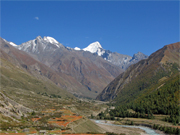
Like so many popular treks around the world, the Annapurna Circuit is in danger of becoming a victim of its own success and at times you find yourself in a continuous stream of human traffic. It seems unfair to decry this too much though as tourism provides a vital income for what is one of the world’s poorest nations. The popularity also ensures a fantastic infrastructure of teahouse accommodation serving excellent wholesome food along the way.

As well as the human traffic, the region is home to a rich variety of animals. Foremost amongst these, particularly at higher altitudes, is the yak. Whether it’s yak cheese, the New Yak Hotel, yak wool hats or Yakdonalds (I kid you not), this hairy Himalayan beast is inescapable. I only indulged in one yak burger on the entire trek, though I doubt the blackened hunk of meat served up between two slices of stale white bread would have passed the quality control in Yakdonalds. My standard fayre was the omnipresent daal bhat (lentils, rice and vegetable curry), which was generally superb.

At the risk of sounding clichéd, the worst thing about trekking the Annapurna Circuit is that it has to end. Despite the sense of achievement and the inevitable reward of ridiculously cheap steak washed down with copious amounts of beer in Pokhara, the descent from the village of Ghandruk towards driveable roads and civilisation left me feeling massively deflated. Having been back in Manchester for a couple of months now, the whole experience seems like a dream – a magical dream featuring golden eagles, avalanches on Gangapurna, and deep fried Snickers. I feel sure it is only a matter of time until I’m Nepal-bound once more.

Having previously used Trailblazer’s guide to the West Highland Way, I had no hesitation in picking up Trailblazer’s Trekking In The Annapurna Region. Although it would be pretty difficult – though not impossible – to get lost on the circuit, this guide added to my enjoyment every step of the way. I soon got into the habit of reading what was in store the following day as I was wrapped up in countless layers within my counterfeit sleeping bag. In addition to comprehensive information on treks in the Annapurna region, it also includes chapters on Pokhara and Kathmandu, as well as a wealth of background on Nepali history, culture and wildlife.

Browse our collection of travel guides and maps to Annapurna Region >

Author: Dan Weston

Himachal Pradesh

A week in Delhi is more than enough to make most people crave clean mountain air and I was no exception as four days of traffic-choked madness drove me in the direction of Himachal Pradesh.
Himachal literally means ‘Abode of Snow’ and the state nestles between Uttaranchal and Kashmir, sharing a mountainous border with Tibet to the east. Any exploration of Himachal is likely to begin in Shimla, formerly summer capital to the British Raj and popular with Indians and foreigners alike. Set in the Himalayan foothills, Shimla is a pleasant place to kick back for a few days but it doesn’t even come close to the wonders that wait if you head East. The road towards the Kinnaur Valley follows the route of the old Hindustan-Tibet Highway, though it now bears the somewhat less inspiring name of NH-22. Don’t however let the road’s designation as a National Highway fool you into believing that it will resemble anything remotely like a British motorway. The route to Kinnaur and Spiti is largely unpaved single tracks that spend much of their time clinging to the side of the impossibly steep Sutlej Valley. Local TATA buses are robust, but cramped in the extreme, and the stretch of ‘road’ between Rekong Peo and Tabo is truly hair-raising, with your view of the road’s edge being replaced by a 500m near-vertical drop to the seething boulder strewn Sutlej River below. In short, it rocks.

As the highway winds its way ever upward through Kinnaur, Hinduism gradually surrenders its hold and Buddhism becomes increasingly evident. The food also changes, with the mountain staple being daal & rice served in epic proportions. The rule of thumb seems to be that your plate is continuously refilled until you submit! The route is littered with small villages, a personal favourite of mine being Sarahan, and finding a bed is rarely a problem. A side trip to the Baspa Valley is well worth the effort – Chitkul, the final village accessible by road before reaching Tibet, offers possibly the most beautiful scenery I’ve ever strayed across. For the more adventurous, Chitkul is also a good base to start or finish a trek around Kinnaur Kailash – check out Lonely Planet’s guide “Trekking in the Indian Himalaya”.

The contrast between the alpine pastures and pine forests of Kinnaur with the barren desert constituting the Spiti Valley could not be starker. As NH-22 moves into a region sheltered from the monsoon by the rain-shadow it’s like stepping onto another planet. Weird and wonderful rock formations are dotted around a vast arid landscape and seemingly ubiquitous prayer flags are whipped by fierce dry dusty winds. Although I subsequently visited Daramshala, home of the Tibetan government in exile, the tiny villages of Spiti certainly came closest to my preconceived ideas on Buddhism.

From Spiti, it is a long and arduous bus ride to Manali in the Kullu Valley. Fortunately I was sustained by a combination of ferociously hot roadside food and mind-blowing views as we crawled our way over Kunzum La, a pass at 4,551m. Manali itself, with its large backpacker community, tends to divide opinion – I was a big fan, particularly of the old town. Though it’s quite possible to spend all your time listening to bad techno music, Manali’s surrounds offer similar scenery to that of Kinnaur in a less remote location. If you like walking but find multi-day treks intimidating Manali is perfect, with daylong valley walks aplenty. It’s also home to Dylan’s coffee bar, purveyor of the finest coffee and shortbread I stumbled across on my trip!

It may not be as hyped as the Manali to Leh road, but the journey through Kinnaur and Spiti is truly an epic.

I would highly recommend the Footprint India Handbook and Lonely Planet’s India guidebook, both of which I found to be invaluable.

Browse our collection of maps, guides and travel literature:
> India travel guides
> India road maps and atlases
> Travel literature inspired by India

Author: Dan Weston

The Rif and The Mediterranean

My chosen summer destination in 2006 was the Rif, an area of Morocco steeped in history and a site in modern times of transit and migration between Africa and Europe. The Rif stretches from the intense, profligate Tangier – home to the Beat writers in the 1950s – by the Strait of Gibraltar and the Spanish enclave of Ceuta in the far north of the country, through the Mediterranean towns of Tetouan and Al Hoceima, all the way to Nador and the calm beach resort of Saïdia – the last town in Morocco before you reach the heavily guarded Algerian border. Further inland, you’ll find mountain lakes, forests, tight hairpin turns and endless fields of Moroccan hashish – kif.

My own journey to this region, dominated by the mountains of the same name, involved arriving by ferry from Málaga early one evening in May. My point of arrival was a Spanish-owned enclave in Morocco – Melilla. It is an intense yet safe way of beginning a trip to North Africa – a site of languages, cultures and religions living side-by-side. I was never quite sure whether I was in Europe, Africa or the Middle East. Perhaps it’s all of these in one.

Although Melilla is a claustrophobic place to visit, surrounded as it is by the sea on one side and high border fences on the other, there is enough there to merit at least a day of your attention. A walk along the ancient walls of the medina at midnight was a unique and eery experience – as was the sight of a statue of General Francisco Franco hidden behind a builder’s storage unit near the port!

As there is no rail service to speak of in the Rif, travel between towns is necessarily by road – this can be done either by bus or shared taxi. I took a taxi, a five-seater Mercedes holding a driver and six squashed passengers, on my way to the Cap des Trois Fourches and the most beautiful lighthouse and secluded beach I have ever seen. Translated as the Cape of Three Forks, the name perfectly describes the shape of the coastline on this secluded peninsula, north of Melilla. Here, I learnt quickly the warmth and generosity of Moroccan people, on meeting both a soldier who was guarding the lighthouse and a local teenager offering an insight into the life and geography of the area. My extremely useful Rough Guide to Morocco and CR Pennell’s compact history of the country, Morocco: From Empire to Independence, were my other aids in this area, while I should have taken Carima’s Rif Occidental map too.

After a short, mapless, trek along the coast, taking in gorgeous vistas and being greeted by Berber families working their land, I arrived at Tibouda, a tiny, desolate fishing village of several small houses and many more boats. Moroccan hospitality was once again on the plate. After a polite request to pitch my tent in the village, I was served an afternoon Moroccan mint tea by a soldier who later that night gave me an impromptu lesson in the Arabic of astronomy as I gazed up at the clarity of the stars and the moon.

An early rise the next morning allowed me to see the fishing community in full action, with men leaving and others returning with their catch. But a rule I like to follow on my travels is to leave a place just when I feel comfortable, so I took another taxi to the relative hustle and bustle of Nador, before planning where I would next pitch my tent along the coast. The next few days took in Kariet Arkmane, Ras El Ma and Saïdia, all places where I could swim in the sea and sample mint tea, coucous and fresh Moroccan fish. At Saïdia, the long stretches of clean sand were punctuated by the Moroccan-Algerian border. When a soldier’s gun was raised as I brazenly brushed my feet through the first grains of Algerian sand, I realised my journey along the coast had come to an end.

With my coastal trip at a close, I decided it would be good to end my Moroccan adventure with a journey inland to Taforalt, a mountain village found in the Beni Snassen mountain range. Here I was warmly welcomed by a local farmer who gave me a tour of his fields, beehives and the beautifully decorated lounge and courtyard of his home. I also had the opportunity to meet his 80-year-old father who had been born here, attended the local school and fought against the French colonial army to defend his own fields.

The Rif, then, may be Morocco’s poorest and most underdeveloped region, but it offers the richest of experiences.

Browse our collection of maps, guides and travel literature:
> Morocco travel guides
> Morocco road maps and atlases
> Travel literature inspired by Morocco

Author: Tim Cleary

Arctic Europe

At 66 1/2º north the sun never sets on the longest day of the year, yet never rises on the shortest. This is the Arctic Circle, encompassing a suprisingly large part of Europe, including northern Scandinavia, to the east of this the Kola Peninsula in Russia, Greenland to the west and the Norwegian-owned Svalbard archipelago 1,000 miles north of Norway.

Amongst this variety of landscape is to be found a surprising diversity of flora and fauna, as climate changes from the wet coastal areas of Norway warmed by the Gulf stream to the dramatic dry ice walls of Thule in west Greenland.

Here are some highlights we’ve picked out for you:

Norway

Off the north-west coast the atmospheric spikes of Lofoten Islands pierce the sea, towering over tiny fishing villages. Opposite is Narvik, where you can ski above the coastline. Further north is Tromso, Europe’s most northern university town, and even further, NordKap, claimed to be Europe’s most northern point, and spiritual center for indigineous Sami people.

Sweden

Hike to Kebnekaise, Sweden’s highest mountain and an excellent area for climbing and cross-country skiing/snow shoeing/trekking. Further south is the Sarek National Park – ‘Europe’s Serengeti’, beautiful and challenging, it’s the continent’s biggest wilderness. At Ritzgrantzen there is a resort where you can ski or snowboard under the midnight sun.

Stay in The Ice Hotel – or just drink out of ice at the Ice Bar – just outside Kiruna, a stunning, majestic, artistic structure which melts into oblivion every summer.

Finland

Travel north through endless forests and lakes to Rovaniemi, the capital of Lappland. Planned in the shape of reindeer horns, it’s the home of Santa Claus’ post office and a great base for reindeer sledging. More remote is Utsjoki where you can see the lifestyle of the indigeneous reindeer herding population, the Sami. If you want to leave civilisation completely, trek or sled through the Saariselka Wilderness National Park.

Svalbard

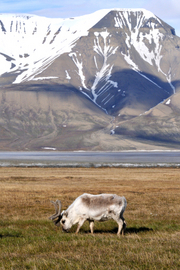
Despite its geographical remoteness, these spectacular icefield and glacier covered islands are quite accessible (flights from Tromso in Norway for approx £250). Here you’ll find a suprising variety of flora and fauna, including seals, walruses, arctic foxes, polar bears, and many whales. There are many tours operated from the capital, including trekking, skiing , mountaineering, and wildlife watching. But beware, polar bears are a common sight!

Kola Peninsula, Russia

This rather unknown area of tundra and taiga forests is actually no further from England than Turkey is. It stretches east from its borders with Finland and Norway, bounded by the Barents and White Seas.

In Laplandsky Zapovednik, a 3,000 km^2^ natural wonderland, you’ll find excellent and remote ski-touring. More challenging is the Khibins Mountains, an area for hiking and mountaineering. Then there is Nikel. In contrast to Laplandsy, this is a moving landmark of post-apocalyptic mining hell, surrounded by 50km of devastated vegetation. Emphatically worth visiting for similar reasons to those that could take you to Pompeii.

Greenland

This place of tortured ice rivers, rocky peaks and tundra, surrounded by seas infested with icebergs and ice floes is quickly being discovered. It is partly covered by a 3km ice sheet. At Ilulissat Kangerlua there is an extraordinary icefjord, carved by a 1,100m deep glacier moving at 25m a day. Visit Tasilaq Peak on Ammassalik Island, with its crazy views of icebergs and ice floes on one side, an ice sheet on the other and a nature-filled valley with a wild town in it. Uummannag is a town hanging off rock faces, with an ice golf course. The favourite word here is “immaqa” – “maybe”.

Resources

The best all-round book to give you a taste is Lonely Planet’s Greenland and The Arctic which more or less covers everything worldwide above the Arctic Circle. Bradt do Tony Soper’s The Arctic: A Guide to Coastal Wildlife – “as vital as longjohns”. The Rough Guide to Scandinavia deals with the mainland only, though exhaustively. Lonely Planet’s Scandinavian Europe guide covers all of Denmark, Norway, Sweden and Finland, and also includes Svalbard and a detailed section on Greenland. Greenland is covered photographically in Kalaallit Nunaat: North East Greenland by Christian Kempf. You should also check out the colourful and authoritative Norsk-Polarinstitutt series covering Svalbard’s flora, geology and wildlife. Meanwhile the Kola Peninsula is covered in Lonely Planet’s now out of print Russia and Belarus.