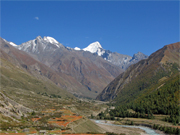
 A week in Delhi is more than enough to make most people crave clean mountain air and I was no exception as four days of traffic-choked madness drove me in the direction of Himachal Pradesh.
Himachal literally means ‘Abode of Snow’ and the state nestles between Uttaranchal and Kashmir, sharing a mountainous border with Tibet to the east. Any exploration of Himachal is likely to begin in Shimla, formerly summer capital to the British Raj and popular with Indians and foreigners alike. Set in the Himalayan foothills, Shimla is a pleasant place to kick back for a few days but it doesn’t even come close to the wonders that wait if you head East. The road towards the Kinnaur Valley follows the route of the old Hindustan-Tibet Highway, though it now bears the somewhat less inspiring name of NH-22. Don’t however let the road’s designation as a National Highway fool you into believing that it will resemble anything remotely like a British motorway. The route to Kinnaur and Spiti is largely unpaved single tracks that spend much of their time clinging to the side of the impossibly steep Sutlej Valley. Local TATA buses are robust, but cramped in the extreme, and the stretch of ‘road’ between Rekong Peo and Tabo is truly hair-raising, with your view of the road’s edge being replaced by a 500m near-vertical drop to the seething boulder strewn Sutlej River below. In short, it rocks.
As the highway winds its way ever upward through Kinnaur, Hinduism gradually surrenders its hold and Buddhism becomes increasingly evident. The food also changes, with the mountain staple being daal & rice served in epic proportions. The rule of thumb seems to be that your plate is continuously refilled until you submit! The route is littered with small villages, a personal favourite of mine being Sarahan, and finding a bed is rarely a problem. A side trip to the Baspa Valley is well worth the effort – Chitkul, the final village accessible by road before reaching Tibet, offers possibly the most beautiful scenery I’ve ever strayed across. For the more adventurous, Chitkul is also a good base to start or finish a trek around Kinnaur Kailash – check out Lonely Planet’s guide “Trekking in the Indian Himalaya”.
The contrast between the alpine pastures and pine forests of Kinnaur with the barren desert constituting the Spiti Valley could not be starker. As NH-22 moves into a region sheltered from the monsoon by the rain-shadow it’s like stepping onto another planet. Weird and wonderful rock formations are dotted around a vast arid landscape and seemingly ubiquitous prayer flags are whipped by fierce dry dusty winds. Although I subsequently visited Daramshala, home of the Tibetan government in exile, the tiny villages of Spiti certainly came closest to my preconceived ideas on Buddhism.
From Spiti, it is a long and arduous bus ride to Manali in the Kullu Valley. Fortunately I was sustained by a combination of ferociously hot roadside food and mind-blowing views as we crawled our way over Kunzum La, a pass at 4,551m. Manali itself, with its large backpacker community, tends to divide opinion – I was a big fan, particularly of the old town. Though it’s quite possible to spend all your time listening to bad techno music, Manali’s surrounds offer similar scenery to that of Kinnaur in a less remote location. If you like walking but find multi-day treks intimidating Manali is perfect, with daylong valley walks aplenty. It’s also home to Dylan’s coffee bar, purveyor of the finest coffee and shortbread I stumbled across on my trip!
It may not be as hyped as the Manali to Leh road, but the journey through Kinnaur and Spiti is truly an epic.
I would highly recommend the Footprint India Handbook and Lonely Planet’s India guidebook, both of which I found to be invaluable.
- Browse our collection of maps, guides and travel literature:
- > India travel guides
- > India road maps and atlases
- > Travel literature inspired by India
Author: Dan Weston