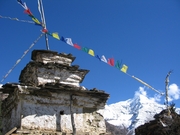
Peaks of 8,000 metres, Earth’s deepest valley and a dizzyingly high mountain pass are just some of the attractions to draw you into Nepal’s Annapurna region. Also on offer is a complete absence of cars and a veritable feast, both literally and figuratively speaking, of yak-based products!
Having longed to visit Nepal for years, my eventual arrival as I travelled overland from Delhi could not have been more anticlimactic. A combination of 36 hours solid travel, a road accident, and being scammed by a travel agent on the border meant my spirits were seriously low as I headed north. But when I was jolted out of my fitful sleep for the hundredth time on my ‘luxury’ night bus, I caught my first glimpse of the Annapurna Range towering above Pokhara, and all was well in my world once more.
The city of Pokhara is an experience in itself. Most tourists wind up in Lakeside, located, unsurprisingly, on the side of Phewa Lake. Lakeside is essentially one long road packed full of exceptionally slow web cafes, restaurants serving western food, and countless vendors of fake North Face gear. While not really capturing the essence of Nepal, if you’ve just arrived from India Pokhara can seem like an oasis.
Perhaps more importantly, the city is home to the offices of the Annapurna Conservation Area Project (ACAP), as any adventure into the Conservation Area will require an entry permit. I arrived in Pokhara with the intention of trekking alone, but after half an hour in ACAP HQ I’d teamed up in a gang of four. A new issue with trekking in the park is the recent advent of Trekking Permit legislation. The appeal of visiting the Nepalese Himalaya has traditionally been the feasibility of independent, or teahouse – trekking; new rules, however, mean you are obliged to take a guide. Having said that, the situation seemed fairly fluid when I was there, so check the ACAP website for up to date information. As it transpired, our guide Arjun only served to enhance what was an amazing experience.
 Within the Conservation Area there’s scope for a huge variety of treks long and short. We opted for the Annapurna Circuit, a long distance trek of around 300km that usually takes two to three weeks. Providing you’re in reasonably good shape and kitted out with some good boots the circuit should really hold no fear for you. Despite two or three tough days, particularly the Thorung La pass at 5,416m, the real danger is that the duration of the trek means the daily grind of getting up early and walking all day can turn into a slog. Fortunately, the scenery is varied and breathtaking, and unless you’re in a mad dash to catch a flight there’s nothing to stop you having a few slack days along the way to boost energy levels – the trekkers’ fuel of choice in these parts is usually apple pie. I’d recommend the villages of Braga (cake), Marpha (cider) and Sikha (daal-bhat) as good locations for rest days!
Like so many popular treks around the world, the Annapurna Circuit is in danger of becoming a victim of its own success and at times you find yourself in a continuous stream of human traffic. It seems unfair to decry this too much though as tourism provides a vital income for what is one of the world’s poorest nations. The popularity also ensures a fantastic infrastructure of teahouse accommodation serving excellent wholesome food along the way.
As well as the human traffic, the region is home to a rich variety of animals. Foremost amongst these, particularly at higher altitudes, is the yak. Whether it’s yak cheese, the New Yak Hotel, yak wool hats or Yakdonalds (I kid you not), this hairy Himalayan beast is inescapable. I only indulged in one yak burger on the entire trek, though I doubt the blackened hunk of meat served up between two slices of stale white bread would have passed the quality control in Yakdonalds. My standard fayre was the omnipresent daal bhat (lentils, rice and vegetable curry), which was generally superb.
At the risk of sounding clichéd, the worst thing about trekking the Annapurna Circuit is that it has to end. Despite the sense of achievement and the inevitable reward of ridiculously cheap steak washed down with copious amounts of beer in Pokhara, the descent from the village of Ghandruk towards driveable roads and civilisation left me feeling massively deflated. Having been back in Manchester for a couple of months now, the whole experience seems like a dream – a magical dream featuring golden eagles, avalanches on Gangapurna, and deep fried Snickers. I feel sure it is only a matter of time until I’m Nepal-bound once more.
Having previously used Trailblazer’s guide to the West Highland Way, I had no hesitation in picking up Trailblazer’s Trekking In The Annapurna Region. Although it would be pretty difficult – though not impossible – to get lost on the circuit, this guide added to my enjoyment every step of the way. I soon got into the habit of reading what was in store the following day as I was wrapped up in countless layers within my counterfeit sleeping bag. In addition to comprehensive information on treks in the Annapurna region, it also includes chapters on Pokhara and Kathmandu, as well as a wealth of background on Nepali history, culture and wildlife.
Browse our collection of travel guides and maps to Annapurna Region >
Author: Dan Weston