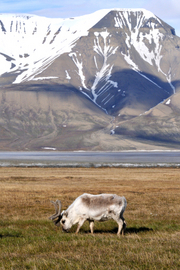
At 66 1/2º north the sun never sets on the longest day of the year, yet never rises on the shortest. This is the Arctic Circle, encompassing a suprisingly large part of Europe, including northern Scandinavia, to the east of this the Kola Peninsula in Russia, Greenland to the west and the Norwegian-owned Svalbard archipelago 1,000 miles north of Norway.
Amongst this variety of landscape is to be found a surprising diversity of flora and fauna, as climate changes from the wet coastal areas of Norway warmed by the Gulf stream to the dramatic dry ice walls of Thule in west Greenland.
Here are some highlights we’ve picked out for you:
Norway
Off the north-west coast the atmospheric spikes of Lofoten Islands pierce the sea, towering over tiny fishing villages. Opposite is Narvik, where you can ski above the coastline. Further north is Tromso, Europe’s most northern university town, and even further, NordKap, claimed to be Europe’s most northern point, and spiritual center for indigineous Sami people.
Sweden
Hike to Kebnekaise, Sweden’s highest mountain and an excellent area for climbing and cross-country skiing/snow shoeing/trekking. Further south is the Sarek National Park – ‘Europe’s Serengeti’, beautiful and challenging, it’s the continent’s biggest wilderness. At Ritzgrantzen there is a resort where you can ski or snowboard under the midnight sun.
Stay in The Ice Hotel – or just drink out of ice at the Ice Bar – just outside Kiruna, a stunning, majestic, artistic structure which melts into oblivion every summer.
Finland
Travel north through endless forests and lakes to Rovaniemi, the capital of Lappland. Planned in the shape of reindeer horns, it’s the home of Santa Claus’ post office and a great base for reindeer sledging. More remote is Utsjoki where you can see the lifestyle of the indigeneous reindeer herding population, the Sami. If you want to leave civilisation completely, trek or sled through the Saariselka Wilderness National Park.
Svalbard
Despite its geographical remoteness, these spectacular icefield and glacier covered islands are quite accessible (flights from Tromso in Norway for approx £250). Here you’ll find a suprising variety of flora and fauna, including seals, walruses, arctic foxes, polar bears, and many whales. There are many tours operated from the capital, including trekking, skiing , mountaineering, and wildlife watching. But beware, polar bears are a common sight!
Kola Peninsula, Russia
This rather unknown area of tundra and taiga forests is actually no further from England than Turkey is. It stretches east from its borders with Finland and Norway, bounded by the Barents and White Seas.
In Laplandsky Zapovednik, a 3,000 km^2^ natural wonderland, you’ll find excellent and remote ski-touring. More challenging is the Khibins Mountains, an area for hiking and mountaineering. Then there is Nikel. In contrast to Laplandsy, this is a moving landmark of post-apocalyptic mining hell, surrounded by 50km of devastated vegetation. Emphatically worth visiting for similar reasons to those that could take you to Pompeii.
Greenland
This place of tortured ice rivers, rocky peaks and tundra, surrounded by seas infested with icebergs and ice floes is quickly being discovered. It is partly covered by a 3km ice sheet. At Ilulissat Kangerlua there is an extraordinary icefjord, carved by a 1,100m deep glacier moving at 25m a day. Visit Tasilaq Peak on Ammassalik Island, with its crazy views of icebergs and ice floes on one side, an ice sheet on the other and a nature-filled valley with a wild town in it. Uummannag is a town hanging off rock faces, with an ice golf course. The favourite word here is “immaqa” – “maybe”.
Resources
The best all-round book to give you a taste is Lonely Planet’s Greenland and The Arctic which more or less covers everything worldwide above the Arctic Circle. Bradt do Tony Soper’s The Arctic: A Guide to Coastal Wildlife – “as vital as longjohns”. The Rough Guide to Scandinavia deals with the mainland only, though exhaustively. Lonely Planet’s Scandinavian Europe guide covers all of Denmark, Norway, Sweden and Finland, and also includes Svalbard and a detailed section on Greenland. Greenland is covered photographically in Kalaallit Nunaat: North East Greenland by Christian Kempf. You should also check out the colourful and authoritative Norsk-Polarinstitutt series covering Svalbard’s flora, geology and wildlife. Meanwhile the Kola Peninsula is covered in Lonely Planet’s now out of print Russia and Belarus.