England – Manchester

ManchesterSidestepping the clichéd comments about rain and industrial gloom, there are strong arguments for choosing Manchester as a city break destination. There is the social and cultural history of one of England’s great urban centres, the sense of vibrancy and vitality of a place in flux, and the architectural wonders of a city with one foot in the past and the other firmly marching forward into the 21st century.

Since it has a relatively compact city centre, Manchester is an ideal option for a weekend getaway. Shops, restaurants, music venues and clubs are a-plenty, especially in the areas between the Arndale Centre, Deansgate, Piccadilly and the famous Canal Street. For those with less disposable income, it is a delight to just walk the streets and soak up the atmosphere of the place. I would definitely recommend a visit to the splendid John Rylands Library and a walk around the canals and bridges in the Castlefield area of town. You could even visit the Lowry arts centre, the City Art Gallery or any of the smaller galleries to be found in the city. In Manchester, delights can be found in the most unlikely of places, where side alleys, backstreets and canal paths reveal hidden spires, public art and music venues.

My favourite area was the Northern Quarter, with its boutiques, trendy record shops, edgy pubs and classy bars. It was here that made me think most of my musical heroes who hail from Manchester: Joy Division, New Order, the Stone Roses and the Smiths all grew out of the vibrancy of this city.

For my trip, the Manchester Time Out Shortlist guide was invaluable for up-to-date practical advice and maps to find my way around. Also very useful were Clare Hartwell’s Manchester Pevsner Architecture Guide and an eccentric walking guide called Morrissey’s Manchester, which details the haunts of Manchester’s favourite miserabilist and his chums from his former band, the Smiths.

There may be rain, and Morrissey and Marr may not be everyone’s cup of tea, but Manchester is a breath of fresh air for anyone looking for a stimulating short break.

Browse our collection of maps & guides:

> England travel guides

> England road maps and atlases

> Travel literature inspired by England

> See all our maps and guides to Manchester.

Author: Tim Cleary

Cameron Highlands, Malaysia

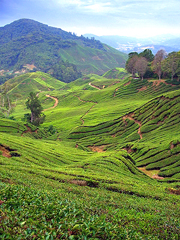
Not far from the hectic capital Kuala Lumpur  is a green and pleasant land, where tea and scones are served in mock-Tudor restaurants, and it’s prone to rain now and again. Yes, there is a small patch of England in Malaysia.

Harking of course back to colonial times, the Cameron Highlands were established as a hill station for the poor old British retreating from the heat. And when I left the bus from KL in Tanah Rata, it seemed very little had changed.

I headed for a guesthouse on top of a hill, where the accommodation occupied Nissen huts used by the British army in World War II. Now with a modern cafe and reception area, the guesthouse was surrounded by well-tended, flower-filled gardens and scenic views of lush green hills.

Perusing the information boards, I read numerous warnings against setting off on treks alone or unprepared. Jim Thompson, who set up the Thai Silk Company, set off for a walk one evening, while holidaying in the Cameron Highlands in 1967, and never returned. His disappearance remains a mystery to this day, with various theories trying to solve the riddle, ranging from kidnapping to tiger attacks.

I decided to put off doing a jungle trek, and instead opted for a more genteel tour of a tea plantation. The Boh Tea Estate is one of the biggest producers of tea in the country and we were shown the passage from leaf to cup. Nearby are other opportunities for gentle pursuits, including visits to butterfly, honey bee and strawberry farms.

Later that day I discovered yet more reminders of England, with the mock-Tudor ‘Ye Olde Smokehouse’ hotel and restaurant that even has a red British phone box outside. Stepping inside the house, the several thousand miles back to the UK disappeared as I was met with floral furnishings, wooden beams and old furniture. It seemed only appropriate to try out the cream tea, complete with scones, and of course the locally produced tea and strawberry jam.

The next day I felt ready to tackle a trek through the jungle. I followed a steep forest trail, sometimes climbing almost vertically up tree roots, to finally reach a mountain summit. And while in places it was tough-going, I’m pleased to report I did not disappear, but instead returned to civilisation in time for tea.

Maybe I was saved by using the Rough Guide to Malaysia, Singapore & Brunei. If you’re prone to getting lost, please do take along a good map such as Freytag & Berndt’s map to Malaysia. There is also the Lonely Planet Malaysia, Singapore and Brunei, with a brief synopsis of each hiking trail in the Camerons.

Browse our collection of maps, guides and travel literature:
> Malaysia travel guides
> Malaysia road maps and atlases
> Travel literature inspired by Malaysia

Author: Rachel Ricks

Best Map of the Year Announced

A map of important geological sites has been announced as 2007’s winner of a new British Cartography Society (BCS) award sponsored by Stanfords.

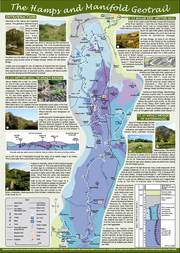
Rosemary Duncan’s entry, the Hamps and Manifold Geotrail, details Regionally Important Geological and Geomorphological Sites (RIGS) – areas of significant earth science importance – and was commissioned by the Staffordshire RIGS Group.

Stanfords’ Margaret Ross, buyer of map products imported from overseas, and Chris English, responsible for map graphics on our website, were among six judges from the maps and graphics industry who assessed more than 30 entries. Chris says of the winner, “This map fulfilled its intended purpose, as well as being nice and tidy, with good graphics, and it looks really attractive. It’s great that it guides you through a walk and puts the landscape into context, pointing out features along the way. Just looking at it made me want to go to the area straight away.” Continue reading Best Map of the Year Announced

Stanfords Supports Coast-To-Coast Trek

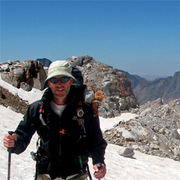
An intrepid businessman trekked from coast to coast of France to raise money for Macmillan Cancer Support. Mike Heyes, a senior consultant from Cheshire, set off on 11 July from Hendaye, a small French town on the Atlantic coast and, with the help of maps supplied from Stanfords, traversed his way across 800km of varied landscape. Forty-seven days later, having climbed a total of 40,000 metres, he enjoyed a swim in the Mediterranean.

Walking every day, except for three rest days, Mike walked an average of 20km and ascended about 1,000m each day, which he says, “The total ascent, 40,000m, is nearly five times the height of Mount Everest.” Mike adds, “The scenery was continuously breathtaking. The weather was generally kind to me, mostly blue sky days, but there were several big storms and half a dozen total white-out days, when thick cloud covered the mountains and tested my navigation skills.”

With a pack weight sometimes reaching 20kg, Mike experienced vastly varied temperatures – from sub zero in the high mountains to a steamy 35C during the last few days towards the Med. He says, “I encountered a number of problems on route, but I was totally focused on the end result and that helped me to overcome them.”

Back home, Mike says, “The experience has left me feeling strong and self-confident but very humble, in that I am very fortunate to be healthy enough to have taken on and completed this adventure. We should not forget that many people are not so fortunate. Their lives have been turned upside down by cancer, so let’s remember that the main event is raising money for Macmillan.”

Donations can be made at www.justgiving.com/mikeheyes. For more information on Just Giving, visit their site at www.justgiving.com and for Macmillan Cancer Support, visit www.macmillan.org.uk. Author: Rachel Ricks

Sumatra

After a terrifyingly choppy five-hour ferry trip across the Strait of Malacca from Malaysia, then a lost number of hours with a minibus driver negotiating dusty, potholed roads at top speed, I eventually started my exploration of Sumatra in Bukit Lawang. Here, thanks to the Bohorok orang-utan reintroduction centre, backpacker cafes and guesthouses once lined the riverbanks, until almost the entire town was destroyed by a flash flood one night in 2003.

Now, the resilient locals are even more welcoming than ever as they are starting to rebuild their businesses. I stayed at Jungle Inn, a brilliantly constructed jumble of fairytale accommodation, with log cabins overlooking waterfalls, and furnished with oversized carved wooden tables and chairs. It is also in an ideal location, right by the river crossing over to the orang-utan centre on the opposite bank.

We had barely crossed the rushing waters in the dug-out canoe when we spotted an extremely hairy orang-utan leisurely sitting on the riverbank, trying to get the last sips from an abandoned can of fizzy drink.

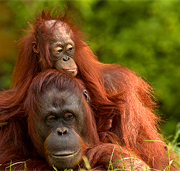
At this reintroduction centre, the orang-utans are semi-wild, having been released from captivity into the jungle but returning for twice-daily feedings at a specially built platform. And it’s here that visitors have the privilege to view the feedings. On the footpath through the trees up to the platform by a particularly friendly orang-utan who insisted on holding someone’s hand to help her up the steep path.

One of the centre’s workers carried the bucket of food onto to the platform, and we stood waiting in suspense, peering into the treetops, for the animals’ arrival. It wasn’t long before we heard the distant rustling of branches with the first diner swinging towards us.

We all stood in silent awe as a mother orang-utan, with her baby clinging onto her, lumbered a few feet from us, took the food and then deftly made her way up a tree, to settle on a branch above our heads. The mother let go of the baby, leaving him to dangle from the branch by one spindly arm, spinning one way and then the other until finally slowing to a halt where he continued to dangle non-chalantly. That sight alone already made it well worth that bumpy journey.

For more information on the plight of the Sumatran orangutan, see the websites of the Sumatran Orangutan Society: www.orangutans-sos.organd the Sumatran Orangutan Conservation Programme: www.sumatranorangutan.org.

The Lonely Planet guide to Indonesiawill give you the low-down on where to stay and how to get there. I recommend taking along an Lonely Planet Indonesian Phrasebook in handy pocket size. To help you get around, take along the ITMB map of Indonesia, or the more specific Nelles map of Sumatra, complete with insets of its main city centres. For a beautiful insight into the plight of the orang-utan, check out Thinkers of the Jungle.

Browse our collection of travel guides and maps to Sumatra >

Author: Rachel Ricks

The Lyn Hughes Interview

Ranulph FiennesLyn Hughes and her late husband Paul Morrison launched Wanderlust magazine in 1993 having thought out the project on a flight to Ecuador. It has since gone on to become the UK’s leading publication for independent travellers, and one for which Bill Bryson claimed, “There simply isn’t a better magazine for the serious traveller.”

Since then the couple were also involved in the relaunch of Songlines, the world music magazine, covering everything from traditional and popular to contemporary and fusion. Both magazines are available in Stanfords stores and all good newsagents. You can check out back issues of Wanderlust at their website www.wanderlust.co.uk and get all the latest news from the world music scene at www.songlines.co.uk.

When and where did you first begin travelling and was it clear to you that one day you’d want to make it such a great part of your life?

Believe it or not, I was a late starter. My first long haul trip was Hong Kong when I was 22. But, geography was one of my favourite subjects at school, David Attenborough was my hero, and I devoured any travel book I could get my hands on.

Much like Hilary Bradt, Tony Wheeler and Mark Ellingham who decided to publish guidebooks when travelling, you came up with the idea of creating the magazine en-route to South America. What led to that initial inspiration and when you sketched out your plans did you ever really imagine it would all come about in such a successful way or were you just passing the time on a flight?

My late husband, Paul Morrison, and I were on a flight to South America in late 1992. We were travelling light – hand luggage only – so had no books to read. There was no entertainment on the plane so we had to make our own. There was an in-flight mag so we’d read that from front to back. It got us talking about magazines and why there were no travel magazines for people like us. We borrowed a pen off a stewardess and started planning out our perfect magazine on a sickbag .We argued for years over which of us actually turned to the other and said “We could do this for real.”

What were those first few months like working out of the spare bedroom? I understand you had no real journalism or publishing experience so how scary was it for you and Paul to give up successful careers in pursuit of the dream?

When it comes to life changes, the only scary bit is making the actual decision. That point with us was when, on the eve of us buying our first Apple Mac – the only reason to buy was to run publishing software on it, – I got a phone call from Australia offering me a terrific job. We sat up all night discussing what to do. Our heads said to go Australia, but our hearts told us to stay and launch Wanderlust. So, that’s what we did.

Since then, Paul also relaunched Songlines, the world music magazine, after it was dropped by Haymarket and, like Wanderlust, it appears to have gone from strength to strength. It clearly sits very well with the Wanderlust brand, but how did that all come about?

Paul was a subscriber to Songlines, and was really disappointed when it stopped publishing. Eventually a consortium of five of us got together, including its editor, its founder, and Mark Ellingham, founder of Rough Guides, to rescue it. We set it up as its own company, and it was initially based in the Wanderlust offices. We redesigned it, made it more accessible to non-experts, and focussed on building the subscription base. I hadn’t been as enthusiastic as Paul about taking it on as he was fighting cancer. He was in hospital leading up the launch, and so I used to go visit him in the evenings with all the layouts and reports. I’d then go back to the office at 10pm and put in a few more hours work. Not easy days. But Songlines is now flourishing and has a cracking team. Paul would be really proud.

You’ll soon be relaunching the Wanderlust website. What can your readers expect to find on the new site? And are there any plans to continue to expand your media reach beyond Wanderlust, the website and Songlines?

Our website has long been due an overhaul so we are very excited. There will be a lot more content on there, including an archive of articles from the magazine. And we’ll also be able to be a lot more topical and react to relevant news stories immediately. There will also be a separate but related networking/community site for our readers, contributors and other keen travellers to share experiences, tips, photos and video footage.

We already publish several newsletters and magazines for travel companies on their behalf. Basically, we’ll do anything to do with travel media – as long as we passionately believe in it.

Many of our interviewees come to Stanfords with Travellers’ Tales and you’re also involved with that company while also running Wanderlust’s own writing courses. Why do you think all these great travel writers and photographers want to teach? What do you personally take from the experience? And what is your one big tip to somebody wanting to get published as a writer or photographer?

Travel writing and photography are incredibly competitive and we are getting approached all the time. But the good news is the number of outlets has also grown considerably over the past decade. Most people wanting to break in fall into the trap of thinking that it’s just enough to write up an account of their last trip. It’s stimulating to see some of the participants in the talks and courses really develop and start to see the world from the view of the readers and editors. My top tip would be to join out next course with Travellers’ Tales!

Finally, what is your favourite sort of travel and your favourite destination? What has been your best and worst travel experience? And what are your favourite and most hated aspects of travel?

My loves are wildlife, horses, and big landscapes; a walking or riding safari is probably my dream trip. However, I’m also interested in local culture (I always try and visit a supermarket in any destination!) and relish culture shock.

Iran was one of my best trips; it overturned all my preconceptions and the people were so welcoming.

My least favourite aspect of travelling is often the airport and the flight – the way we are treated is increasingly dehumanising. My favourite aspect is those unexpected encounters and experiences that end up enriching your life for years to come. Author: James Innes Williams

The Chris Stewart Interview

Chris Stewart, the drummer from Genesis’ first album, is today better known as the witty author of Driving Over Lemons, A Parrot in the Pepper Tree and The Almond Blossom Appreciation Society. He visited Stanfords, in the company of Travellers’ Tales, to give a small talk on how to write travel books. It was a quick taste of the writing courses he leads for the company near his home in Granada, and gave us a chance to put a few questions to him.

I think it’s fair to say you’ve had quite a varied career, being the original drummer for Genesis, an under pig-man, sheep shearing and drumming with Sir Robert Fossett’s circus before you turned your hand to travel writing. What was it you were looking for in these different roles, what was it that appealed to you about them?

Under Assistant Pig-man as a matter of fact… well, my grandfather worked for the Bank of England all his working life. On the day he retired he told me that he felt as if he had just been released from prison. I never forgot that, and determined that I would be a jolly Jack of All Trades rather than a miserable master of one. And I have to say that each one of the occupations you mention… and there were others too… gave me an awful lot of pleasure.

Just before you started travel writing, you achieved an ambition to move to Spain, to your farm in the mountains near Granada. Firstly, why did you choose Spain and this particular area, and when making the move did you always have the idea of the book, Driving Over Lemons in mind?

I had fallen in love with Spain many years before when I studied guitar in Sevilla, propelled there by Laurie Lee’s As I Walked out One Midsummer Morning. Spain then contained enough wildness and beauty to satisfy my soul… the music, the language, the people, the architecture, the landscape… also there was just a hint of anarchy about the place that appealed to me. And then it was Gerald Brenan’s South from Granada that drew me to the Alpujarra… and once I had seen the place, I decided that here was where I wanted to lay my bones.

Nope… I had not the least intention of writing a book; that idea was foisted upon me many years later… much against my better judgement.

 You have now produced three books. What was it that made you pick up the pen initially? How easy was it for you to put your family and friends in the books? And what do they and the village make of the success?

I was persuaded by my friends [see next question] who reckoned that our story was a good one and worth the telling. I protested that I knew nothing about the business of writing, but they suggested I give it a go anyway. I’m sort of glad I did as it happens… I love writing. Hmm, the family and friends… well, I think they’ve all got used to the idea that they are all material, and in general they don’t seem to mind. I must ask them what they think of it all. The village and its villagers are on the whole ecstatic about the fact that the success of the books has given a bit of a shot in the arm to the economy of the place, which before was a little on the stagnant side. Of course I have my critics and indeed my enemies, but that is only to be expected – all part of the fun.

You were, I believe, the first author published by Sort Of books, seemingly set up for you by Rough Guides’ Mark Ellingham and his wife Natania Jansz. How did that all come about?

Mark sent me to China in 1984 to write the Rough Guide to China… I had met him at a party and told him I could speak Mandarin, which to a certain extent I could. This was in the early days of the RG. We subsequently became good friends, and Mark and Nat came to visit us here at El Valero. That was the beginning of Sort Of.

When you came to Stanfords, with Travellers’ Tales, you were giving insight into how to write travel books and a glimpse into the courses run with you by the company in Granada. What made you want to begin teaching and why in this way? What, for you, are the bonuses in learning in the field and what do they learn on a night like those at Stanfords? And lastly, what’s your one big tip to budding writers reading this?

Ho… you ask questions like a Spaniard. When it’s question time at the book talks I give in this country, it goes on for hours, and each question usually has between five and nine parts, and by the time the questioner has got to the end of his composite question, you’ve forgotten what the beginning was about…

The teaching is a new departure… and great fun; I love it. It’s no bad thing for the poor timid nerd of a writer to be released from the penumbra of his lonely workplace and get out there and strut his stuff for the public once in a while. In my case it’s rather a matter of the blind leading the blind, but I do have an idea or two, and if I can help other aspirants in any way, then I’m pretty happy to do so.

The Stanfords thing… well, I wanted to make it fun and a bit lively, so I fished out a load of offbeat quotations and got the audience to participate as much as possible, which worked well. What did we learn… well, I think my main tips are to write naturally, as you would speak… and to be a listener to other storytellers as much as a storyteller yourself… and of course, read widely.

Finally, what’s coming up next for you? What will be your next book? What’s happening with the farm? And to come full circle, as you’re photographed with your guitar to advertise these events, what’s happening with your music?

More writing… It’s what I love doing best. I cannot describe the pleasure I get from writing when it’s going well… a bit like flying in a sense. I’m just back from Peru, where I spent a month wandering with a friend, Michael Jacobs, who is writing a book on the Andes [Ghost Train Through the Andes]. I hadn’t travelled for many years and sort of wondered if I was still up to it. I was, and though I had no intention of writing a book about it – I was only there for a month – the journey presented me with so much material that I think it might become part of a travel book… perhaps three or five journeys. Who can say? I loved the travel bit of The Almond Blossom Appreciation Society, the chapters in Morocco… I enjoyed writing those most and also reading them, so I think I might move in the direction of travel writing. I can’t keep banging out the same sort of books, I can already hear the critics filing their blades.

Ah, the farm… well, I’ve just been down chopping away with my mattock at the irrigation channels. I love it, but I fear it is a bit of an anachronism… a tremendous amount of work for a miserable return… apart from the incomparable quality of life that the place gives us, of course.

As for music… well, I’ve always been an atrocious musician and not fit to play with proper musicians… that’s one reason why they gave me the well deserved boot from Genesis. I just fool around with a guitar to amuse myself these days, and to annoy the womenfolk.
The Charlie Connelly Interview

Ranulph Fiennes

When Charlie Connelly came to Stanfords to sign copies of his hugely successful Attention All Shipping just prior to the launch of his next book, In Search of Elvis, James Innes Williams was there to catch up his latest exploits including singing Elvis songs live on Uzbek television and being pulled up for being sleazy in his first attempt at romantic fiction.


What are your fondest memories of travel from your childhood?

Not so much a memory but I’m told that the first family holiday we had, when I was really, really tiny we drove to Devon and I thought every animal was a teddy bear. So, we’d go past a few of the cows and apparently I was going, “Teddies, Teddies.” My mum reminds me every time I bring a new girlfriend home. I was always a really shy traveller as a child, so I don’t know how come I ended up doing this kind of thing. 

What were your first influences on you in the way you write? The biography on your website mentions Douglas Adams… Continue reading The Charlie Connelly Interview

Uganda – Kampala

It was February and my dad and I wanted to escape cold, grey London so we headed south to Uganda. We landed at Entebbe and got a taxi to our hotel The Sheraton – I wanted to stay somewhere more African but my dad did not. The airport had huge piles of dead mosquitoes on the floor and other strange bugs – the reason it is particularly bad at Entebbe is because it is on the huge freshwater lake that is Lake Victoria. The weather was hot, humid and cloudy, which was better than the cold and cloudy weather in London. Continue reading Uganda – Kampala
China – Beijing

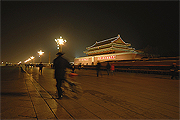
ChinaWhen I first arrived in Beijing the first thing that struck me was the pollution and the haziness of the skies. My dad and I hailed a taxi at the airport – my first chance to practice my basic Chinese. Luckily the driver seemed to understand what I was I was saying however if you can’t speak any of the language I advise you to get the hotel or a Chinese friend to write it down for you on paper because the taxi drivers know little or no English. Huge highways congested with trucks and cars waited in a long traffic jam heading towards the city centre. Our hotel was situated in an ideal location, only a five-minute walk to Tiananmen Square on a long busy road; you should pay around 120 yuan to go from the airport to central Beijing. There are many things you could say about Beijing but one thing you can’t say is that it is boring – during the summer everyone stays out late, eating at small noodle bars and cafes.

Everyone there wakes up early and often jog before work or school while the older generation do tai chi in large leafy parks – there is a dominant habit of old men in Beijing to make a huge flemmy noise and then spit every few minutes. The streets and other public places are full of life and many people spend much of their day here because the majority of the population are crammed into small rooms in massive blocks of flats. Many of the tourist attractions in Beijing are overcrowded and overrated, however, the Summer Palace and the Temple of Heaven are definitely worth your while. It is a good idea to visit the more touristy sites as early as possible as crowds become unbearable after 8 o’clock.

As I found out, if a taxi driver thinks you can speak Chinese they will speak quickly and they like to shout when they speak to foreigners, however most of them were extremely friendly and helpful. Walking from place to place is nearly impossible due to the size and the spread of the city – but you can quite easily walk if you want to find a restaurant or a park because there are restaurants on nearly every street. Good places to go for dinner or lunch are in the small hutongs (side roads) that can be found in the north of the city and in some parts of the centre. These more authentic slightly shabby narrow roads are what real Beijing is like – old men playing Chinese chess, young children playing out and very good street food without any illnesses to follow.

These areas date back hundreds of years and are far more traditional in architecture and daily life than any other part of Beijing, and are virtually tourist-free. A good place to go out after you eat is KTV, which is the Chinese version of karaoke. You hire a small room with a TV for as long as you want and you sing along to Korean and Taiwanese pop music. If, for some reason, you get bored of Chinese food – if you stay for a long period of time – go to a Hanguo kao rou restaurant where they give you a variety of very good quality meat and you roast it yourself over hot coals. It is also popular to go to one of the many tea houses in Beijing before or after a meal.

If you travel to anywhere in China take the opportunity to buy as many DVDs or any electrical things because it is far cheaper and their technology is far ahead of what we have in the West. Not just electrical equipment but everything in China, except things that they see as exotic such as coffee, are cheap, 15 renminbi to the pound.

If you don’t want to take a taxi everywhere take a bus – it is the cheapest mode of transport and is efficient. However, like any vehicle in Beijing it will get caught up in traffic a lot of the time. Do take into account that the buses are usually ridiculously crowded, as is the small subway system which would be confusing enough even if it was in English. Beijing can sometimes be a confusing city but it isn’t too hard to find your way around, however if you ask any of the locals a direction in Chinese they will always tell you North, South, East or West so be sure to ask what road to take.

Anyone who comes to Beijing almost always eats at a roast duck restaurant – there are huge duck farms outside Beijing where the animals are fattened up to be roasted until there is a perfectly crisp skin and succulent inner flesh. Beijing duck tastes completely different to the Cantonese version we have in London. If you want to go to a duck restaurant just wander around until you find one as there are restaurants everywhere – it is pretty obvious to tell a duck restaurant because they tend to have a picture of a cartoon bird.

In some restaurants they carve the duck in front of you and they are extremely hygiene conscious as they wear a plastic mask and gloves whilst touching food. When I was in Beijing I had noticed that in many restaurants they give a free bottle of mao tai which is a 53% bottle of rice-based alcohol. Drinking here is quite acceptable and many business men smoke or drink whilst chatting. The best way to take in Beijing life is to spend time in a school or college as I did, you get a completely different view of the city from the eyes of the local people but the main reason I did it was to improve my Chinese speech. But I recommend it to anyone, however the government can make it quite hard for you to do so.

Stanfords’ recommendations for a trip to Beijing are the ITMB Beijing map and Lonely Planet’s Beijing guide.

Browse our collection of China Maps and Guide books here >

Author: Angus Lee