Girona and the Costa Brava

Girona has a quiet charm and a placid air about it. The best way to observe this is by walking the ancient city walls, stopping for contemplative rests at the intermittent observation towers. The views from here can be mixed – one glance throws up ugly cranes and scaffolding, the next red roofs and the soaring towers of Girona’s religious landmarks – but it is well worth the effort.

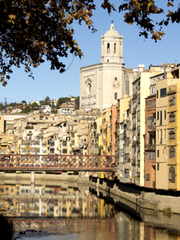
Further serenity can be found in the labyrinthine streets and steps of the old town, the Call (the former Jewish quarter, where there is a small museum documenting the history of Catalonia’s medieval Jewry before their 15th-century expulsion from Spain), and the squares, gardens and promenades that follow the River Onyar through the city. From the bridges that lead between old and new towns, you can observe eccentric buildings that line the banks of the river.

A useful guide for maps and inspiration is Triangle Postals’ compact guide to Girona, which also suggests trips and tours in north-eastern Catalonia. For a more detailed map, try the city plan by Telstar.

Easily accessible by coach, the national parks near Girona (try the volcanic Garrotxa National Park) and the rugged coastline leading up to the French border offer glimpses of Catalonia’s natural beauty. On the Costa Brava, you could always try visiting the resorts that are so popular, but you definitely shouldn’t miss the quiet fishing villages, coves and spectacular views to be found in some of the more remote places like Calella de Palafrugell, south-east of Girona.

If you have the energy, try walking some of the GR92 coastal path, which will take your breath away and may also leave you breathless. For excursions such as this, you could refer to the Catalan survey(see their excellent topographic atlas) and the Rough Guide to Spain. Walking Maps of Spain by Editorial Alpinaare also very useful due to the fact that they come with booklets to help plan walks and outdoor activities.

Browse our collection of travel guides and maps to Girona >

Browse our collection of travel guides and maps to Costa Brava >

Author: Tim Cleary
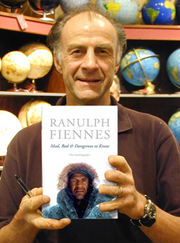
The Ranulph Fiennes Interview

Ranulph FiennesRanulph Fiennes is one of Britain’s most famous expedition leaders, with such feats under his belt as reaching both poles by surface travel, crossing the Antarctic unsupported, and running seven marathons in seven days on seven continents. His most recent accomplishment was scaling the notoriously challenging North Face of the Eiger in Switzerland, despite a fear of heights. Fiennes, now 63, describes these adventures and more in his latest autobiographical book: Mad, Bad and Dangerous to Know. Ranulph found time in between adventures to stop into Stanfords to give some more insights into his fascinating life…

How did it start – who were your heroes as a child?

My dad was. He was killed four months before I was born and my mother brought me up on stories about him and the war. He was commander of the Royal Scots Greys regiment and he was killed in Naples. He was definitely my hero and still is. Continue reading The Ranulph Fiennes Interview

Stanfords Starts Publishing Travel Classics

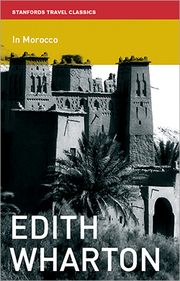
Here at Stanfords we have just unveiled exciting new additions to our shelves – Stanfords Travel Classics.

As a specialist travel bookseller we were inspired to put together a collection of the travel books that we really love, so we have launched a series that republishes some of the finest historical travel writing in our own branded paperbacks.

Our expert readers have combed the archives of historical travel literature to find the very best writing from the very best writers to launch the series. We’ve just produced our first 10 titles and they include famous literary names such as Robert Louis Stevenson, Henry James, Mark Twain and Edith Wharton, as well as classic tales of exploration and adventure from Ernest Shackleton, Mungo Park, Isabella Bird and Joshua Slocum.

We wanted to republish these titles using a striking contemporary design to demonstrate that this historical writing can be as fresh today as when it was first printed. We worked with expert book designer, Adrian Sharman of StudioAS, who came up with some wonderful fresh cover designs for a Stanfords Travel Classics. We think that the striking black and white photographs that Adrian has found for the covers evoke the subjects of the books beautifully. These are books that we are proud to put our name on.

The first 10 titles are numbered on the spine so why not collect the complete library? We plan to add more titles to the a Stanfords Travel Classics – there are many more wonderful travel books out there that are out of copyright and that we’d like to republish. If you have any suggestions about titles you would recommend, we’d love to hear from you. Just email [email protected] with your favourites and when we publish a book that you recommend we’ll send you a free copy! (Remember to qualify for our series the book must be out of copyright which means the author must have died more than 70 years ago).

If you want to be kept up to date on new titles in our Classics series, and other Stanfords’ news, join our email newsletter.

Stanfords Travel Classics – the perfect opportunity to build up a collection of your favourite travel literature from your favourite travel book seller!

Budapest, Kisalföld and Lake Balaton

For a good mix of history, culture, food and relaxation, Hungary offers its fair share of attractions for tourists. My trip to Hungary took in quite varied pleasures, from relaxing in the Turkish baths of Budapest (try jumping from a boiling hot sauna into a pool of cold water) to intrepid quad driving through the beautiful, verdant fields and woods of the north-eastern Kisalföld region.

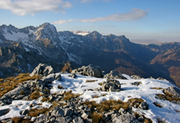
The Kisalföld offers not only nature, but also the pretty city of Györ and the historically rich Pannonhalma Monastery, perched on a hill with fine views of the surrounding area.

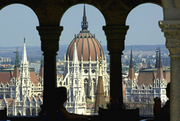
Budapest was an inspiring city to visit. The architecture along the banks of the gorgeous Danube is radiant both in the daytime and at night, and walking the banks of the river was a refreshing way to start my visit. Walking the streets of the city throws up pretty squares, historic buildings (try Europe’s largest synagogue in Pest), proud statues and outdoor cafés, bars and restaurants. Late-night revellers might enjoy a trip to an outdoor club in Buda, where you can dance in the warm air and sample fine lagers and the peculiar Unicum, which is a dark, herbal Magyar spirit.

After the capital, my excellent hosts took me to visit Lake Balaton. A gorgeous milky blue lake, Balaton offers not only relaxed bathing, but also delightful small towns on the northern shores where you can visit museums, palaces and climb up to the ruins of a hilltop castle on the Szigliget peninsula. Life in this area seems very relaxed, especially while you recline in a dimly lit winery, sip red wine and listen to live violin performed by a Roma gypsy band.

Other, more random activities included enduring a concert by the long-established Hungarian rock band EDDA and a trip to an ice-cream factory. Here, I participated in a company table-tennis tournament, bowing out in shame after being challenged by a former national champion. I consoled myself with a tour of the factory, tasting the ice cream and seeing how the flavours are created by scientists in a Willy Wonka-style setting.

Any gastronomes should bear in mind that Hungary is a nation of meat-eaters – meat is eaten in copious amounts even at the breakfast table – and goulash, spicy stews and cold meats are a staple. But this need not put off any vegans or vegetarians, since you’ll find dishes with glorious combinations of ingredients you never would have dreamt of. As a vegetarian, my favourite meal comprised of a fruit soup, followed by a cherry strudel and a shot of lethal plum brandy (pálinka).

For any trip to Hungary, I would recommend some decent books and maps. The Rough Guide to Hungary was extremely informative and the Bradt Travel Guide to Hungary gave me inspiration and interesting facts (particularly about Hungarian naming conventions and a history of the Rubik’s cube). For travel literature, you might enjoy reading sections of Patrick Leigh Fermor’s Between the Woods and the Water, which recounts his walk across central and eastern Europe in the 1930s. The Insight Fleximap of Budapest offers clear mapping of the key tourist destinations. And if you’re hoping to explore other areas of the country in more depth, particularly if you are hiking or trekking, you could try Hungary’s own mapping from Cartographia. But before any of this, try acquainting yourself with the strange and beautiful Hungarian language – for this, the Rough Guide Hungarian phrasebook served me very well.

Browse our collection of maps, guides and travel literature:
> Hungary travel guides
> Hungary road maps and atlases
> Travel literature inspired by Hungary
> See all our maps and guides to Budapest

Author: Tim Cleary

Stanfords Helps Decide London as ‘Capital of the World’

Stanfords was used as a point of research in The Independent Traveller survey that resulted in London being named the capital of the world.

Researchers from the Saturday travel supplement used the criteria of the number of individual guidebooks that appeared on the shelves of our store to score each capital city of the world. They also used criteria such as populations, number of Unesco World Heritage Sites, the number of non-native restaurants listed in the current Time Out City Guide, and ‘Three-star sights’ (the top rating) in the Michelin Green Guide.

London came out top, followed by New York, Paris, Tokyo and Chicago. The results were published on 22 December 07 and are on the Independent’s website.

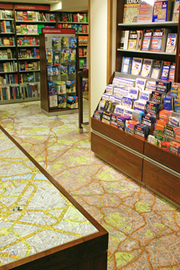
In the article, travel editor Simon Calder also mentioned our store as he celebrated London’s result: ‘To see how much there is to fathom [of London], wander down the basement of Stanfords, the map and travel guide shop in Covent Garden (and venue for some of our researches). You can walk across the full extent of the city in about 10 seconds flat, because a giant map of the capital is printed on the floor.’

The World In Figures

Andorra is the place to live long – it has the highest life expectancy in the world, at the grand 83.5 years.

The five most populous countries in the world are:

1. China
2. India
3. USA
4. Indonesia
5. Brazil.

Women in Niger, Afghanistan and Guinea-Bissau have the world’s highest fertility rates – with an average of over seven children each. Continue reading The World In Figures

Montenegro

The travel supplements have long been asking, ‘Where is the new Prague?’ (My vote would be for Ljubljana, the Slovene capital). Today the question should be, ‘Where is the next Croatia?’ Croatian tourism has really kicked off in recent years, and the coast is saturated from Istria down to Dubrovnik. And yet, just a few miles south of Dubrovnik is a beautiful, secret country, crying out for tourists.

Montenegro was the smallest Yugoslav republic, and the last to break away from big brother Serbia as recently as June 2006. Until then, Montenegrin coastal resorts, such as Budva and Herceg Novi, relied on Serbian tourists. But since the split, Serbs have got the hump and Montenegro’s hoteliers and guesthouse owners are crying out for new guests.

The coast is just as beautiful as Croatia, but with a more spectacular mountain backdrop. It’s up in the mountains where Montenegro’s soul lies, particularly in Cetinje – the ancient capital – with its Ruritanian royal palaces and long-deserted embassies. It’s so much prettier than the modern capital, Podgorica (formerly Titograd), down on the plain.

Another unique feature of Montenegro is the Bay of Kotor (Boka Kotorska), the biggest fjord in the Mediterranean. Here the coast and the mountains come into direct contact, and deep in the chasm lies Kotor, a walled Venetian city dwarfed by the towering walls of the fjord.

There are no cheap flights to Montenegro’s Podgorica or Tivat airports (yet), but that is irrelevant when Dubrovnik airport is just 18km from the border. Or you can do as I did – get a boat from Bari in Italy to the Montenegrin port of Bar. I could give you the address of a good guesthouse owner there – she’s my mother-in-law!

The Bradt guide to Montenegro is the only guide to the country published in the UK. As a series, they are highly personal guides that cover countries overlooked by other publishers, including all the Balkan nations.

Lonely Planet’s Western Balkans covers Montenegro. Hungary’s Gizi Maps do a national map of Montenegro, while Slovenia’s Geodetski Zavod Slovenije (GZS) 100k map of the Montenegrin Coast (Crnogorsko primorje) is excellent. Don’t rely on any locally produced maps.

Browse our collection of Montenegro Maps and Guide books here >

Montenegro travel information >

Author: Guy Bristow

Maribor, Slovenia

‘Pozdravi iz Maribor’ – Greetings from Maribor! Ryanair’s latest destination, which personally I’m very happy about, because since I left Stanfords’ employ, I have been living and working in the Maribor area.
Slovenia’s second city is not much more than a small town, and consequently Maribor Aerodrom is much smaller than Ljubljana’s Brnik Airport. There is no luggage carousel, for example, just a table where your baggage is handled.

So, a second front has been opened on the tourist invasion of Slovenia. Ljubljana and Lake Bled are already overrun with easyJet weekenders, but Maribor is still mostly tourist-free. A proud city, and rival to the capital, but is it prettier than Ljubljana? Well no, but it’s not without its own charm. Its best feature is the riverfront. The River Drava wends its way slowly from the Austrian Alps down to the Danube in far off Serbia. The Old Town is a cluster of red-roofed mediaeval buildings on the left (north) bank, although the best views are from the right (south) bank. Particularly from the terrace of the Europark Shopping Centre, the only place you don’t have to look at this monstrosity. Continue reading Maribor, Slovenia

007's Car Drives from Tokyo to London with help from Stanfords

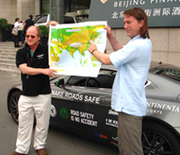
Two adventurous British men have returned from a record-breaking epic charity drive from Tokyo to London in James Bond’s favourite car. The length of the Asian Highway and across Europe was driven by Phil Colley and Richard Meredith in an Aston Martin V8 Vantage to raise awareness of the Make Roads Safe campaign.

The tour operator and school teacher began their feat where all great journeys begin, at our very own store in Covent Garden, London – all the maps the pair used on their trip were from Stanfords, and they even shunned their in-car sat-nav system in favour of the trusty paper map. Phil told us, “The maps we used to get from Tokyo to London were all purchased at your wonderful shop. There was a sat-nav in the car for Europe but we never used it – even if we’d known how! Thanks for the great maps!”

The UN-backed trip took them through countries including South Korea, China, Kazakhstan, Kyrgyzstan and Uzbekistan, with the car attracting much attention along the way. On arriving in Istanbul, Phil and Richard became the first people to drive the entire length of the new Asian Highway.

After 10,000 miles and 49 days, crossing two continents, 18 countries and four seas, the triumphant pair pulled into London on 12 August, exactly on schedule, for an official reception at the Park Lane Intercontinental Hotel.

Make Roads Safe is an international campaign to put global road traffic injuries on the G8 and UN sustainability agendas. The campaign aims to raise awareness of a global road traffic injury epidemic that kills at least 3,000 people and 500 children every day.

Aston Martin provided the car, counting the journey towards an ongoing long distance testing programme which would have been undertaken on European motorways, and together with other sponsors, including Intercontinental Hotels and Bridgestone, has used the journey to raise money for a Unicef-led road safety programme for children in China. The car will also be auctioned in support of Unicef.

Read Richard Meredith’s blog on the feat

Author: Rachel Ricks

Bristol Stanfords' 10th Birthday

We have given a new look to Stanfords in Bristol, marking the 10th anniversary of the shop. The new bookcases in Stanfords Bristol shop

The Stanfords store in Bristol was our first branch to launch outside of London and the doors were opened 10 years ago by the great travel writer Eric Newby.

The shop has now been entirely refitted to mimic the London Covent Garden store with walnut and silver furniture, and a combination of wooden floors and carpets. A new highlight is a 1:5000 map of Bristol covering the staircase wall from the ground floor to the basement, and Caroline Bowler, Stanfords Bristol shop manager, says, “This will be quite a talking point with customers as you are able to identify individual houses on the map.” Continue reading Bristol Stanfords' 10th Birthday