Amazonas Travel Guide: 4 Days Down the Amazon

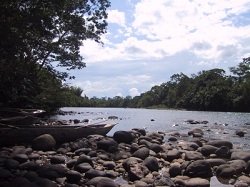
Amazon ColumbiaLily Taylor writes about her four-day adventure down the Amazon. Her starting point was Leticia – the town where Columbia, Peru and Brazil come together.

This fantastic trip starts off with a nerve-jangling rattletrap flight to Leticia, the most southerly town in Columbia and a major port on the Amazon River.

A town where people open their front porches to passers-by as makeshift restaurants, Leticia is dominated by the Amazon – arguably the world’s mightiest river. From here I embarked on an adventure down the river that I’ll certainly never forget. Continue reading Amazonas Travel Guide: 4 Days Down the Amazon

Stanfords Welcomes Wild Frontiers to Covent Garden Store Themed Area

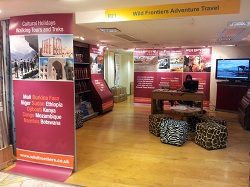
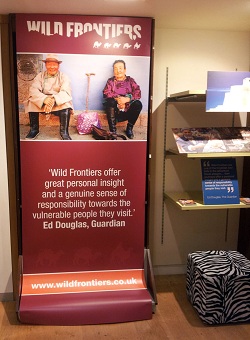
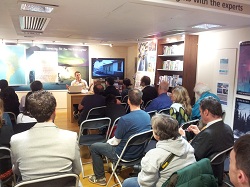
Stanfords Wild FrontiersWe’re delighted to welcome Wild Frontiers, the recipient of the Best Ethical Travel Company accolade at the 2012 Guardian Observer Annual Travel Awards, to our flagship Covent Garden store’s themed area for the duration of October.

The independent travel company, which specialises in tailor-made holidays to countries including India, Burma and Ethiopia, will offer Stanfords’ visitors bespoke travel advice and host in-store talks from destination experts until 31st October.

To celebrate the partnership, we’ve joined forces to offer a brand-new Kindle Fire pre-loaded with five classic travel books to one lucky winner – entrants need only to visit our competition page to enter.

Stanfords Wild Frontiers

Commenting on the partnership, Chris Powell, Stanfords’ Managing Director, said: “We have already had many interesting travel companies exhibit in our themed area, from Exodus to Discover the World, and this month Wild Frontiers are exhibiting their knowledge of the silk route from China through to Uzbekistan.

“We are delighted that Wild Frontiers wish to participate in our themed idea and hope our travelling customers come to the interesting seminars to enjoy learning more about this fascinating part of the world.”

Wild Frontiers Travel Adviser Natalie Morris said: “Having worked closely with Stanfords for the last few years, we are really excited to be setting up a pop-up travel centre in the themed area. In the past we’ve given talks in the store about up-and-coming holiday destinations, which have been really successful – it’s the ideal venue to fuel the travel bug.

“For us, October is going to a great opportunity to meet potential travellers face-to-face and talk about a variety of destinations. We also have talks planned by travel writer Jonny Bealby and Alan Curr, which we hope will encourage people to dust off their passports.”

Stanfords Wild Frontiers

Wild Frontiers’ presence will complement our already-comprehensive collection of adventure travel guides and maps, with the Long Acre store accommodating almost 34,000 titles covering destinations in all four corners of the globe.

Wild Frontiers will focus on Uzbekistan, Tajikistan, Mongolia, China, India and Pakistan travel itineraries during its month-long tenure, with customers able to benefit from our unrivalled collection of travel guides and maps to the central and east Asian destinations.

Alan Curr will be delivering a talk at Stanfords Covent Garden on his new book, Cricket on Everest, on Thursday 18th October. Jonny Bealby, Wild Frontiers’ founder and the author of three books, will talk about his love of the Indian subcontinent at a separate event on Thursday 25th October. Both talks start at 18:30 and are free to attend – see our events page for further information.

Photographing the Northern Lights: William Gray's 10 Top Tips

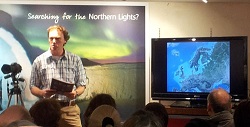
William GrayAward-winning photographer and travel writer William Gray told an audience at Stanfords Covent Garden his 10 top tips for successfully photographing the Northern Lights, courtesy of Discover the World.

“The aurora borealis really is a celestial temptress – she might grace you with her presence for a few minutes or flaunt herself for hour after hour. The key to capturing her with your camera is to be prepared,” William explained. Continue reading Photographing the Northern Lights: William Gray's 10 Top Tips

Ollantaytambo: The Village the Whole World Passes Through

Rachel Ricks discovers Ollantaytambo, a picturesque Peruvian village that serves as the gateway to Machu Picchu.

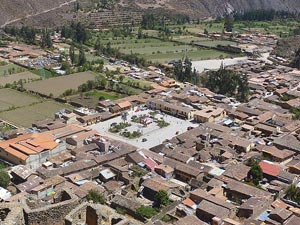
Ollantaytambo from above.In Peru’s Sacred Valley is a small but picturesque village where it seems on any given day, the whole world has come to converge.

It doesn’t even have an easy name to pronounce for the nationalities of the world – Ollantaytambo. And the reason everyone visits this tiny pueblo? To get to and from one of the New Seven Wonders of the World: Machu Picchu.

I spent longer than most visitors do in Ollanta – as, thankfully, it’s called for short (I panicked originally at the thought of not being able to pronounce where I was staying) – and I knew I’d love to invest more time here after my first visit. Continue reading Ollantaytambo: The Village the Whole World Passes Through

Win a New KINDLE FIRE Loaded With 5 Travel Classics!

Wild Frontiers competition

This competition is now closed.

We’re excited to confirm that Wild Frontiers will be based in our Covent Garden store’s themed area for the whole of October.

Founded in 2002, the independent travel specialists offer tailor-made holidays and adventure tours worldwide including India, Burma and Central Asia.

To celebrate, Wild Frontiers is giving away a new Kindle Fire pre-loaded with five classic travel books! To be in with a chance of winning, simply complete the form below.

Run by travellers for travellers, Wild Frontiers operates on the ethos of helping would-be explorers access some of the world’s most incredible and inaccessible places. Pay one of its resident travel experts a visit at our London store in October to start planning your next adventure!

Short Walks From Bogota: A Talk by Tom Feiling

The Columbian identity is a work in progress, with the nation’s population unsure of how they should be perceived by the wider world.

Tom Feiling at Stanfords Covent Garden storeThis is according to Short Walks from Bogota: Journeys in the New Columbia author Tom Feiling, who delivered a talk at Stanfords on his recent trip to the South American country; the inspiration behind his latest work.

“There’s an idea that no-one in Colombia wants to be Colombian,” he told the audience, with the nation’s middle classes looking towards the United States and its poorer population yearning “to be Mexican”.

“Colombians still aren’t fully aware of how to pitch themselves, particularly in relation to what their strengths are vis-a-vis the rest of the world.” Continue reading Short Walks From Bogota: A Talk by Tom Feiling

Nepal 'Reaffirms My Golden Travel Rule'

After experiencing Nepali hospitality first hand, Paul Darlow’s first rule of travel – go slowly and talk to as many people as you can – was reaffirmed.
Nepali hospitality

Nepali hospitality

During one of my first visits to Nepal, I was looking around the Monkey Temple in Kathmandu. As I sat on a stone step contemplating what little I had learned about Buddhism, I saw out of the corner of my eye a Nepali man feeding a chapatti to a dog. Something told me to go over and talk to him.

Binod was his name. His mother having died when he was young, he was pushed out of his village to go to Kathmandu and look for work at the age of 12. Now in his late 20s, he ran a souvenir stall.

After chatting for a couple of hours, Binod invited me back to his house.  After an evening of buffalo curry and rakshi (the local alcoholic tipple) I was far too drunk to walk back to my guest house, so Binod offered me his bed while he took the floor.

The next morning, both of us feeling slightly worse for wear, Binod explained that an important festival was approaching and that he was going to travel to a small village where his wife and newborn baby were staying at her parents’ house. He invited me to join him – and so I found myself riding on the roof of a bus along the road to Chitwan, every now and then having to climb back inside the bus before the police checkpoints.

Nepali village life
Nepali cooking

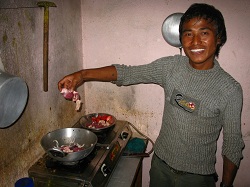
The family we stayed with consisted of 12 people, and between them they had two one-storey, one-room houses made of mud, wood and straw. One of the buildings was about two metres by three metres; the other maybe five metres by two metres. There was one bed, no running water and no electricity. Food was cooked over an open wood fire.

After introductions and small talk, preparations for the following day’s festival commenced – yak dung mixed with mud was applied to the outsides of the houses to make them look smart, and marigolds were picked to make flour garlands while Binod and I went fishing. Unfortunately, the only fish we managed to catch were small water snails known as ‘gunghi’, so we also went and bought a chicken which was quickly dispatched, prepared and cooked.

That night, despite my reservations, Binod and I were allocated the only bed in the house. Everyone else (all 12 of them including the grandmother and two newborn babies) had to make do with the floor.

As I was falling asleep, the women gathered together at the firepit and started cooking chapatis for the next day. I think I finally drifted off to sleep at about three o’clock with the smells of cooking and the gentle chatter of Nepali women floating around me.

The Bhai Tika Festival

The next day was the Bhai Tika Festival.

‘Bhai’ means ‘brother’ in Nepali, although not necessarily in a blood-relative sense.

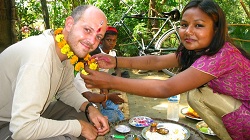
Each man took turns to sit on the floor as the woman selected to act as his sister for the ceremony said a few words while making a tika on our foreheads, placing a garland of flowers around our necks, and presenting us with a plate of food, a bottle of rakshi and some small gifts.

Over the next few hours the food was eaten, the rakshi drunk, and my golden rule about travelling was reaffirmed – go slowly and talk to as many people as you can, for it’s the people you remember long after you’ve left the place.

Paul Darlow manages Nepal Trekking Holidays, a travel blog dedicated to walking holidays in Nepal.

If you’ve been inspired by his experiences, you may be interested in one of these Nepal travel guides and maps:
> Nepal tear-resistant road map
> Nepal: Schneider Trekking Maps
> Lonely Planet Nepal

The UK's Top 5 Autumn Coastal Walks

With September’s sunshine having come to an abrupt end, we take a look at five of the UK’s best autumn coastal walks.

1. Looe to Polperro, Cornwall

PolperroThe 5.5-mile stretch of coast path between Looe and Polperro is one of Cornwall’s best-loved. Starting at the western end of Looe’s seafront, the route takes in Portnadler Bay’s National Trust-protected beach, the dramatic headland before Talland Bay and the picture-postcard views of Polperro.
Polperro’s narrow, winding streets are home to an excellent choice of welcoming pubs – so you’re bound to find somewhere to rest your legs following the walk, which can be completed briskly in a couple of hours or enjoyed more leisurely over half a day. Continue reading The UK's Top 5 Autumn Coastal Walks

Secrets of Iceland's Killer Whales Revealed

Holidaymakers travelling to Iceland are likely to see the best Northern Lights display in years thanks to the solar max period, but the aurora isn’t the only natural phenomenon to grace the Nordic island nation this winter.

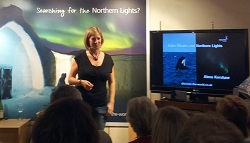
During a talk at Stanfords’ Covent Garden store on Wednesday, Cetacean expert and Discover The World tour guide Alexa Kershaw explained the intricacies and quirks of Iceland’s abundant killer whale population.

Alexa Kershaw“Whales are found in all the world’s oceans, and about a quarter of the world’s species are found in the waters around Iceland and the UK,” Ms Kershaw said.
“The reason for Iceland’s abundant killer whale population is the warm waters of the gulf stream mixing with the cooler coastal currents, which means more plankton and fish.

“The Icelandic killer whales feed on herring and historically during the winter months were seen on the east coast of the island, but their location varies depending on the herrings’ activity – with more now being seen in Grundarfjörður on the western Snæfellsnes peninsula.

“The best time for sightings is between October and March, when the herrings come close to the fjords to escape the worst of the winter. Unfortunately for them, the killer whales know where they are – so they’re preyed on quite heavily. There are about two million tonnes though, so stocks recover quite well.

The Cetacean expert went on to explain that killer whales are sexually dimorphic, which means males and females can be identified just by sight.

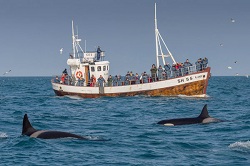
“Females have smaller, curved dorsal fins – adult males have taller, more distinctive ones, and they’re usually more than a metre and a half tall,” Ms Kershaw told her audience.

Orca watching“Orcas are highly social creatures and they usually remain in the same family for life. Males tend to live for about 30 years and females as long as 50, though they can live much longer. Males grow to about 7.5 metres in length; females five, so they are pretty huge animals.

“A lot of what we know about killer whales comes from photo identification studies – scientists take photos of dorsal fins to be able to recognise individuals. They can then look at population structure and population size.

“We’ve been working with Icelandic researchers using holidaymakers’ photos to help them build a better picture of the whales’ behaviour.

Ms Kershaw went on to talk about Icelandic orcas’ unique feeding call, which allows them to hunt for herring more successfully.

“All whales and dolphins use sound as their primary sense because light cannot travel deep under water. In a recent study, it was discovered that Icelandic whales have a unique herding call – when they’re feeding on herring, they emit a three-second-long very low frequency sound, which can affect the fish’s swim direction and cause them to bunch together tightly.

“But contrary to popular belief, the whales don’t go in and eat a bunch of fish at the same time – they pick them off one-by-one.”

You can visit Discover the World and speak to one of their expert travel advisers on the lower floor of the Stanfords’ Covent Garden store. The tour operator will be based in the themed area until the end of September.

Browse our collection of Iceland Maps and Guide books here >

Iceland travel information >

Genie and Paul by Natasha Soobramanien: Review

Mauritius enthusiast Tim Cleary reviews Genie and Paul, Natasha Soobramanien’s reworking of the 18th century classic Paul et Virginie.

Genie and Paul
Click here to buy
your copy >

Genie and Paul tackles the themes of memory, sibling relationships, self-imposed exile, lost innocence and the troubled – perhaps doomed – lives of three generations of one family caught between London, Mauritius and Rodrigues.

This wonderful novel needn’t be restricted to those interested in Mauritius and Mauritian immigrants living in London – it has actually holds universal appeal – although some knowledge of Mauritian culture is required to understand certain passages (even some knowledge of London’s geography and the British alternative music scene in the late 80s is necessary to understand the text).

A cannibalistic reworking

The novel is a loose reworking of Paul et Virginie, Bernardin de Saint-Pierre’s 18th century classic set on the tropical Indian Ocean island of Isle de France (now Mauritius). I have read this slightly-sickening tragic romance because it’s an important part of French (and Mauritian) literary heritage, but I didn’t enjoy it nearly as much as Soobramanien’s more honest take on love, life and loss. Continue reading Genie and Paul by Natasha Soobramanien: Review