Mauritius enthusiast Tim Cleary reviews Genie and Paul, Natasha Soobramanien’s reworking of the 18th century classic Paul et Virginie.
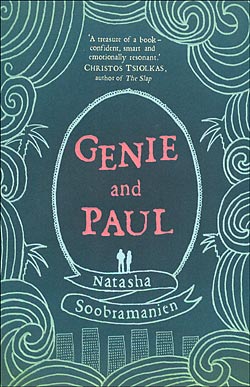
Genie and Paul tackles the themes of memory, sibling relationships, self-imposed exile, lost innocence and the troubled – perhaps doomed – lives of three generations of one family caught between London, Mauritius and Rodrigues.
This wonderful novel needn’t be restricted to those interested in Mauritius and Mauritian immigrants living in London – it has actually holds universal appeal – although some knowledge of Mauritian culture is required to understand certain passages (even some knowledge of London’s geography and the British alternative music scene in the late 80s is necessary to understand the text).
A cannibalistic reworking
The novel is a loose reworking of Paul et Virginie, Bernardin de Saint-Pierre’s 18th century classic set on the tropical Indian Ocean island of Isle de France (now Mauritius). I have read this slightly-sickening tragic romance because it’s an important part of French (and Mauritian) literary heritage, but I didn’t enjoy it nearly as much as Soobramanien’s more honest take on love, life and loss.
Here, the author does something quite remarkable: she subverts part of the literary canon. Swallows it; allows it to be partially digested; regurgitates it. Spits out what remains to reveal something far less pious and sickly sentimental, something far more beautiful. Perhaps this is what she means when she talks about her “cannibalistic” writing in a recent interview.
Polyphonic
Genie and Paul is polyphonic novel because of the multiple voices at play. First, there is a third-person narrator recounting the experiences lived out by multiple characters, particularly siblings Genie and Paul. Then, the narrative is interspersed with letters, notes and stories as written or told by the various characters, and myths and legends passed down through generations of Mauritians. The novel itself depends on its multiple voices and on other narratives that exist outside the text. A refreshing view of the world is revealed in the process.
The power of language
My own interest in the text relates to language, or the linguistic relationships between Mauritius, Rodrigues, the Chagos Islands, colonial powers France and Britain, and all the countries that have fed the populations of the islands of the south-western Indian Ocean.
Each of the languages spoken in this part of the world – Kreol, French, Bhojpuri and English, among many others – depends for its continued use on all the others. All of them are interdependent, adding to each other’s vocabulary words to describe objects and concepts that Mauritians encounter in their daily lives. The vitality of each of the languages relies on its speakers’ openness to the influence of other languages.
Nevertheless, to a large extent Mauritians will choose to use a specific language for a particular purpose or effect, which underlines the language hierarchy on the island and in Mauritian culture in general. This is exemplified in Genie and Paul, where English and French are higher up in the pecking order than Kreol.
 Paul, who was older than Genie when they left Mauritius for London as young children, still speaks Kreol fairly well (although not perfectly) and he is drawn towards its sounds and rhythms. He sometimes uses it to tease his younger sister, who does not speak the language well enough to answer back convincingly. Her knowledge of Kreol is passive: she understands it because she hears it around her at home among older family members, but she is too attached to British culture and the English language to be able to speak it properly:
“I know all the words, I can hear them in my head but I have to think really carefully before I open my mouth. Like people who have to point to the words when they read.” (Page 179)
For Paul, Kreol is a “Masonic handshake”, a “bastard language, formed from the cacophany of a hundred enslaved languages to confuse the oppressors, to hide things from them.” It is a language “for taking the piss out of people in, for swearing in, for being mad in, for cutting someone down in, for joking in, for being affectionate and playful…” (Page 100)
Paul even dreams in Kreol.
However, and despite speaking Kreol herself with other Mauritians, upon moving to London, his mother “insisted that they spoke only in English”, presumably as a means to integrate and adopt British ways, to the exclusion of their Mauritian heritage and Paul’s attachment to his roots. Consequently, Paul experiences alienation in both Britain and Mauritius, which seems to be the cause of his troubled life.
Far away from London, in Mauritius, French is presented as the language of polite society, especially on the streets of the capital, Port Louis. To speak Kreol is seen to be “offensive” when speaking to people you do not know.
In both Britain and Mauritius, despite Paul’s attachment to it and its unique sounds and rhythms, Kreol is relegated to the status of non-language. The premise that this adaptable and uniquely Mauritian language is unfit for communication in the modern world is upheld by the very people who use it.
- Want to discover more about Mauritius?
Browse our collection of - > Mauritius maps and travel guides.