Holidaymakers travelling to Iceland are likely to see the best Northern Lights display in years thanks to the solar max period, but the aurora isn’t the only natural phenomenon to grace the Nordic island nation this winter.
During a talk at Stanfords’ Covent Garden store on Wednesday, Cetacean expert and Discover The World tour guide Alexa Kershaw explained the intricacies and quirks of Iceland’s abundant killer whale population.
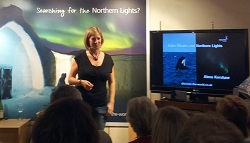 “Whales are found in all the world’s oceans, and about a quarter of the world’s species are found in the waters around Iceland and the UK,” Ms Kershaw said.
“The reason for Iceland’s abundant killer whale population is the warm waters of the gulf stream mixing with the cooler coastal currents, which means more plankton and fish.
“The Icelandic killer whales feed on herring and historically during the winter months were seen on the east coast of the island, but their location varies depending on the herrings’ activity – with more now being seen in Grundarfjörður on the western Snæfellsnes peninsula.
“The best time for sightings is between October and March, when the herrings come close to the fjords to escape the worst of the winter. Unfortunately for them, the killer whales know where they are – so they’re preyed on quite heavily. There are about two million tonnes though, so stocks recover quite well.
The Cetacean expert went on to explain that killer whales are sexually dimorphic, which means males and females can be identified just by sight.
“Females have smaller, curved dorsal fins – adult males have taller, more distinctive ones, and they’re usually more than a metre and a half tall,” Ms Kershaw told her audience.
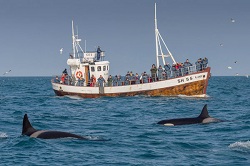 “Orcas are highly social creatures and they usually remain in the same family for life. Males tend to live for about 30 years and females as long as 50, though they can live much longer. Males grow to about 7.5 metres in length; females five, so they are pretty huge animals.
“A lot of what we know about killer whales comes from photo identification studies – scientists take photos of dorsal fins to be able to recognise individuals. They can then look at population structure and population size.
“We’ve been working with Icelandic researchers using holidaymakers’ photos to help them build a better picture of the whales’ behaviour.
Ms Kershaw went on to talk about Icelandic orcas’ unique feeding call, which allows them to hunt for herring more successfully.
“All whales and dolphins use sound as their primary sense because light cannot travel deep under water. In a recent study, it was discovered that Icelandic whales have a unique herding call – when they’re feeding on herring, they emit a three-second-long very low frequency sound, which can affect the fish’s swim direction and cause them to bunch together tightly.
“But contrary to popular belief, the whales don’t go in and eat a bunch of fish at the same time – they pick them off one-by-one.”
You can visit Discover the World and speak to one of their expert travel advisers on the lower floor of the Stanfords’ Covent Garden store. The tour operator will be based in the themed area until the end of September.
Browse our collection of Iceland Maps and Guide books here >