The Columbian identity is a work in progress, with the nation’s population unsure of how they should be perceived by the wider world.
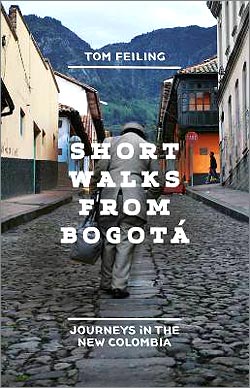
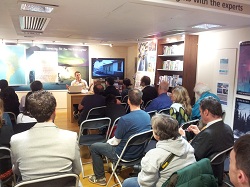 This is according to Short Walks from Bogota: Journeys in the New Columbia author Tom Feiling, who delivered a talk at Stanfords on his recent trip to the South American country; the inspiration behind his latest work.
“There’s an idea that no-one in Colombia wants to be Colombian,” he told the audience, with the nation’s middle classes looking towards the United States and its poorer population yearning “to be Mexican”.
“Colombians still aren’t fully aware of how to pitch themselves, particularly in relation to what their strengths are vis-a-vis the rest of the world.”
Tom spent nine months in Columbia during 2010-11, with Short Walks detailing his experiences with ‘ordinary’ Colombians: former guerrilla fighters and their ex captives, a nomadic tribe who once believed they were the only people on Earth, and mothers whose sons disappeared at the hands of paramilitaries.
From their stories, and excursions across Colombia’s challenging landscape, the travel writer aimed to discover the truth behind the Latin American country’s new-found reputation as a rising star of the global economy.
“There are so many aspects of Colombia – paramilitaries, conflicts with guerrillas, cocaine trafficking – previously, no-one would recommend travelling there.
“This was the overriding impression: a nation that’s supposedly been torn apart and is the very epitome of conflict. But now that’s changed – I had nine very peaceful months there.
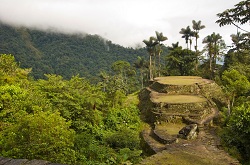
“You can also define Colombia by its huge rivers, the Caribbean, the Pacific coast, the jungle and the desert. It’s a country with a huge variety of landscapes, and a huge variety of people who have adapted to those landscapes.
“But it’s also a nation divided by its huge valleys – since the Spanish left 200 years ago, its different areas have grown up as very autonomous and are quite ready to tell the politicians in Bogota what they think.”
Despite its challenging geography – dominated by the Andes mountain range, many villages are almost inaccessible – Tom explained that Colombia “is one of the happiest countries in the world”.
“I think it’s something to do with the way Colombians raise their children – families are very warm towards them and quite indulgent – but at the same time I never saw anyone making too much of a fuss.”
The author suggested that Colombians’ happiness may also be attributed to the nation’s abundant national resources, with the UN revealing that Colombia is one of only seven countries the world will rely on to produce all the food it requires later in the 21st century.
He also touched on Colombia’s economic development, which is being accelerated by Chinese investment.
“The Chinese have plans to build a brand new city in Colombia and a new ‘dry’ canal to challenge the Panama Canal,” he explained.
“It’s due to be built 100 miles to the south through jungle and swamps, where every engineer would say it’s impossible.”
 Plans for a Panama Canal alternative were confirmed by the Colombian government in 2011, when it revealed the new route, linking the Pacific port of Buenaventura to the Atlantic coast, will be designed for rail transportation and be constructed by China.
Trade between the two nations has grown from $10 million in 1980 to more than $5 billion in 2011.
“Colombia needs economic development and it looks like most of this will come from China. Sadly, hopes and ideals have been corroded away by the nature of Columbia’s challenging landscape, so it will be interesting to see how trade develops.
“If its peace talks in October succeed and a political settlement is reached, Colombia with its excellent natural resources and potential in terms of food production has a fantastic future.
“My book is trying to strike a balance between this and the somewhat grim political history.”
Browse our collection of Colombia Maps and Guide books here >