After experiencing Nepali hospitality first hand, Paul Darlow’s first rule of travel – go slowly and talk to as many people as you can – was reaffirmed.
Nepali hospitality
During one of my first visits to Nepal, I was looking around the Monkey Temple in Kathmandu. As I sat on a stone step contemplating what little I had learned about Buddhism, I saw out of the corner of my eye a Nepali man feeding a chapatti to a dog. Something told me to go over and talk to him.
Binod was his name. His mother having died when he was young, he was pushed out of his village to go to Kathmandu and look for work at the age of 12. Now in his late 20s, he ran a souvenir stall.
After chatting for a couple of hours, Binod invited me back to his house. After an evening of buffalo curry and rakshi (the local alcoholic tipple) I was far too drunk to walk back to my guest house, so Binod offered me his bed while he took the floor.
The next morning, both of us feeling slightly worse for wear, Binod explained that an important festival was approaching and that he was going to travel to a small village where his wife and newborn baby were staying at her parents’ house. He invited me to join him – and so I found myself riding on the roof of a bus along the road to Chitwan, every now and then having to climb back inside the bus before the police checkpoints.
Nepali village life
The family we stayed with consisted of 12 people, and between them they had two one-storey, one-room houses made of mud, wood and straw. One of the buildings was about two metres by three metres; the other maybe five metres by two metres. There was one bed, no running water and no electricity. Food was cooked over an open wood fire.
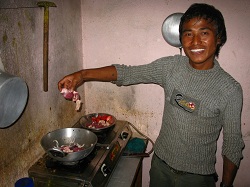
After introductions and small talk, preparations for the following day’s festival commenced – yak dung mixed with mud was applied to the outsides of the houses to make them look smart, and marigolds were picked to make flour garlands while Binod and I went fishing. Unfortunately, the only fish we managed to catch were small water snails known as ‘gunghi’, so we also went and bought a chicken which was quickly dispatched, prepared and cooked.
That night, despite my reservations, Binod and I were allocated the only bed in the house. Everyone else (all 12 of them including the grandmother and two newborn babies) had to make do with the floor.
As I was falling asleep, the women gathered together at the firepit and started cooking chapatis for the next day. I think I finally drifted off to sleep at about three o’clock with the smells of cooking and the gentle chatter of Nepali women floating around me.
The Bhai Tika Festival
The next day was the Bhai Tika Festival.
‘Bhai’ means ‘brother’ in Nepali, although not necessarily in a blood-relative sense.
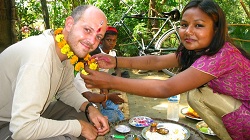
Each man took turns to sit on the floor as the woman selected to act as his sister for the ceremony said a few words while making a tika on our foreheads, placing a garland of flowers around our necks, and presenting us with a plate of food, a bottle of rakshi and some small gifts.
Over the next few hours the food was eaten, the rakshi drunk, and my golden rule about travelling was reaffirmed – go slowly and talk to as many people as you can, for it’s the people you remember long after you’ve left the place.
Paul Darlow manages Nepal Trekking Holidays, a travel blog dedicated to walking holidays in Nepal.
- If you’ve been inspired by his experiences, you may be interested in one of these Nepal travel guides and maps:
- > Nepal tear-resistant road map
- > Nepal: Schneider Trekking Maps
- > Lonely Planet Nepal
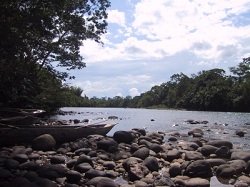 Lily Taylor writes about her four-day adventure down the Amazon. Her starting point was Leticia – the town where Columbia, Peru and Brazil come together.
 We’re delighted to welcome


 This is according to
 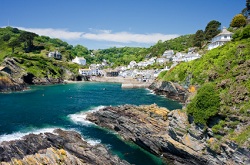 The 5.5-mile stretch of coast path between Looe and Polperro is one of Cornwall’s best-loved. Starting at the western end of Looe’s seafront, the route takes in Portnadler Bay’s National Trust-protected beach, the dramatic headland before Talland Bay and the picture-postcard views of Polperro.
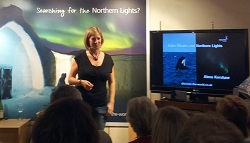 “Whales are found in all the world’s oceans, and about a quarter of the world’s species are found in the waters around Iceland and the UK,” Ms Kershaw said.
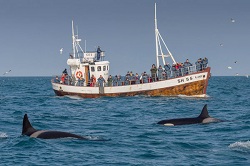 “Orcas are highly social creatures and they usually remain in the same family for life. Males tend to live for about 30 years and females as long as 50, though they can live much longer. Males grow to about 7.5 metres in length; females five, so they are pretty huge animals.