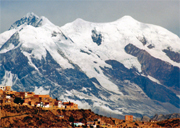
 I think I fell in love with Bolivia as I watched the bus I’d been travelling on from Peru being ferried across Lake Titicaca on what amounted to a glorified raft. Bolivia’s landscape may initially appear harsh and its people stand-offish, but a scratch beneath the surface soon reveals these impressions untrue and this landlocked Andean country inevitably weaves its spell.
La Paz provides a good jumping off point for any Bolivian adventure. Although its traffic-choked streets may not be to everyone’s tastes, the city has a real energy about it, with its bright buses, ever-insistent street vendors and lively nightlife (check out the Sopocachi district). Make sure you take the time to look skywards after nightfall, as La Paz’s altitude and relatively low light pollution from its ramshackle street lamps combine to give a spectacular view of the stars. A trip to see one of La Paz’s football teams is well worth the entry fee, if only to contrast your altitude sickness while climbing to take a seat with the frenetic fare on the pitch… easy to see why the beach-boy Brazilians fear their visits to Bolivia!
Moving away from the capital, my personal highlight was the now legendary bike ride on, “the world’s most dangerous road.” A short bus ride from La Paz plus a bit of strenuous high altitude cycling takes you up into the clouds at just under 5,000m; from here it’s only a few hours (and 70km) in the saddle to the subtropical climes of Coroico, dropping around 3,500m on the way and giving one of the biggest legal adrenaline rushes imaginable!
If you feel you can face a tortuous overnight bone-shaking bus ride from La Paz to Uyuni, accompanied predominantly by bags of poultry, you’ll be rewarded with arguably Latin America’s most captivating landscapes. The Bolivian Altiplano is a vast high altitude plateau dotted with technicolour lakes, surreal rock shapes, giant cacti and seemingly endless salt plains. Throw a few geysers, flamingoes, llamas and volcanoes into the mix and it can feel like you’ve arrived in another world.
Whether Bolivia is your sole destination, or part of a bigger South American journey, you can’t go far wrong with a Footprint South American Handbook and a Reise Know-How map to Bolivia. For reading material, try to pick up an old copy of the now out of print Bolivian Diary by Ernesto Che Guevara, which tells the story of his ill-fated guerilla campaign of the late ’60s.
Browse all our guide books and maps of Bolivia here >
Author: Dan Weston
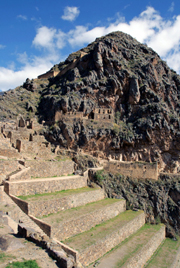 Images of Peru, more often than not Machu Picchu, adorn countless travel publications and newspaper supplements. Consequently, deepest darkest Peru has become readily accessible, and the track so well beaten that it can be difficult to get off of. Such popularity however, is not without good reason, and the jewels in Peru’s tourism crown live up their reputation spectacularly whether you want to climb them, or just walk around them in awe, mountain-junkies should head for Huaraz.
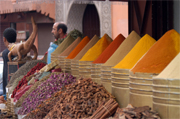 For those wanting a city break with a little more spice Marrakech is perfect. It is a vibrant, tantalizing blend of North African, Middle Eastern and European cultures which arouses all the senses. Stroll through the souqs to find craftsmen making traditional silver jewellery, ornate leather slippers and wooden toys. Then for the brave (and carnivorous) tourist, a visit to the traditional street tanneries to see animal skins drying in the scorching sun is a must (if you can stand the smell!).
 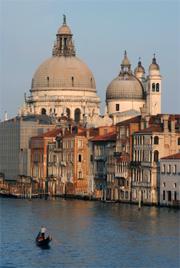 With the millions of tourists that flood Venice each year it is easy to think that all of its attractions are overwhelmed by the crowds, but even at high season it is surprising how few venture to some of the most rewarding sights.
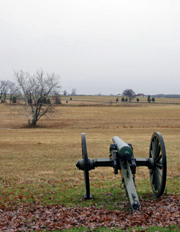 Our trip started in Toronto, Canada, and it was to be a two day car journey through New York State and Pennsylvania to the town of Gettysburg, just north of the Maryland border. The drive down takes you through some fantastic countryside including the Allegheny National Forest.
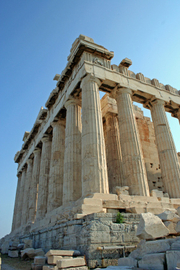 Athens has become the starting point for all of my visits to the Greek Islands. Although frequently castigated for its air pollution and congestion, there is something undeniably appealing about this bustling, vibrant city.
 Last summer I went to Brighton, with the wholesome intentions of going on many cultural expeditions and walking along the South Downs, saturating myself in the idyllic scenery. Unfortunately I was to find myself distracted by the allure of shots of toffee schnapps for a pound and the onset of liver failure.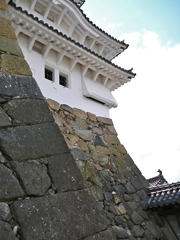
 As Beethoven once said, ‘When a man is tired of Khao San Road, he is tired of backpackers’, but the truth of this misses the point about the oft maligned and more oft frequented road in question, which is the first stop in Thailand for the majority of Western visitors.