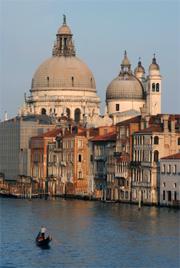
 With the millions of tourists that flood Venice each year it is easy to think that all of its attractions are overwhelmed by the crowds, but even at high season it is surprising how few venture to some of the most rewarding sights.
My personal favourites include the Scuola Grande di San Rocco for Tintoretto’s monumental series of paintings, including especially his Crocifissione; incredibly there were no more than half a dozen people there when we went in June. Likewise, there were very few who had sought out Bellini’s Madonna and Child in the Frari church, which in its original frame is one of the most luminous paintings in the city (also a favourite of Henry James).
We were lucky enough to catch a guided tour of the restored monastery at San Giorgio Maggiore (only on weekend mornings – check at the main tourist information centre in town), where we felt especially fortunate to see Palladio’s elegant cloister and refectory, as well as the stunning 128-metre long dormitory and the original library.
I am loath to recommend an excursion to the island and cathedral of Torcello, if only because the more people that go the less it will stay as we saw it: unspoiled and serene. We even stayed at the locanda to savour the peace and quiet. Don’t go!
My favourite guidebook was the Rough Guide to Venice & the Veneto – a great blend of background and detail. I think that the TCI Map of Venice is the best: it includes the outlying islands and most helpfully the vaporetto routes. I also recommend dipping into Henry James’ Italian Hours. His observations on tourists and the wonders of Venice remain remarkably true today.
- Browse our collection of maps, guides and travel literature:
- > Venice travel guides
- > Travel literature inspired by Venice
Author: Douglas Schatz
Douglas Schatz worked at Stanfords for more than 20 years, and was the company’s managing director until April 2009. He is now pursuing several exciting ideas in the world of books and digital publishing.