 Wyoming is big. Very big. It is actually damn huge. And empty. I was going to visit only the north-west corner of Wyoming, which is of course the world famous Yellowstone National Park. But to get there from Salt Lake City I was crossing all its length from south to north.
It is a long, lonely drive. Views on the way are less dramatic than in Utah as there are not so many impressive geological formations. It is rather gently rolling landscape, and settlements (it is difficult to really call them towns) are few and far between. In a way, that’s how I always imagined a road trip in the USA. And probably because of that I absolutely loved Wyoming. It was like being in a movie set. Wide, empty road, good music, big sky. Perfection. The only problem was that it all made me drive a little bit too fast. Fortunately the local sheriff was a nice guy, so I only got a polite warning. Apparently I was the fourth European tourist he stopped that day. It is probably something in those wild landscapes and open spaces which gives us some sort of hmm… freedom. I know, it sounds pathetic but I think that’s what it is. A bit of extra kick.
Eventually after an all-day drive I arrived in Jackson. It is a very unusual town. An urban (however small) oasis in a generally rural and conservative state, where mining and ranching are the main industries. Jackson felt more like a Californian town. In fact, quite a lot of its population are formed by ex-pats from either the west or east coast. And you can see and feel it. Nice coffee shops, galleries, outdoor shops, trendy boutiques and restaurants, all this makes you feel like you’re somewhere in northern California or Oregon.
But don’t be fooled. When you enter, for example, an outdoor shop, next to the sleeping bags you can find the gun section. And I mean the really big guns. As interesting as it is, Jackson will always be mainly a gateway to the two great national parks…

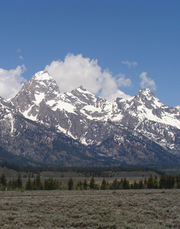
Grand Teton and Yellowstone. I entered Grand Teton on a glorious sunny morning. The most impressive feature of it is the Grand Teton Range. The steep rugged mountains, rising 7,000 feet straight from the flat valley floor, make an amazing and lasting impression. You can find pictures of them in virtually every guidebook, calendar or coffee-table book about the USA. And, to be honest, I understand why. I even took the same shots you can find in all these publications. I just couldn’t resist, even if I knew it lacked imagination.
The most popular attraction of the park is Jenny Lake. There is a nice and easy circular trail around it, but I hiked just part of it and then climbed a bit higher to one of the side valleys and to Inspiration Point. From there you can admire a great view of Jenny Lake and the entire Jackson valley. It was a very nice hike but at some point I had to go back. There was just too much snow to continue higher. If you are too lazy to hike around the lake, you can take the miniature ferry boat across it.

However spectacular, Grand Teton is just a small brother of the real big attraction – Yellowstone. Probably everyone knows something about it. Geysers, bison, waterfalls, they are all images we see when we think of Yellowstone. It is all true, but what struck me first was how big and wild it actually is. Grand Teton and Yellowstone border each other but driving between them involves a few hours to get to some sort of facilities. In the meantime I crossed the continental divide twice, saw the lake covered with ice (in June) and a lot of snow on the side of the road (some of the viewpoints were still closed due to snow banks).
There are plenty of accommodation options in the park – campgrounds, lodges, hotels, you name it. Being on a budget, I went for camping of course. Seeing all the snow at the higher elevations I opted for Madison Junction Campground which is one of the lower ones in Yellowstone but also conveniently located not too far from the major attractions like Geyser Basin and Canyon Area. It is a huge campground, with over 350 sites, but all nicely dispersed in the forest (which helps protect from the wind) and just yards from the Madison River. It didn’t feel crowded at all and you could even see wildlife just outside of your tent.
No, I didn’t see any bears but one evening there was small herd of bison roaming between the tents. You just have to be careful when going to the loo.

Unfortunately nights were cold. Even using a sleeping bag liner, which I bought after experiencing a cold night at Bryce NP, didn’t help much. So I was up and running fairly early in the morning. On the up-side, morning is the best time to see wildlife. This is the time when you can experience “the bison jams”. Bison simply walk on the road and you just have to patiently drive behind them. Or very slowly and carefully overtake them – possible when they decide to eat some grass on the side of the road.
On my first full day in Yellowstone I went to see the biggest attraction of the whole park – the geysers. Two-thirds of the world’s geysers are in Yellowstone and the biggest concentration of them is in the upper geyser basin where the famous Old Faithful is located. It is called Old Faithful because it erupts fairly regularly and the park service posts predicted eruption times at the visitor centre. It is also a real magnet for the crowds. Actually, crowds are probably an even better indicator of the coming eruption than the park service notices. If you see the crowd growing, with all the benches occupied, it means the eruption is coming. Sometimes it looks more like Oxford Street on a sale day than a national park. Fortunately there are plenty of geysers in walking distance from the Old Faithful. For some of them, park service also posts the predicted eruption times but they are not as reliable as the big daddy. Anyway if you have all day to explore the area you will probably see some spectacular eruptions without the crowds.
Apart from geysers there are plenty of other geothermal wonders. Hot springs, multicoloured thermal pools, mud volcanoes, it all creates very interesting landscapes. They are especially concentrated in a few areas inside the park which are called basins. Some of these basins look absolutely amazing, especially in the cold mornings when they are full of steam rising from thermal features. You can feel like you are on some alien planet.
But geology is not the only attraction in Yellowstone. There is also plenty of wildlife. I mentioned bison walking down the road or roaming between the tents. But that is only the tip of the iceberg (although very visible). There are also bears, elks, deer, wolves, plus many species of birds and smaller mammals. The best place to watch wildlife in the park is the world-famous Lamar Valley which is often called the American Serengeti due to the abundance of the big mammals. Some of the most famous residents are wolves reintroduced to Yellowstone a few years ago. And the biggest concentration of them is in the valley. It is in the northernmost part of the national park next to the Montana border.
Marches on the flat valley floor offer great grazing grounds for elk, bison and deer, and they are the main prey for wolves. Unfortunately, to see them one has to get up at about 3am and have good lenses or binoculars. Good knowledge of the local terrain and a lot of good luck helps as well. I didn’t have any of the above so I didn’t see wolves. But I did see even more bison plus some elks and deer. Now I can imagine how the American West looked before arrival of the white settlers.

The last part of Yellowstone where I spent some time was the area around the Canyon. It doesn’t offer geothermal attractions of the Old Faithful area and wildlife is far less common than in Lamar Valley but there is one spectacular site worth visiting: Yellowstone River Canyon. It is a deep, narrow, steep, v-shaped valley which the river cut through the soft volcanic rock. Adding to the attractiveness there are two impressive waterfalls (best in spring when snows are melting) and rocky canyon walls have spectacular bright colours (yellow, red, orange) which are created by minerals from the hot springs. It is definitely worth going down into the canyon using one of the short but steep trails which lead to the viewpoints just above or below the waterfalls.
Driving between different areas of the park involves crossing some very high mountain passes. Always check before visiting if all the roads you want to drive are open. Especially on the road from Lamar Valley to Canyon and from Grand Teton National Park to Old Faithful area, I have seen high snow banks on the side of the road even in mid-June. The first of these roads is also very steep and curvy. Think twice when you drive an RV. And if you want to camp, take a warmer sleeping bag than you think you need. You’ll need it.
Wyoming in general and Yellowstone region especially are well worth visiting. They offer some typical American experiences: the great outdoors, Wild West, cowboys, wildlife, open space and big skies.
I could say it is my favourite US region. But I would be lying. There is still the Pacific North West.
That’s where I was heading next. But more about that next time…
To read before you go I suggest the Moon Guide to Wyoming or if you just go to the national parks, the Moon Guide to Yellowstone and Grand Teton.
The best tool for navigation is the Wyoming Recreational & Road Atlaspublished by Benchmark, and for walking in the national parks the best maps are published by National Geographic. Author: Gregor Swiderek
- Browse our collection of maps, guides and travel literature:
- > USA travel guides
- > USA road maps and atlases
- > Travel literature inspired by the USA
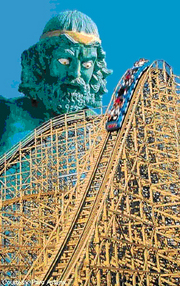 When you think Paris, you think romance. But Paris can also match with thrills in amusement parks. No, not with Disneyland Paris, but with the little-known Astérix Park.
 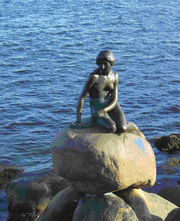 I was an Erasmus student in Denmark the first time I visited Copenhagen (Kobenhavn). I really didn’t know what to expect from the Danish capital, and I was astonished how great the city is. The town is renowned for its quietness and its environmental side, where the bicycle and the pedestrian are kings.
 The icon of Copenhagen is the The Little Mermaid statue (Den lille havfrue in Danish), an unimposing sculpture sitting on a rock in the harbour. We were a little disappointed to see it so small, as we all remembered fondly Andersen’s fairytale. The statue was created in 1913 by Eriksen who, it is said, used his wife as the model.
 Nearby Christiana, there is the Vor Frelsers Kirke, which is an eccentric but beautiful church.
 What better way to get a feel for the city and its different areas than to simply wander the streets? Places are closer to each other in London than the tube would have you think. There are many books to guide you around particular sights, or more vigorous treks across the city and its parks. Here are just a few ideas…
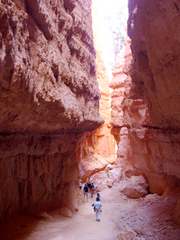 Utah is an amazing destination for people who like outdoor fun. But my recent trip there started in the urban jungle of the metropolitan Los Angeles. It is just much cheaper to fly there than anywhere in Utah itself.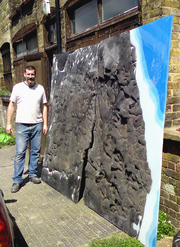
 be fixed and changed as necessary. He aimed to show as many natural features as he could fit in, but features had had to be exaggerated, as Ghana is quite flat, and at that scale, their tallest point would have been just 3mm high.