 I was an Erasmus student in Denmark the first time I visited Copenhagen (Kobenhavn). I really didn’t know what to expect from the Danish capital, and I was astonished how great the city is. The town is renowned for its quietness and its environmental side, where the bicycle and the pedestrian are kings.
We were a small group of friends so decided to take the cheapest option – stay in a hostel. But here we had to face the hard reality: even staying in a hostel is expensive in Denmark! However, the hostel was huge, comfortable and very clean. Even the view from our room was amazing; in fact we were on the fifteenth floor and had a wonderful view over Tivoli Park and the city centre. As the window ledge was very large, we even decided to take our breakfast on it to enjoy the view!
Our visit of the city started in Stroget with Rådshuspladsen (the city hall square), equivalent to Piccadilly Circus with all its illuminated signs. We then went along the pedestrian path bordered by restaurants, pubs and shops. It was very relaxing.
We then reached Nyhavn, the new harbour of Copenhagen characterised with its brightly coloured townhouses including the home of Hans Christian Andersen (author of The Little Mermaid). It is lined by numerous bars, cafés and restaurants.
Walking alongside the sea, we discovered the Amalienborg Palace (the winter home of the Danish royal family), consisting of four identical little palaces surrounding a plaza. But what captivated our attention was the imposing marble cathedral facing the Amalienborg Palace. Its dome is one of the highest in Europe.
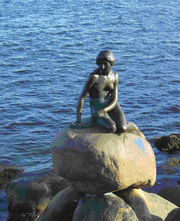
 The icon of Copenhagen is the The Little Mermaid statue (Den lille havfrue in Danish), an unimposing sculpture sitting on a rock in the harbour. We were a little disappointed to see it so small, as we all remembered fondly Andersen’s fairytale. The statue was created in 1913 by Eriksen who, it is said, used his wife as the model.
After all the conventional visits, we decided to reach the other part of Copenhagen, the popular borough of Christianshavn and its must-see Freetown Christiana. It is a self-proclaimed autonomous neighbourhood of about 850 residents and has been a source of controversy since its creation in a squatted military area in 1971. The people in Christiania have developed their own set of rules, their own school and even their own flag. The place is also famous for ‘Pusher Street’, where hash is sold openly. To be honest, I felt a bit uncomfortable to visit this place as if it was a touristic destination. It was still interesting to see how they try – or pretend – to live independently from the government. Houses are covered by colourful graffiti and by many signs indicating ‘No Photos’!
 Nearby Christiana, there is the Vor Frelsers Kirke, which is an eccentric but beautiful church.
Finally we went to the amazing Tivoli Park – including an amusement park, pleasure garden and a concert venue. Tivoli Park opened in 1843 and is the oldest amusement park in the world. You don’t really feel as if you were in an amusement park as Tivoli is home to a lake, ancient trees, fountains and gorgeous gardens. Tivoli Park includes numerous rides, such as a giant roller coaster. At night, the park is magic with all the colourful fairy lights and the Chinese lanterns; it is really worth a visit. It is said that even Michael Jackson (who performed there in the ‘90s) offered to buy it!
During the visit, I advise you to have the DK-Top 10 Copenhagen and Time Out Copenhagen.
Even if Copenhagen is not a big city, I still recommend taking a map such as the Copenhagen Popout city guide or a classic one – Freytag & Berndt- Copenhagen.
Browse our collection of Copenhagen Maps and Guide books here >
Author: Violaine Sabot