Montevideo: A Cultural Guide

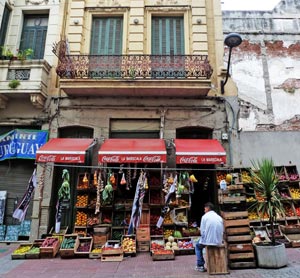
Montevideo fruit shop

In the first of a three-part series on Montevideo, Rachel Ricks looks at the Uruguayan capital’s cultural offerings.

Montevideo is the 2013 Ibero-American Capital of Culture, and I reckon it’s about time this unassuming city got some attention. I’ve been here for five weeks now and I’ve noticed a real buzz in the air. A year of free activities and events opened on Friday 11th January with a night of four free concerts happening at different locations round the city. I opted to see Molotov – a Grammy Award-winning Mexican band that’s been highly popular in Latin America for more than 20 years. The stage was set up on a large seafront area and hundreds of people streamed in from all over the city to take advantage of this concert. The bass player announced that he was very happy to be here, because not only was today his birthday but this was the band’s first concert of 2013. They played to an enthusiastic crowd for nearly two hours – pretty good for a free gig, and what a great start to an exciting year for Montevideo.

What else is happening this year?

The city will see lots of events, markets and shows cropping up throughout the year. I came across an artisans’ market lining the seafront Ramblas at Punta Trouville, in the Pocitos neighbourhood, with stalls of lovely locally-made arts and crafts, a small stage with bands and an interesting photography exhibition of Pocitos in the early 20th century.
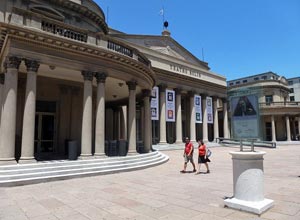
Teatro Solis Montevideo

Teatro Solis on Plaza Independencia is the most prestigious theatre in the country and has a varied programme of opera, plays and dances, particularly for 2013. This year’s highlights include Shakespeare’s The Tempest, led by British director Declan Donnellan; Cuarteto, a theatrical work by Heiner Müller; and The Met: Live in HD – a series of 12 operas transmitted live from New York, starting with Rigoletto by Verdi in February. You can also take a fascinating guided tour behind the scenes of the theatre.

And of course, every year from the end of January you can catch the city’s Carnaval that runs for no less than 40 days – the longest celebration of its type in South America. Free workshops, performances and parades fill the city’s streets in these weeks. From my hostel, I can hear the practising for the drums – the llamadas (calls) every night. Check out this year’s programme on the city government’s website.

A walk through the culture and sights of Montevideo

The Ciudad Vieja (Old Town) is the area to head if history and culture are what you’re after in Montevideo. This area of the city maintains many colonial buildings, some of which house quirky little museums.
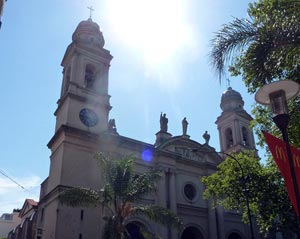
Cathedral Montevideo

The Plaza de la Constitucion is the oldest in Uruguay, built in 1726, and is home to the Catedral Metropolitana – one of the most attractive cathedrals I’ve stepped in to. On the other side of the plaza is the Cabildo, once both the town hall and prison, where you can wander the ground floor which now holds small exhibitions. Of particular interest for me were the black-and-white photos of Montevideo in the 1800s to the 1930s.

Running through the centre of the Old Town is Sarandi – an attractive pedestrianised street lined with cafés and interesting shops. Follow this down to Perez Castellano and turn right to continue along this pedestrianised street with old-fashioned fruit and veg shops, down towards the port.

The Port Market building was designed like a Victorian British railway station with an elegant glass roof and a clock in the centre of it. It is full of parradillas or asados – the type of grills that Uruguay is famous for, piled high with every kind of meat, and where you can join locals and tourists alike sat round the bar tucking in to mouth-watering meals.

For more, look out for my 11 quirky sights of Montevideo – and for more on where to eat and drink, my Montevideo café guide – both coming soon.

Where to stay

Budget travellers beware – Montevideo is not cheap. Even the hostels charge US$50 for a room.  Your best bet is Planet Hostel (Canelones 1095), where dorms are 320 Uruguayan pesos (£10.50) a night.
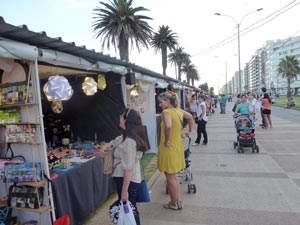
Artisans market Montevideo

If you’re after a private room, you’re better to walk into any of the one-star hotels in the blocks either side of Avenida 18 de Julio. I opted for Hotel Ideal (Colonia 914) where a private double with shared bathroom was 650 Uruguayan pesos (£21) – the best deal I found – and I enquired in many. Don’t be put off by the one star – the hotel, although a little old and tired in places, did a better job than any hostel – the incredibly friendly and helpful staff insisted on giving fresh towels, soap and linen every day and I even had cable TV and an elegant balcony.

If your budget stretches further, there are also plenty of two-star-plus hotels in this area, while plusher hotels sit along the Ramblas facing the Atlantic Ocean.

How to get around

Montevideo is perfectly walkable. The main sights are close to each other, and the streets are safe and pleasant to stroll around. The bus network is simple to use too, with locals more than ready to help out.

Getting there

There is an international airport, but flights to Montevideo do not come cheap. Most people travel by road down from Brazil, or across from Buenos Aires in Argentina. I did the latter – for this, take the ferry (two to four hours journey time, depending on boat service) to Colonia in Uruguay where you transfer to a bus to Montevideo (2.5 hours). Prices vary according to your chosen route, boat service and whether you include the bus – the companies offer boat + bus packages – see Colonia Express and BuqueBus.

All prices and conversions were correct at time of my visit in Dec 2012 – Jan 2013.

You can read more about Rachel’s travels on her blog.

> Marvel at Montevideo’s culture with our range of travel guides and maps.

All photos © Rachel Ricks
His and Hers Guide to the Globe – Part 3: Siem Reap

Matt and Sharon Ward in Cambodia

Our round-the-world couple Matt and Sharon Ward have spent the next stage of their journey exploring the delights of Siem Reap in Cambodia. Here’s what they had to say about the world-famous Angkor region from a his and hers perspective…

A very early flight took us to Siem Reap in Cambodia, where we were surprised at how nice the small, modern airport was with its beautifully-landscaped grounds. You need $20 each and a passport photo to purchase your travel visa – ours were processed via a handful of officials who sat in a line, stamping and passing them onto the next official: a seamless and efficient process. A quick taxi journey took us to the Bun Nath Guesthouse, which was our first accommodation away from friends and the big city lifestyle.

Matt’s ‘His Guide’

After a quick power nap due to our 3am start, we ventured out to take in our new surroundings. Siem Reap has a long main street and many side streets off it with shops, bars and restaurants. I wasn’t too sure what to make of it at first, but as before I was prepared to give it a chance. We arranged our tuk-tuk driver through our guesthouse rather than going with the pushy airport driver. Mr Dano was polite and happy to drive us around for our stay and at a very good price ($15 per day).

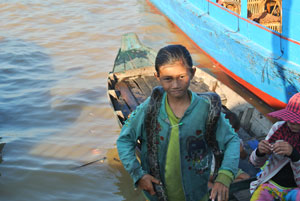
First off we headed towards Tonle Sap Lake, which involved a relaxing but occasionally bumpy 40-minute ride. Here we purchased tickets for a one-hour boat trip, which saw us take in the Floating Village & Crocodile Farm. This was a real eye opener for me with the sight of children begging with snakes wrapped around their necks, infants in tin bowls sailing the filthy river and people asking for help at every turn. There were hardly any adults to be seen – our guide mentioned that a lot of parents never returned alive from fishing trips. The tuk-tuk ride back to the guesthouse was a quiet one as I tried to make sense of what we had just witnessed. I felt very humbled and fortunate with the childhood I had.

That night we took a walk down to Pub Street, which is the main hub for food and drinks. We experienced our first power cut as we sat patiently in the dark awaiting our meal at Tigre De Papier – unfortunately, my chicken in basil with rice wasn’t worth the wait. From here we stopped off at a rooftop bar called Purple Mangosteen, a great place to take a few night-time pictures of the busy streets, before finishing off our first day at the Night Market.

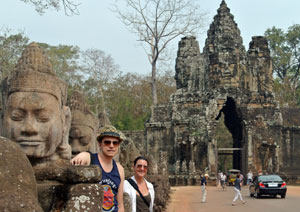
The following morning we had a 5:30am pickup taking us to Angkor Wat for sunrise. For $20 each we made our way in darkness towards the temple. A massive crowd had started to form, which felt a bit like a rock concert with fans eagerly awaiting the headline act to enter the stage. As the sun began to rise the temples looked stunning as they took on many different forms. This is something I would definitely recommend seeing. We spent about three hours walking around the temple before jumping back into our tuk-tuk and making the short trip to Angkor Thom. By late morning we were hungry, tired and a bit ‘templed out’, so decided to head back and grab some food and rest.

Angkor Wat

That night we popped into the Cambodian Soup Restaurant to try the Khmer Curry. With poor service, dirty tables and miserable staff, we quickly moved next door to the Khmer Family Restaurant for a curry and a few Angkor Beers with the bill coming to a whopping $9!

For our final day we decided to have a lie in before venturing out to the Red Piano for breakfast and coffees (our guesthouse didn’t provide meals). We popped into a bookstore and picked up a few books on the Khmer Rouge Regime and Cambodia’s struggles as neither of us remembered being taught this at school. From here we took in the Royal Residence and National Museum, which for me was slightly overpriced at $12, as was the café inside.

As a whole, I felt that Siem Reap really came to life at night with the overhead neon street lights, busy night markets and a packed Pub Street. Our informative day tours also contributed towards a thoroughly enjoyable trip and one that I’d recommend to anyone.

Sharon’s ‘Her Guide’

From outside the terminal building we easily picked up a taxi. Our driver was very friendly but tried desperately to get us to book him for tours. Matt was having none of it, but I eventually gave in, as I was feeling both tired and a little vulnerable. We agreed with him to pick us up at 3.30pm for our first tour. When we arrived at our guesthouse, we realised its tuk-tuk driver was in fact $2 cheaper ($8), so we arranged for him to pick us up at 3pm, avoiding the airport taxi driver. When we got to our room I immediately noticed a rancid smell; Matt having no sense of smell was oblivious to it. I made my way out to the balcony and below our room appeared to be an open sewer. We had already been told that we were moving to another room in the morning, so I just put up with it.

Our tuk-tuk driver called Mr Dano picked us up for our Floating Village tour. This is when we got to experience the real Cambodia. There were huts at the side of a dirt track road built up on sticks, children running around in the middle of the road and although they appeared to be living in real poverty, they all looked very happy. The Floating Village tour cost $20 each and we are taken by boat along the river, with houses, schools, shops and even a basketball court floating around us. From there, we were then taken to a Crocodile Farm, where we witnessed some of the children selling photos of themselves with snakes round their necks for a dollar. The journey back to the guesthouse was subdued as we both sat reflecting on what we had seen, and for me I realised how lucky I actually am.

Cambodia snake

That evening we made our way to Pub Street and noticed how the city had suddenly come to life. The streets were lit with neon lights and the night markets were a hive of activity.  We ate in Tigre De Papier, which seemed a little grubby with mosquitoes buzzing around us.  We then tried our hand at some haggling at the night market. I wasn’t quite sure if I came away with a bargain or not, but I did leave with two very nice sarongs for $10.

The next day we got picked up by Mr Dano at 5:30am to see the sunrise over Angkor Wat, which cost us $20 each for the full day. We stood patiently with the rest of the gathering crowds and watched the silhouette of Angkor Wat gradually paint itself out as the dawn broke behind it. We spent several hours walking around trying to find Angkor Thom from the map, when we eventually realised that it’s a lot further away. We made our way back to Mr Dano, who was waving and smiling at us and ready to take us to wherever we want to go next. By 11:30am we are both hungry and exhausted.  We decided to head back for lunch at the Blue Pumpkin and then get our heads down for a couple of hours.

That evening we had a refreshing cold shower which was not through choice, unfortunately I had (accidentally) booked our rooms without hot water, which easily explains why the rooms were only £3 each a night. We made our way down to Pub Street for some dinner. The first place we tried was the Cambodia Soup Restaurant.  We were rudely pointed towards a table, menus thrown down at us. One glance at the unclean table, flies and mosquitoes buzzing around us, and we walked out. Next door was the Khmer Family Restaurant where we were greeted with a welcoming smile, taken to a clean table and gracefully handed our menus. We both had the Khmer curry and beers. Although lacking a little in chicken it was tasty and I enjoyed it.

On our final day we enjoyed a long lie before heading out for breakfast at the Red Piano. We came across a bookstore where we both bought books on Cambodia. We spent the rest of the morning walking through the Royal Residence and National Museum. At $12 each, I thought it was over priced; though modern, small and easy to get around.  It was mainly based around the temples and Buddhism, but there wasn’t much else on the history of Cambodia, nor anything about the Khmer Rouge Regime.

I really enjoyed my time in Siem Reap. I felt safe and loved the idea of Pub Street. The night markets were just fantastic for bargains and there were foot massages available everywhere for something crazy like a dollar. My only regret was not stopping for a foot massage while I had the chance.

> Cover more of Cambodia with our collection of travel guides and maps.

Chicago: Top 10 Things to Do

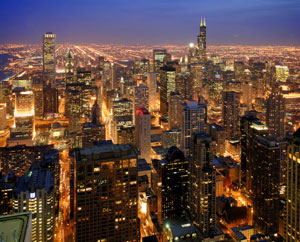
Chicago skyline

Chicagoan Molly Loeffler takes an in-depth look at her home city to reveal her Chicago top 10

Frank Sinatra got it right when he said Chicago was “My kind of town”. I have lived here for 20 years and truly love Illinois’ largest city – one that’s big to tackle but easy to manoeuvre thanks to buses, cabs, water taxies, free trolleys, and the infamous L – our elevated rail system. If you’re planning a visit here but aren’t sure where to visit, here’s my Chicago top 10:

1. Michigan Avenue

Busy yes, but here it’s definitely worth fighting the crowds. Michigan Avenue’s northern section is known as the Magnificent Mile (Mag Mile among locals) and is filled with high-end shops, popular department stores and wonderful restaurants. One shopping highlight is Water Tower Place – an eight-story shopping mall that’s home to Foodlife, an ‘eating experience’ featuring legendary Chicago restaurants.

Also at the northern end is the Water Tower – one of the few surviving buildings of the Great Chicago Fire of 1871. Follow the Mag Mile further north and you’ll hit Lake Michigan and Oak Street Beach – in the spring it’s lovely to walk the paths along the lakefront and enjoy the picturesque views. When things hot up in the summer you can lie in the sand, play beach volleyball, and, if the water’s warm enough, take a dip.

> Mosey on down to Michigan Avenue with Chicago Map Guide.

2. Millennium and Grant Park

After a day’s shopping it’s time to visit Michigan Avenue’s southern section and Millennium Park. A major tourist spot it might be, but locals still love it here. Jay Pritzker Pavilion is the first thing you’ll notice en route to Millennium Park – a gorgeous steel band shell with 4,000 fixed seats and a large lawn accommodating 7,000 more. During the spring and summer, the pavilion hosts many concerts, performances and events such as free yoga on the lawn.

Another Millennium Park must is the Cloudgate sculpture, known to Chicagoans as ‘the Bean’. A three-story steel structure with a highly-polished exterior, it gives stunning reflections of the skyline and the Chicago cityscape. Walk down the stairs from the Bean towards McCorkmick Tribune Plaza and the Plaza at Park Grill. In the warmer months you can eat outside on the plaza, while in winter there’s an ice skating rink regarded as among Chicago’s best people-watching spots. When it’s time to get away from the park’s crowds, stroll through Lurie Garden – home to the world’s largest green roof.

Next to the pavilion is the Pedestrian Bridge that crosses over Columbus Drive and ends at Grant Park – the perfect way to walk from Millennium Park to Grant Park, aka ‘Chicago’s front lawn’. This 319-acre park is greener than Millennium Park and hosts many concerts and events, including Taste of Chicago and the Lollapalooza music festival. At Grant Park’s centre is Buckingham Fountain – a Chicago icon and one of the largest fountains in the world.

> Gravitate to Grant Park with Red Maps’ Chicago.

Sears Tower

3. Willis Tower (or Sears Tower, as it’s better known)

Willis Group holdings purchased the naming rights to the Sears Tower in 2009, but away from corporate bigwigs no-one calls it by its official name. This 108-story skyscraper is the tallest building in the US (though it may be surpassed by New York’s One World Trade Center later this year) and a huge Chicago attraction – visitors should take the 60-second lift ride to the Skydeck and bask in the views of Illinois (and on a clear day, Michigan, Wisconsin, and Indiana). A new Skydeck feature is the retractable glass balcony boxes, allowing people to look down 108 stories at the streets of Chicago.

> Walk to Willis Tower with Hello Chicago.

4. Museums

Take your pick! The Art Institute of Chicago is the second-largest art museum in the US with more than 260,000 exhibits, including the likes of Monet, Renoir, Grant Wood, Edward Hopper and Matisse. Also recommended is the Museum Campus – home to the Field Museum of Natural History, Adler Planetarium and the Shedd Aquarium. Here visitors will see everything from Sue, the largest and most complete Tyrannosaurus Rex skeleton, to the stars and planets, and, if they so desire, an exhibition on jelly fish. Another institution worth visiting is the Museum of Science and Industry, where the many interesting and interactive exhibits make for a fun afternoon.

> Meander to the museums with MapEasy’s Chicago.

5. Lincoln Park Zoo

This is a fun (and best of all, free) attraction in the Lincoln Park neighbourhood of Chicago. It is One of the oldest zoos in the US, Lincoln Park is home to a wide variety of animals – and best of all, it doesn’t cost a dime to get in!

> Be led to Lincoln Park Zoo with the National Geographic Chicago map.

6. True Chicago Food

It’s a must for visitors to eat the food Chicago is famous for. Fancy a deep dish pizza? Head to Lou Malnati’s or Gino’s East. For a famous Chicago hot dog, go to Portillos or Superdawg – just don’t ask for ketchup. Want a good Italian beef sandwich? Al’s Beef, which does the best beef sandwich in Chicago, has it covered. If you head to the branch on Taylor Street, cross the street after your sandwich for some Mario’s Italian Lemonade – only open in the spring and summer, this little shack has the best lemon ice in the city./p>

One of Chicago’s most famous food attractions is Garrett’s Popcorn. A line may form outside each of its branches, but the popcorn is definitely worth the wait. You can order cheese, caramel, butter and many other flavours, but the most popular item on the menu is the Chicago Mix – a combination of cheese and caramel flavours.

> Roam to Chicago’s restaurants with the Chicago Eyewitness Guide.

7. Navy Pier

This 1,010 m-long pier alongside Lake Michigan was once a navy training centre, but it’s now home to many attractions, shops and restaurants. Travelling with children? Take them to the award-winning Chicago Children’s Museum right at the pier’s entrance. They’ll also enjoy the Navy Pier Ferris Wheel, which runs year-round, weather permitting. During the summer, Navy Pier hosts a fireworks show every Wednesday and Saturday night – watch them from the pier or a boat on the lake!

> Navigate to Navy Pier with Frommer’s Chicago: Free and Dirt Cheap.

8. Wrigleyville and Lincoln Park

If downtown is a little busy, take the ‘L’ out to one of the outer neighbourhoods. Two of my favourite are Wrigleyville and Lincoln Park – both on the north side. Wrigleyville surrounds the famous Wrigley Field, home of the Chicago Cubs baseball team. In the summer when the Cubs are playing, the streets are packed with people going to the game or to a nearby bar like the famous Cubby Bear to watch. On non-matchdays, Wrigleyville is a fun place at night with lots of bars and clubs.

Lincoln Park is another great neighbourhood and the home of Lincoln Park Zoo. It’s filled with many nice shops and delicious restaurants, as well as a great nightlife scene thanks to the plethora of bars here. If you’re paying a visit, I highly suggest going to CBA: Chicago Bagel Authority for breakfast or lunch. This quirky stop has just about every combination of sandwich toppings on a freshly-steamed bagel.

> Walk to Wrigleyville with Lonely Planet’s Chicago City Guide.

9. Shows and theatres

Chicago is always hosting different musicals and plays as well as concerts and comedians. Heading to an event can make for a very fun night and tickets are fairly easy to purchase. My favourite part is the theatres themselves – Chicago is home to many gorgeous old theatres dating back to the early 20th century. Among my favourite are The Chicago Theatre, Ford Centre for the Performing Arts also known as The Oriental Theatre, Bank of America Theatre, and The Cadillac Palace Theatre. All have gorgeous interiors and make the price of a ticket well worth it.

> See a show with the Chicago Wallpaper City Guide.

10. Second City

To understand the sense of humour of Chicagoans, a show at Second City is the thing to do, with this city specialising in sketch comedy and improv. Many hilarious actors and comedians have been discovered at Second City such as Tina Fey, Chris Farley, Steve Carell, Amy Poehler, Mike Myers, Stephen Colbert, Bonnie Hunt and many others.

> Catch up on Chicagoan culture with Chicago Culture Shock.

A Geek's Day Out in NYC

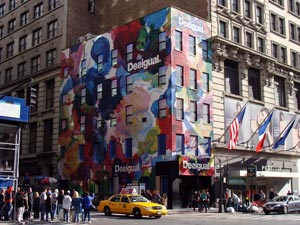
NYC street

Gregor Swiderek travelled to New York City five years after his maiden visit, and while he didn’t fall in love with the Big Apple first time around, he found the city’s charms irresistible on his return.

I recently returned to New York almost exactly five years after my first visit. By coincidence I entered the city in precisely same way as the first, driving Interstate 95 from New Jersey across the George Washington Bridge and following Henry Hudson Parkway south towards Midtown Manhattan. It really gave me a strange feeling of deja vu.

The big difference from the first trip was that back then I didn’t really know what to do or see – despite so many things to do in NYC, I simply followed a random path across the city, while now I had a list of attractions I really wanted to visit. Continue reading A Geek's Day Out in NYC

His and Hers Guide to the Globe – Part 2: Kuala Lumpur

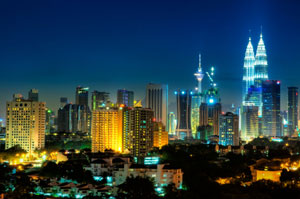
Kuala Lumpur skyline

Round-the-world adventurers Matt and Sharon Ward have been busy exploring Kuala Lumpur from a his and hers perspective. Here’s what they had to say about the Malaysian capital…

We were keen to try the train from Singapore to Kuala Lumpur so we could take in some of the countryside. Strangely enough, it worked out cheaper for us to fly the 45-minute journey at a total of £57, rather than £34 each by train. With the airport only 15 minutes away by bus, and being on a tight budget, we decided to fly to the Malaysian capital. On arrival, we were looking forward to free digs thanks to one of Sharon’s KL-based friends. Continue reading His and Hers Guide to the Globe – Part 2: Kuala Lumpur

Christchurch: Top 5 Tips

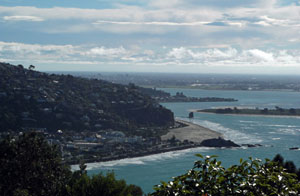
Christchurch coast

After experiencing Christchurch‘s earthquake first-hand in 2011, Chloe McInnes, who spent two years living and working in New Zealand, uncovers a rebuilt city that’s beginning to welcome back visitors.

Whenever I mention living in Christchurch, the most commonly-asked questions are “Wasn’t there an earthquake there?” and “Was it scary?” Well, yes, and (obviously) yes. And I’m beginning to find this discouraging, because it’s almost two years since the quake, and the people of Christchurch have worked tirelessly to rebuild the city and its surrounding suburbs.

Continue reading Christchurch: Top 5 Tips

Kolkata: The Nostalgic Indian Megacity

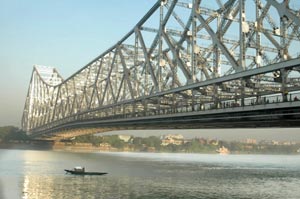
Howrah Bridge Calcutta

Travel blogger Aditya Akhauri explains the appeal of Kolkata, a city he believes is defined by its appetite for nostalgia.

Every Indian metropolis has its own distinct character. The style and pace of Mumbai, the sights and smells of all-powerful Delhi, the culture and traditionalist attitude of Chennai and the nostalgia that is the very air of Kolkata. Yes, nostalgia is what makes Kolkata great.

It is a city of the past, where the old meets the new, but unlike other places it’s the old that’s powerful. Things change slowly in Kolkata. One can see the remnants of the British Raj everywhere in the city – from the trams that crawl the streets like giant rats to the architecture in the old quarters, everything strikes of modern Indian history.

Kolkata – perhaps still better known as Calcutta – is the only Indian metropolis where the ideologies of Marx are still taken seriously and beyond textbooks. In fact, the hundreds of closed factories on the Howrah side of the city are testament to its relationship with socialism. Political graffiti, monuments and heritage buildings coupled with the fact that all the city’s landmarks were constructed during the Raj make this the ultimate place to experience the history of colonialism and Kolkata’s fraught relationship with it, one that pushed the city into the arms of Marxism.

Kolkata’s culture is perhaps its most vibrant attribute. It has its uniqueness still intact. Here, folk still take pride in selecting a fish from the bazaar rather than buying from a supermarket, which is fast becoming the trend elsewhere. It is a city of people who are as yet undaunted by the modern emphasis on looks and adhere to the view that what matters is what’s in your head. In Kolkata people like to take things slowly – they don’t chase money with the madness of Delhi nor are they in a perpetual rush like the hordes of Mumbai. Office lunch hours are often an extended affair (indeed, cab drivers working the commercial areas often refuse passengers during lunch) and evenings are spent on tea stalls chatting with neighbours. Perhaps no other metropolis in the world has such a leisurely pace of life – be it rich or poor, seemingly everybody indulges in keeping things slow.

As the strides of capitalism try to shake things up, Kolkata as we know it is changing. The pace of life is picking up and many things are no longer as they were. Marxist parties have given way to pseudo capitalism and high rises are cropping up – structures that are fast becoming new landmarks. Old mansions adorned with dates like 1821 or 1835 are crumbling and people are finding it increasingly difficult to find time to sit down and chat. There is a struggle that is going on; one that will change the city forever.

Perhaps today we are in a position to see the city in all its historical glory for the last time. It is changing and straddles a precarious position between the new and the old. What paths it will take no-one knows. What we do know is that all Kolkata’s fans are praying that some things don’t change – the awesome cuisine, the warmth of the people, the beautiful buildings from the colonial era and its deep affection for past – arguably this Indian megacity’s defining attribute.

Ahmedabad-based travel writer Aditya Akhauri writes for the Lonelyronin blog.

> Discover more of Kolkata with our range of travel guides and maps.

An Adventure in Bolivia's Salt and Sand Deserts

Rachel Ricks UyuniRachel Ricks travels to south-west Bolivia to take in Salar de Uyuni – at 4,086 sq mi, the world’s largest salt flat.

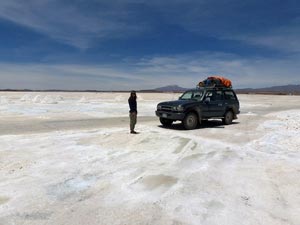
I strode out into the abyss of white. The ground was snow white as far as the eye could see in every direction. Silhouettes of mountains hovered in the far horizons, but otherwise nothing interrupted the white. I kept walking until the last voice of a tourist had faded out. I sat down on the ground and stared out across the salt flats of Uyuni. Then the silence hit my ears so hard they began to ring. I picked up a pinch of salt and let it crumble through my fingers. I could hear every grain hit the ground.

This surreal and stunning experience was just the beginning of a three-day tour I took in a 4×4 jeep from Uyuni in south-west Bolivia through to the border of Chile.

We’d booked the tour in La Paz after asking round several different agencies to get an idea of the price and what sort of service to expect. We also chose to fly from La Paz to Uyuni after hearing nightmare tales of the overnight bus journey. The flight with TAM (the Bolivian air force which operates commercial flights) was reasonably cheap, pleasant and efficient, and had the added bonus of offering spectacular views over the salt flats from the air.

Our flight arrived in Uyuni at 8:30 in the morning, so we were able to book onto a tour that started that day – most set off at around 10:30-11am.

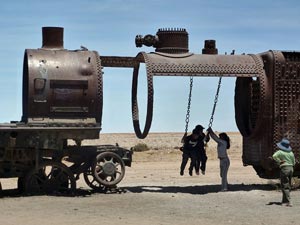
Uyuni train cemeteryWe joined the jeep with our companions for the next couple of days – a German father and daughter, two Israeli girls and Luis, our driver/guide/chef. First stop was the ‘train cemetery’ just outside of town, where engines that once ran through to Chile have been left to rust after the days of silver and mineral mining in the region ended. Now a bizarre tourist attraction-cum-playground for local kids, I wasn’t quite sure what the appeal was.

After that, the tour began in earnest – until we pulled up 10 minutes later at a row of souvenir and ‘handicraft’ shops where we were given more time than any site we visited on the whole trip. I didn’t even get out of the car to look at the same alpaca jumpers and flappy hats I’d seen for the past three months in Peru.

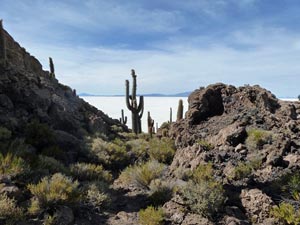
Luckily it wasn’t far from here until we hit the salt flats. Luis stopped for two photo opportunities before roaring us onwards to the Isla Incahuasi – literally an island of rocks and cactuses in the middle of the salt flats. Here, we along with 20 or so other jeep tours parked up for lunch.

Isla IncahuasiLuis brought us plates of llama meat, rice and salad. Afterwards, we clambered along a signposted path over the rocks to the summit of the island where everyone gathered to take photos. Carlos and I veered off from the masses and the signposted path, instead descending a much more exciting-looking side of the island to the salty ‘beach’, where we were at last alone and took our photographs.

Luis was waiting impatiently for us by the car when we returned, and this was how it continued for the next two days – we didn’t realise until afterwards that the drivers have a system of leaving in order so they constantly have two other cars in their sight. You wouldn’t want to be stuck alone out here considering the distance we travelled from civilisation, and there is certainly no chance of phone reception.

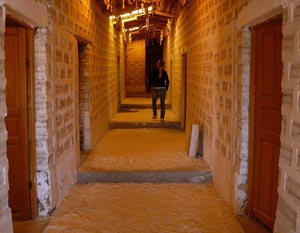
We drove for a good couple of hours over the salt flats until Luis told us to say adios to the salar, and suddenly we were driving along a desert road instead to shortly pull up to our hostel for the night – built entirely of salt. The walls were constructed of salt bricks, the beds, tables and chairs were all made of large blocks of salt, the floor was granules of salt, and even the lights were decorated with salt chandeliers. I found it interesting that there was no salt on the table for dinner.

Salt HotelBefore dinner was served, I went for a stroll along the sandy road. I turned a bend round a mountain and saw it had hand-painted signposts pointing out a trail up its rocky side, so I followed it up and discovered a petrified sea of corals and large cactuses. I stopped on the rocks to watch a beautiful glowing sunset over the never-ending desert landscape.

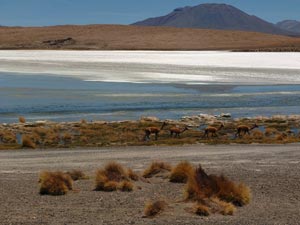
The next day Luis got us up at the crack of dawn to set off on a long morning of driving through vast deserts with volcanoes looming in the distance. By lunchtime we reached the first of several flamingo-filled lakes of the Eduardo Avaroa Andean Nature Reserve. As we drove off, a herd of vicuñas ran in front of the car and down to the lakeshore, making yet another impossibly stunning picture.

I was left astounded by this otherworldly scenery with these ethereal lagoons thousands of feet above sea level and miles from anywhere, with the only signs of life being the graceful vicuñas and the pink flamingos. I thought I’d seen all the different landscapes our planet has to offer, but here I kept being surprised. Luis rounded this long day off with a stop by the immense Red Lake – so called as unique micro-organisms that thrive here rise up towards the sunlight during the day, turning the water crimson.

VicunasThat night we stayed in a basic hostel in the middle of nowhere again, to rise even earlier the next morning in the freezing cold to go and see some steaming geysers at their best. Seeing these jets of steam in front of the rising sun was indeed worth getting up in the dark with teeth chattering.

Luis rewarded us with a stop at thermal baths, formed by the side of the volcanic Lake Challviri, where we gladly wallowed in the warmth for a while.

Carlos and I were to be dropped off at the border to cross into Chile, so there was a quick stop at a green lake this time before we drove on. The border post is just a simple house in the middle of the desert where the tour jeeps drop off or pick up travellers exchanging with Chilean mini-buses. As we drove off down the road into Chile, I turned round for a last glimpse of Bolivia and spotted an ancient burnt-out bus abandoned in the desert. As beautiful as it had all been, somehow I couldn’t wait to get to Chile.

How to do it

Shop around tour agencies in La Paz, Tupiza or Uyuni for prices and get a feel of what they’re offering. As far as we could see, all follow the same route, stay in the same types of accommodation and serve the same meals (we were always joined by at least six other groups), so don’t be so sure that paying more means you get more. The drivers are mostly freelance and simply booked up by agencies as the tourists come.

I paid Bs.720 for my tour with El Desierto, booked through El Solario Travel Agency in La Paz. I could complain about certain aspects of the tour, but I won’t bother because it was all pretty good for the price and for Bolivia.

The basics you should expect for 700-800 bolivianos (Bs.):

A driver/guide/chef who most likely will be Spanish-speaking only; a 4×4 jeep in decent working order, normally accommodating six tourists – your backpacks can be taken on the roof if you’re going on to Chile. Extra costs to expect include entrance to the island on the salt lake (Bs.35) and the nature reserve (Bs.150, although this was being reassessed at the time of my visit). You should be advised on these by your tour agency.

Day one

  • Tour starts at 10:30/11am.
  • Visit train cemetery. 
  • Drive across Salar de Uyuni, taking in old Salt Hotel, now museum, and the island for a walk. 
  • Lunch (cold meat, rice or pasta and salad, fruit, cold drinks). 
  • Tea and biscuits. 
  • Dinner (soup, meat and rice, fruit, water). 
  • Night’s accommodation in dormitory in salt-built hostel (expect solar or generator-powered electricity and to pay extra for a hot shower).

Day two

  • An early rise for breakfast (cereal, yoghurt, tea/coffee, bread).
  • Driving all day with stops at various scenic points including Ollague Volcano, rock formations in the desert and flamingo lakes and the Red Lake in the Eduardo Avaroa Andean Nature Reserve (expect to pay as extra the park’s entrance fee). 
  • Lunch (similar as before). 
  • Dinner (similar as before). 
  • Night’s accommodation in dormitory in basic hostel (again expect solar power and to pay extra for a hot shower).

Day three

  • Breakfast (as before).
  • Early rise to visit geysers. 
  • Green Lake. 
  • Thermal baths.
  • Drive back to Uyuni, or if transferring to Chile you will be dropped off at the border and shown your connection with a mini-bus to San Pedro de Atacama in Chile. 

NB – If taking the latter option, you will pay when you book the tour an additional Bs.50 for the transfer. You get your stamp for Bolivia here, while the Chilean immigration office is some 40 minutes’ drive away on the outskirts of San Pedro de Atacama. Try and ensure your driver gets you to the Bolivian border post early to be prudent; there have also been reports of Bolivian border staff charging unknowing tourists unsolicited fees.

All details and prices I provide here were correct at the time of my visit in late November 2012.

You can read more about Rachel’s travels on her blog.

> Discover the best of Bolivia with our range of travel guides and maps.

All photos © Rachel Ricks 2012
His and Hers Guide to the Globe – Part 1: Singapore

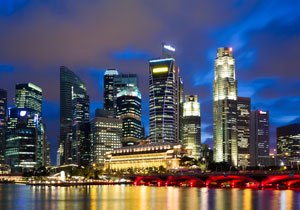
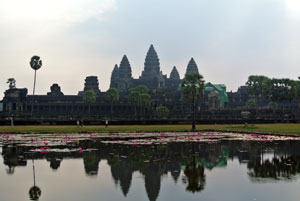
Singapore skylineGlobe-trotting couple Matt and Sharon Ward spent the second leg of their worldwide journey discovering the best of Singapore from a his and hers perspective. Here’s what they had to say about the south-east Asian city state…

We landed in Singapore and caught a taxi to the place of a friend of a friend, who’d kindly allowed us to stay at his beautiful 11th floor apartment on Parkway Parade. For the cost of a duty-free bottle of Bombay Sapphire, our first few nights’ accommodation were sorted. I had a few well-earned bottles of Tiger and Sharon a glass of wine on the balcony as we got to know our temporary landlord. We stumbled to bed around 02:30. Continue reading His and Hers Guide to the Globe – Part 1: Singapore

The Blue Whales of Sri Lanka

Sri Lanka Blue Whale

Venetia Rainey travels to Sri Lanka and gets up close and personal with the largest animal to have ever existed: the blue whale.

In the age of David Attenborough, you don’t need to go far from your sofa to marvel at nature’s awesomeness. From the really small to the really smart, TV has given us the chance to sit front row at the greatest show on Earth.

What David doesn’t tell you though is what these experiences are like in real life.

The largest animals to have ever roamed the planet, blue whales reach up to 30 metres long and rarely come close enough to land for tourists to see them in a day trip. For most, they will only ever be seen through the eyes of another.

But where there’s a whale there’s a way (sorry), and visitors to Sri Lanka will be pleased to learn that between December and April, the island’s southern coast has officially been established as a haven for seeing the beasts as they migrate.

Mirissa

Getting to Sri Lanka’s self-proclaimed whale hotspot is easy: from Colombo, pick from either a regular bus or an irregular train heading south. Both take around four to five hours.

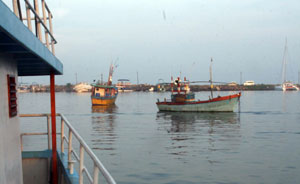
Although Mirissa looks scruffy upon first inspection, the action, as far as tourists are concerned, is on the beach; a pale curve of sand connecting two dramatic, rocky headlands. Mirissa comes into its own at night, with candlelit tables spilling onto the sand from every establishment and stall after stall of freshly-caught seafood to tuck into.

Mirissa Sri Lanka

Picking a boat

The one thing you won’t find on the menu (hopefully) is whale. Regardless, every bar, restaurant, hotel and guesthouse will offer to take you whale watching.

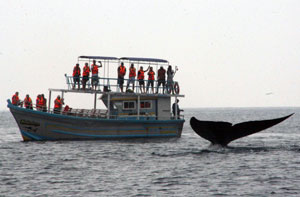
The cheaper options (Rs 3,000 – 3,500) put you on a big boat with between 20 and 30 people sat on both the lower and upper deck. This can be crowded but is also more sociable. The more expensive options (Rs 4,000 – 8,000) mean a smaller boat (still with two levels), fewer people and more space.

Either way, remember that you’ll be out there for a while (at least five hours) and that tours start at the crack of dawn, so sleeping space can be invaluable. All boat operators give you breakfast, a life jacket and insurance (whatever that means).

Crucially, however, all the boats follow each other, so when it comes to the whales, everyone sees the same thing. A final thing to check is how long the boat will stay out if you don’t see anything. I heard tails (sorry, sorry) of people sticking around all day – not ideal if you have travel plans/aren’t that keen on boats.

The main event

First off, a packing list: camera/video-camera, sun cream, sunglasses, hat, waterproof bag, water, snacks. Wear flip-flops and bring a warm layer for the early morning. The boat’s crew should have seasickness pills if you need them.

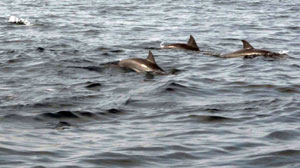
It takes an hour or two to get to the whales’ migratory passage, so if you’re awake watch the sea carefully for jellyfish and ghostly shapes darting below the boat’s prow – pods of dolphins should be easy to spot throughout your trip.

Dolphins Sri Lanka

You’ll know it’s time to wake up and get your camera in sports mode when the crew’s voices get louder, the engine’s growl takes on a new note of determination and your fellow passengers are clinging impatiently to the boat’s sides. It’s time.

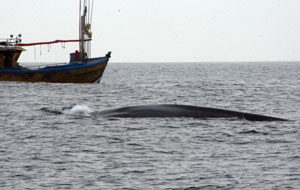
Nothing can prepare you for your first sighting. A flash of greyish-blue blubbery back and then it’s gone, hidden once more beneath the glinting waves. Underwhelming? Perhaps a little, but not for long.

After that first glimpse, your eyes will be glued to the sea. It’s easiest to spot any sea action in cloudy weather, but your eyes begin to play tricks on you whatever the weather.

By this time you’ll be travelling in convoy. The journey out might have given you the impression that it’s going to be just you and nature, but it won’t be, so get used to the pack mentality with which the boats operate.

Eventually, there’ll be another sighting. This time it’s the real deal.

For photos, the money shot is the tail, so don’t worry if you or your camera is slow off the mark. Hopefully you’ll see the entire thing (not all at once) as it comes up for air, announces its arrival through its blowhole, and then sinks back underwater, the full length of its body slowly arcing above surface as it does. The performance ends with the tail, a two-finned behemoth that is flicked into the air with a final flourish before the whale plunges back into the sea’s depths. You’ll probably have a boat or five in your photos, perfect for giving a sense of scale.

Sri Lanka Blue Whale

If you’re lucky your leviathan will hang around to see what all the fuss is about; they can be curious creatures and are not afraid to pop up right next to you. If not, expect to spend a few more hours chasing them around. If you feel your driver is getting too close or harassing them, don’t be shy of making your feelings clear. This is a fairly new industry and needs all the checks it can get to stop it from becoming detrimental to the animals on which it relies.

The journey back is a good chance to do some more dolphin-spotting and check out other people’s photos. Pat yourself on the back, David would be proud.

> Learn more about blue whales and whale watching with Whales: Giants of the Seas and Oceans.

> See more of Sri Lanka with our range of travel guides and maps.