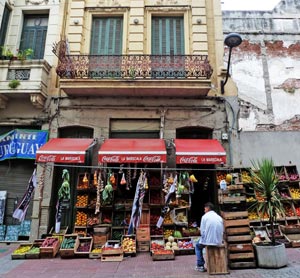
In the first of a three-part series on Montevideo, Rachel Ricks looks at the Uruguayan capital’s cultural offerings.
Montevideo is the 2013 Ibero-American Capital of Culture, and I reckon it’s about time this unassuming city got some attention. I’ve been here for five weeks now and I’ve noticed a real buzz in the air. A year of free activities and events opened on Friday 11th January with a night of four free concerts happening at different locations round the city. I opted to see Molotov – a Grammy Award-winning Mexican band that’s been highly popular in Latin America for more than 20 years. The stage was set up on a large seafront area and hundreds of people streamed in from all over the city to take advantage of this concert. The bass player announced that he was very happy to be here, because not only was today his birthday but this was the band’s first concert of 2013. They played to an enthusiastic crowd for nearly two hours – pretty good for a free gig, and what a great start to an exciting year for Montevideo.
What else is happening this year?
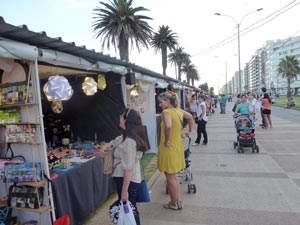
The city will see lots of events, markets and shows cropping up throughout the year. I came across an artisans’ market lining the seafront Ramblas at Punta Trouville, in the Pocitos neighbourhood, with stalls of lovely locally-made arts and crafts, a small stage with bands and an interesting photography exhibition of Pocitos in the early 20th century.
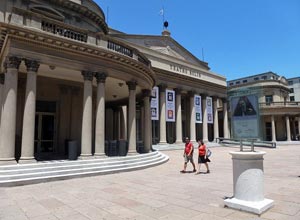
Teatro Solis on Plaza Independencia is the most prestigious theatre in the country and has a varied programme of opera, plays and dances, particularly for 2013. This year’s highlights include Shakespeare’s The Tempest, led by British director Declan Donnellan; Cuarteto, a theatrical work by Heiner Müller; and The Met: Live in HD – a series of 12 operas transmitted live from New York, starting with Rigoletto by Verdi in February. You can also take a fascinating guided tour behind the scenes of the theatre.
And of course, every year from the end of January you can catch the city’s Carnaval that runs for no less than 40 days – the longest celebration of its type in South America. Free workshops, performances and parades fill the city’s streets in these weeks. From my hostel, I can hear the practising for the drums – the llamadas (calls) every night. Check out this year’s programme on the city government’s website.
A walk through the culture and sights of Montevideo
The Ciudad Vieja (Old Town) is the area to head if history and culture are what you’re after in Montevideo. This area of the city maintains many colonial buildings, some of which house quirky little museums.
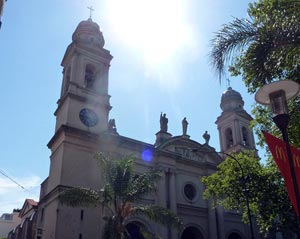
The Plaza de la Constitucion is the oldest in Uruguay, built in 1726, and is home to the Catedral Metropolitana – one of the most attractive cathedrals I’ve stepped in to. On the other side of the plaza is the Cabildo, once both the town hall and prison, where you can wander the ground floor which now holds small exhibitions. Of particular interest for me were the black-and-white photos of Montevideo in the 1800s to the 1930s.
Running through the centre of the Old Town is Sarandi – an attractive pedestrianised street lined with cafés and interesting shops. Follow this down to Perez Castellano and turn right to continue along this pedestrianised street with old-fashioned fruit and veg shops, down towards the port.
The Port Market building was designed like a Victorian British railway station with an elegant glass roof and a clock in the centre of it. It is full of parradillas or asados – the type of grills that Uruguay is famous for, piled high with every kind of meat, and where you can join locals and tourists alike sat round the bar tucking in to mouth-watering meals.
For more, look out for my 11 quirky sights of Montevideo – and for more on where to eat and drink, my Montevideo café guide – both coming soon.
Where to stay
Budget travellers beware – Montevideo is not cheap. Even the hostels charge US$50 for a room. Your best bet is Planet Hostel (Canelones 1095), where dorms are 320 Uruguayan pesos (£10.50) a night.
If you’re after a private room, you’re better to walk into any of the one-star hotels in the blocks either side of Avenida 18 de Julio. I opted for Hotel Ideal (Colonia 914) where a private double with shared bathroom was 650 Uruguayan pesos (£21) – the best deal I found – and I enquired in many. Don’t be put off by the one star – the hotel, although a little old and tired in places, did a better job than any hostel – the incredibly friendly and helpful staff insisted on giving fresh towels, soap and linen every day and I even had cable TV and an elegant balcony.
If your budget stretches further, there are also plenty of two-star-plus hotels in this area, while plusher hotels sit along the Ramblas facing the Atlantic Ocean.
How to get around
Montevideo is perfectly walkable. The main sights are close to each other, and the streets are safe and pleasant to stroll around. The bus network is simple to use too, with locals more than ready to help out.
Getting there
There is an international airport, but flights to Montevideo do not come cheap. Most people travel by road down from Brazil, or across from Buenos Aires in Argentina. I did the latter – for this, take the ferry (two to four hours journey time, depending on boat service) to Colonia in Uruguay where you transfer to a bus to Montevideo (2.5 hours). Prices vary according to your chosen route, boat service and whether you include the bus – the companies offer boat + bus packages – see Colonia Express and BuqueBus.
All prices and conversions were correct at time of my visit in Dec 2012 – Jan 2013.
You can read more about Rachel’s travels on her blog.
> Marvel at Montevideo’s culture with our range of travel guides and maps.
All photos © Rachel Ricks

 The pound has strengthened against the euro and is now at the strongest it has been since 2008 which means people travelling from Britain will get a lot more from their holiday money. The increase is not just restricted to the Eurozone as the pound is also strong against other currencies including Mexican pesos and Rio’s real. According to a poll carried out by Post Office Travel Money, around 80% of world currencies are weaker against the pound. The best value holiday destinations are considered to be Brazil and South Africa as well as Hungary and Greece.