Cricket on Everest: Alan Curr's World Record-Setting Himalayan Adventure

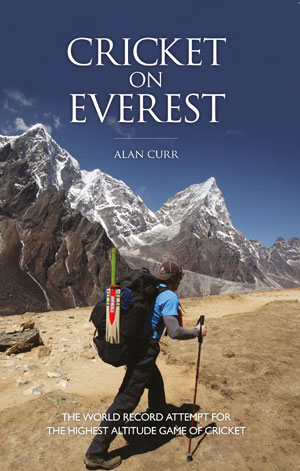
Cricket on EverestFour years ago, Alan Curr was a man on a mission. His goal? To play the world’s highest ever game of cricket on the slopes of Mount Everest. A plan that started over a beer quickly turned into record-setting adventure…

In 2006, Alan Curr’s friend Richard Kirtley completed the Everest Base Camp trek. Coming from a cricket family – his cousin played for England – he noticed a frozen lake bed during the climb and immediately visualised the world’s highest game of cricket. On his return, he pitched his thoughts to Alan.

“I loved the idea, and by 2008 we had put it out to as many people as we could, with the idea of starting in April 2009,” Alan explained.

Despite the eccentricity of the itinerary, the pair attracted an impressive 85 applicants, much to their surprise.

“It was a really mixed bag; generally we had a group of people in their 20s who wanted to go out and do something interesting. We took 50 people in total, many of whom didn’t know each other beforehand.

“Our youngest was 23; the oldest 37 or 38. We had guys who are married – one whose wife was pregnant, another who changed the date of his wedding. We had nine girls, insurance workers, teachers, and a number who were made redundant during the preparation.”

A key part of the group, Alan said, were the ‘trektators’ – girls who completed the trek but didn’t take part in the game, who he described as “the best fundraisers of the lot”.

After 18 months’ planning with Richard and Gareth Wesley, another friend – which included sponsorship deals with Nokia and Qatar Airlines – the party of 50 was ready to travel to Nepal to begin their Everest ascent, but things hadn’t all been plain sailing.

Cricket on Everest book“When we started, Nepal was still a monarchy. It only became a democracy in 2008,” Alan added. “Myself and Richard went there in the winter of 2008-09 to meet ministers and begin laying the foundations for the trip – we were coming up against a fair amount of opposition, and we were worried about being denied access.”

Fortunately, permission was eventually granted – but the pair decided to keep their bureaucratic wrangling from the rest of the group, just in case it affected morale during the build up.

While completing an Everest Base Camp trek is an achievement in itself, Alan said he didn’t want the focus to detract from the task at hand: a fully-recognised, Guinness World Records-approved cricket match.

“We had to take up our own pitch, we all wore helmets and we used proper bats and balls,” Alan explained.

“We had coloured uniforms made up by one of our sponsors, which all needed to be carried up. On top of that, we had to measure out the outfield and put up a scoreboard.

“Because we were worried that not everyone would make it, we took playing squads of 15 – four people from each side had to be left out on match day, which added incentive and motivation in the build up to make sure people contributed.”

When it came to picking the teams, Alan said it was a fine balance between making them competitive and trying to ensure tensions didn’t boil over. Two brothers were part of the group, and they were put on separate sides to ensure that competitive edge.

“We played a 20-20 match, which was the shortest we could do to constitute a match. Any longer would have been really hard work – the guys were struggling bowling and fielding because it was so competitive. It ended up being 120-odd against 130-odd, which made it more legitimate rather than a damp squib.”

But Alan was worried that the match might never go ahead – when the teams arrived, the weather was beautiful and clear. But on matchday, he woke up to a ground covered in mist. Fortunately, it cleared by 08:30 – just 45 minutes before the match’s scheduled start.

The game attracted a fair amount of media attention, with the 50-strong group accompanied on the climb by an ITV journalist, who sent back daily reports to London Tonight.

Cricket on EverestWhat became officially the world’s highest cricket match raised approximately £100,000 for charity, which was split between the Himalayan Trust and the Lord’s Taverners. All the group’s cricket equipment was donated on their Everest descent.

So what does Alan make of his achievement?

“What I liked about the cricket idea is that it’s such a hospitable game, quaint in nature, and we took it to the most inhospitable place we could think of,” he said.

“We were in the shadow of Everest with landslides happening and yaks running around. The grey shale landscape looked like the moon.

“What I want Cricket on Everest to show people is that anyone can do something like this. We decided to take an idea, run with it and make it happen.”

Alan will be appearing at Stanfords Covent Garden on Thursday 18th October at 18:30 to talk about his world record-setting achievement. Please see our events page for more information.

You can buy Cricket on Everest by clicking here.

Photographing the Northern Lights: William Gray's 10 Top Tips

William GrayAward-winning photographer and travel writer William Gray told an audience at Stanfords Covent Garden his 10 top tips for successfully photographing the Northern Lights, courtesy of Discover the World.

“The aurora borealis really is a celestial temptress – she might grace you with her presence for a few minutes or flaunt herself for hour after hour. The key to capturing her with your camera is to be prepared,” William explained. Continue reading Photographing the Northern Lights: William Gray's 10 Top Tips

Short Walks From Bogota: A Talk by Tom Feiling

The Columbian identity is a work in progress, with the nation’s population unsure of how they should be perceived by the wider world.

Tom Feiling at Stanfords Covent Garden storeThis is according to Short Walks from Bogota: Journeys in the New Columbia author Tom Feiling, who delivered a talk at Stanfords on his recent trip to the South American country; the inspiration behind his latest work.

“There’s an idea that no-one in Colombia wants to be Colombian,” he told the audience, with the nation’s middle classes looking towards the United States and its poorer population yearning “to be Mexican”.

“Colombians still aren’t fully aware of how to pitch themselves, particularly in relation to what their strengths are vis-a-vis the rest of the world.” Continue reading Short Walks From Bogota: A Talk by Tom Feiling

The Paddy Dillon Interview

Ranulph FiennesPaddy Dillon is one of Britain’s most prolific outdoor writers, with over 30 guidebooks to his name. He has walked and written about every county in England, Scotland, Ireland and Wales, and has hiked all 19 National Trails at least twice. His latest book, The National Trails, has just been published.

Paddy visited our stores in Bristol and London to give a fascinating slideshow and talk on the trails. He stopped for a chat with our web editor Rachel Ricks, revealing an enviable life of country walking, sunny isles and the value of a dinky, now-extinct computer…

How did it all begin – did you like hiking when you were a child?

When I was a kid, my Mum and Dad were always keen on walks in the park on a Sunday, but I was always keen to have an ice cream, and I wouldn’t go unless I could have an ice cream. They’d say, “You can have an ice cream when you’ve done some walking”, and it all ended up in tears.

I say I got into it later than that. I lived on the edge of Burnley in Lancashire and just one street away from where the fields started. Where the fields ended, that’s where the Pennines started, so it was easy enough for me to just walk over the fields into the Pennines and just wander around. But it’s only really when I was about 16 that I started using things like maps, compasses, and actually planning where I was to go.

In all that time I only lived six miles from the Pennine Way, and older family members were out walking it and coming back with tales of derring-do, so I felt I’d have to get out there and walk it one day. When I was 16 I just set off and I walked a big chunk of the Pennine Way, as a means to get into the Lake District. By the time I’d walked up the Pennines, across to the Lakes and back home again, carrying all the wrong gear, doing all the wrong things, making every mistake under the sun, I think I’d covered about 300 miles with the grand sum of £17.33 in my pocket, so I was starving and blistered and mildewed, everything – you name it, I got it. But somehow I didn’t put myself off, so from then on I thought, “long distance walking – that’s the thing”. Since that time I’ve been trying to do everything right and carry proper gear, but I’m still working on all that, even umpteen years hence!

How did you come to settle in Cumbria – is the Lake District your favourite place to walk?

Well put it this way, I first saw the Lake District when I was 16 and I thought, “I must move up here, pretty damn pronto”, but with no money, no house or anything like that up in the Lakes, I had to work at it. But I’d done it by the time I was 19 – I’d moved up there. Then by the time I was 20 I had a house – only on the grotty fringes of Cumbria, although I’m in a nice little town now. So obviously I must have had a very high regard for it to have done it so quickly. And done it so pennilessly as well!

What inspired you to write The National Trails?

I’ve always been more interested in walking long distance than just walking in a little circle from a car park; circular walks just make me dizzy. I can’t believe that people really want to park a car in the countryside and let it sit there as an eyesore all day long while they’re off enjoying the country, and then come back to the car. It seems that every single walk that people do is to their car. I’d sooner walk up the hill and down the other side and see what’s on the other side of the hill. And just keep keeping going ad infinitum until I’m worn out or just run out of days.

So I like long distance walking most of all, and it seems natural to me to go out and walk established long distance routes like the National Trails. I did them about 12-15 years ago when I was walking one after another for Trail magazine. By the time I’d done half a dozen trails, Trail were already talking to David & Charles publishers about re-using all my articles in a guidebook, so I continued on that basis. Within about two years of the guidebook being published, David & Charles had thrown in the towel as far as outdoor books were concerned, and even though it sold well, they didn’t want to reprint it because it just didn’t fit in with their future plans. So I said, “Can I have my guidebook back please and I’ll find someone else to publish it”, and as I’d done a couple of National Trail guides for Cicerone, I said, “Can I interest you in the whole lot in a single volume?” and they said “Yes”.

The only thing was I had walked them all years ago and there are three extra trails now and a fourth one still being developed. My original plan was just to walk the extra trails but then I thought, no – I’m doing myself a disservice and the readers a disservice if I do that – I should really get out and walk all of them again. So I’ve walked all the National Trails twice now, which is something I don’t think anyone else has ever done! And of course the book is bang up to date, because I spent two years doing it and it’s just been published, so it’s as up to date as it can be – I don’t think anyone else would go out there and do all that in that sort of time. I thoroughly enjoyed it and I was more than happy to walk them all again and do it properly, rather than just do an update of what I thought I could remember from 15 years ago!

What’s your routine when writing a guidebook?

The National Trails of England, Scotland and Wales I suppose it depends on the guidebook because different areas I approach different ways. If I was working on a guidebook that was fairly close to home, and required 40 or 50 one-day walks in it, I may well split that over three different trips in a year. If it’s overseas or if it’s a long distance trail, I would more likely do the whole thing at once; so if it’s say, walking the South West Coast Path, I would go out, walk the whole thing for six weeks, finish, deliver the guidebook. If it was something overseas, like say GR20, Malta, or the Canary Islands, I would go out and do the whole thing at a time of year when I’d be more or less guaranteed good weather, because the last thing you want is to end up with three or four days where you’ve got absolutely zero picture coverage because it was lousy weather, and have to go back just to get the pictures – it could be horrendously expensive – I’d sooner just go and do the whole thing at once.

A day-to-day routine would involve me waking up in the morning, (I’d already have it in mind from the previous evening where I was intending to get to that day) and I will walk. While I’m walking, I use a tiny pocket computer – an obsolete Psion – I can do 25 words a minute on the Psion. All the formatting I do on a Psion can be done exactly the way my publisher intends receiving it by the time I finish, so I don’t need to do much work on it at home. What I write on the spot while I’m stood at the path junction, by the time the reader is there, with the book in their hands, they’re more or less guaranteed that when I say turn left, I was actually stood at that very point they’re standing at, writing the words ‘turn left’, and I don’t think I can get it any more detailed and accurate than that. With a guidebook that has a day-by-day, blow-by-blow description – that’s the sort of detail I’d give it.

But with The National Trails it’s a bit different because I had to get 3,100 miles in between two covers, so it’s not the same level of detail, but what I’m trying to do with that book is to say to people, here are 19 National Trails in England, Wales and Scotland, you can compare and contrast them, you get route profiles, overview maps, you get a suggested day-by-day breakdown. And once you’ve chosen a trail, it tells you what you need in the way of buying further maps and guidebooks to go out and follow the trail of your dreams. Ultimately, I’m sure somebody somewhere is going to work their way through all 19. They may not do it in two years like I did, but if they do it, fair play to them!

Do you have time to actually enjoy the walks when writing the guides? As you have said you write into your palm-top computer “every few steps”, sketch maps and take photos!

Oh yes. I always say the fun part is the walking part. If I was to walk day after day, week after week for a month at a stretch, then go home and start the writing from scratch, I would find the writing sheer drudgery – to have to go home, and sit there tied to the desk, wistfully remembering all the walks I had done!

Whereas if I write it as I’m going along, the writing takes care of itself. Perhaps for a total of one hour during the day’s walk, I may be writing, and maybe an hour editing in the evening – write a nice little intro to that day, measure the map, make sure the ascent and descent are all properly calculated… it saves me having to hunt for that map a month later, scratch my head and try and remember exactly where it was I went and what I did and still have to count all the contours and measure the route. And then I’ve done it all – the writing during the day, the measuring in the evening, I go to bed and I wake up and it’s a whole new day and a whole new chapter.

So I can just get on with enjoying the route without any stress or wondering “am I going to make this deadline” – the deadline will take care of itself.

When I come home I probably have a week’s work to do, sorting out the maps and the pictures, but the text is written. Probably the last thing I will write of all is the introduction – strangely enough that’s the first thing people will see in the book, but it’s the last thing I will write because at that point the entire project will crystallise itself in my mind – I know what the picture quality is like, I know which maps are going in there, I know what I’ve written. So it seems a good time to write the introduction to just pull it all together.

A month away doesn’t mean a month at home. It’s a month away and a week at home, and then delivery, much to my publishers’ annoyance, sometimes – I seem to come in rather quicker than they expect! My thing is always to beat the deadline – give me a deadline for six months hence and you’ll get it in five! So you see the computer actually gives me twice as much time out on the hills and half the time at home!

Do you mostly walk alone, or with people?

If I walk alone, I like to think I don’t miss anything, but I know for a fact if I’m walking with someone else and talking to them, things do just flash by and you can walk for 10 miles and then suddenly stop and think what on earth have I missed in those 10 miles because I’ve been having a great chat with someone and I’m sure I’ve missed something. You rack your brains and try and think, what we did we actually come down – what sort of terrain was it? I think you certainly do miss things like wildlife details. If you’re talking to someone, you may be looking at them occasionally so you’re not looking at the ground – you’re missing the flowers, you’re not looking at the sky – you’re missing whatever’s flying by, if you’re talking, you’re going to scare off very shy and sensitive creatures, that are susceptible to noise and disturbance.

Whereas if you’re just traipsing along nice and quietly through the short grass, you’ve got a good chance of catching the wildlife unawares and sneaking a picture of it before they suddenly realise you’re there and scarper. But if you’re with someone else you almost certainly miss those opportunities, so when I’m working on a guide, I’d say that 99.5% of the time I’m completely on my own and the other half a percent of the time, if I’m with someone else, I’m very conscious that I’m probably missing something.

But it’s also the case if I walk a route I can feel if I know it incredibly well, in great detail, but if I walk it again I’ll always spot something else I may have missed the first time so I always welcome the opportunity not only to go to new places, but to rediscover old places as well, and make sure I’ve got them right. When it’s time for an update to a guidebook, I’m usually quite happy to go out and do it all again. And it will be written differently the second time around, almost certainly!

What’s your ideal sort of scenery – coastal, river valleys or on top of mountains?

What I like most of all is variety, so while I’m quite happy if you give me a mountain trail, I’ll be 100% happy on it, and enjoying the mountain scenery, but if you then asked me to go and cover a coastal trail, I’ll be 100% enjoying the coast. And you cannot compare mountain and coast, you can’t compare fields and forest, a lake with a river, everything is different. I like the fact that in Britain you don’t have to go far to get immense variety. You can walk out of the city into the country, out of the country into the mountains, out of the mountains, down to the lake, along the river, through the forest, and you can do all that in a day and a half.

Whereas in some countries you would walk for a month and the scenery just does not change – you’re stuck in a desert, a mountain, by a huge big river and nothing much changes for weeks on end. What we have is variety and we have it in a very small, very easily managed area and I love that more than anything- the fact that I don’t have to restrict myself to enjoying one particular type of terrain – I can actually enjoy a whole wide variety of terrain in a very short distance. I like it when things change, I’m happy in mountains, on a cliff coast, but to get a cliff coast and a mountain, I’m twice as happy! [Laughs]

Which is your favourite walk of all time?

That’s almost impossible! You could have a really good day somewhere and then go back and it’s lashing with rain, it’s misty and you don’t get the views, and you get cold, wet tired and miserable. And then you fall headlong into a bog and all of a sudden what you once enjoyed is pure misery. I do have a soft spot for the Pennines and the Pennine Way because that was the first National Trail and it’s the first place I really got to know very, very well. But by the same token, when I saw the Lake District for the first time, I just wanted to move up, and I did, so I obviously hold it in high regard.

But again it’s the variety I like – if I want to walk in the Lakes, it’s on my doorstep, if I want to walk in the Pennines, I’ll be there in a couple of days’ time. But a lot does depend on the actual day and the conditions when you’re there. So even if I enjoy something immensely one time, there’s no guarantee that I’m going to get the right conditions to get maximum enjoyment out of it next time I’m there. So it all depends, especially in this country, on the weather.

I was over on crinkle crags just a few days ago with some people over from Northern Ireland and we went up in mist and I thought, they’re doing this because they’ve come all the way over from Northern Ireland, they’ll go up there in the mist, but I don’t need to! I can wait for a fine day – it’s on my doorstep. But then in the afternoon it cleared and I thought now this is what I call a walk! No thrashing around in the mist anymore, this is brilliant – we can get the long views.

But I can remember the times when I would have travelled a long way to do a walk and I would’ve taken the rain, the mist, the sleet and snow in my stride because if I came all the way to do something, I was damn well going to do it! Now, in the Lake District, I can pick and choose, if it doesn’t look a great day, I can stay at home and get on with something. If it looks a brilliant day, I can down tools and just get out there and enjoy that day. But I will often say to people, if it’s a sunny day, head for the fells, you’ll enjoy it immensely, and if it’s a lousy absolutely horrible day of lashing rain, go and look at waterfalls – because they’re going to be absolutely spectacular that day. You always get people in the height of summer going looking for waterfalls in the Lakes when they’ve dried up to a trickle. I say go out in the lashing rain to look at the waterfalls. You won’t regret it. You’ll get soaked to the skin but you won’t regret the power and the splendour of that water surging over some crag.

So my idea of a favourite walk depends entirely on the conditions and where I am and everything so it’s almost impossible to pin one down!

Which walk would you recommend to a beginner?

As a beginner, you’ve always got to walk within your capabilities, there’s no point if you’ve never done a long-distance walk before, taking on something high, wild and remote like the Pennine Way. But there’s nothing to stop you looking at say, a small section of the Pennine Way, preferably low level but with some great scenic merit in the area – potter around the Malham area or something like that. So I’d say keep it short, sweet and simple and something with good scenery. Do not try and do too much too early because there’s a chance you’ll probably burn yourself out and end up so covered in blisters you’ll never want to see another walk again for as long as you live!

Don’t go out in the pouring rain and expect to be wowed by the scenery – pick a nice day. And gradually build up, not only what you’re capable of doing, but your confidence with things like map and compass and using different guidebooks. Anyone can start anywhere, but start a little below what you’re capable of doing and then build up, find what your limits are and don’t push beyond them too much – give yourself a challenge every so often but don’t push it too far. In terms of long distance walking I wouldn’t say to go off and walk the Pennine Way or Offa’s Dyke or the South West Coast Path if you’ve never done long distance walking before, I’d say pick one of the trails that only measures five days and is in very gentle terrain like the Yorkshire Wolds Way or the Speyside Way in Scotland, nice gentle trails that you can’t really go wrong on. I say, start simple and build on that.

Is there any walk you haven’t done that you’d really like to?

I’ve a great big long list and it’s so depressing coming into a place like Stanfords and you see the whole world laid out there in bookshelves and maps. You think, if I had a hundred lifetimes I couldn’t even do a fraction of this! I’ve just been wandering round the shop floor now, unfolding maps and looking wistfully at them, thinking 100 lifetimes is just not enough! I need more time and I’m not going to get more time!

There’s all sorts of places I’d love to go to but by the same token I’m very happy going to places I already know very well. I tend to take a lot of things as they arise, so if all of a sudden, my publisher says an area needs an update, I’ll start thinking about it and enthusing myself and that will become my number one priority – to go there and do all those walks again. But if somebody says they’d like me to do a guidebook on an area I’d never been to before, I look on that as a great opportunity and I get enthused about that.

So there are places I’d love to go to but they never quite get to the top of the list, there are places that simply because someone asks me to do something there, they rocket to the top of the list and I’ll be as enthusiastic about that as anything else that’s likely to come my way. Once that’s done, dusted, parcelled up and delivered, I’m looking for the next great enthusiastic project.

I would love to be able to walk around a country like Tibet entirely on my own, but that just isn’t possible – when you go to Tibet, you must go as part of a group and you must do as you’re told – you can’t just go wandering off, willy-nilly anywhere, but to me it seems like ideal country for doing that.

I’d love to do some of the very, very long walks through America like the Appalachian Trail, the Continental Divide and the Pacific Crest Trail, but each one of those is going to take four, five, six months so I’m going to have to sort out time to do those. But they’re on my list!

So I’ve a wish list that’s infinitely long and wandering around a place like Stanfords just brings tears to my eyes because I just know I’m not going to get round them all! [He laughs] it’s sad but true!

What do you never travel without?

I always have my little computer with me because even if I’m not writing a guidebook it still has my little diary on. It’s always in my pocket wherever I go. If I’m outdoors, I will always have my rucksack with what I need for the particular area and conditions to make sure that whatever type of trouble could arise, I’m capable of heading it off. If I’m heading out into the wilds and I think it’s a very long day’s walk, it’s going to get dark early, it’s not a good weather forecast, I’ll make sure I’ve got a tent and sleeping bag and everything to survive the night if I have to.

I always feel naked if I’m in any place anywhere in the world without a map. Wherever I go in the world, even if I just end up in a city for a couple of hours between flights, the first thing I want is a city plan, I want to know where I am, where things are. To be in a place without any map or plan, I just feel I’m lacking something.

You can’t beat a good map, but the ability to read a map as well, it literally opens the whole world before you – you can be in any place, anywhere in the world, and if you have a map and the ability to read it is immense – it just gives you so many options that you can’t even dream of until you’re there and you’ve got it there in front of you. So I think a map is probably the most essential thing, always, wherever you go!

What’s next?

When I’m finished here, I’m going to visit some family in the Pennines, so I’ll almost certainly do a little walk in the Pennines. When I get back home, I have to complete some route research I did earlier this year – I have to update a guidebook of my own to walks in County Durham. The reason I’m doing that now rather than back in early summer when I did the walking is because I also did a 10-week, 1,000-mile walk through the Alps and that took precedence. So I got all the footwork done in Durham then had to go to the Alps and deliver the Alps to the publisher and now have to pick up the threads with the Durham guidebook and deliver that.

That will take me maybe a couple of weeks to knock into shape, then that’ll put me right in the depths of winter in Britain, so I’ll probably be looking at going somewhere nice and sunny. I’ll look at what’s due for an update and if there’s any sunny islands – the Mediterranean or Canaries – I’ll probably head out there. That’s always an option these days – if you get bad weather in Britain, go and get good weather somewhere else – and come home after a couple of weeks and hope things have changed for the better!

Apart from that, I’ll keep plugging away at my magazines – if they want something, I deliver, and they know when they phone me the answer is invariably yes, and I just put the phone down and do the work and deliver. And then I’ll just roll into next year and keep doing this for as long as I’m able to do it!

The Nick Ward Interview – 1979 Fastnet Race survivor

Ranulph Fiennes

Nick Ward was left for dead in the middle of the deadliest storm in the history of modern sailing. The Fastnet Race of 1979 began in perfect weather conditions but, within 48 hours of the most beautiful sunset Ward had ever seen, it turned into a horrifying storm. By the time it was over, 15 sailors had lost their lives.

Ward remained silent on the events of that race, telling no one what he had been through – not Hollywood when they came knocking or even his family. After 27 years, he was finally able to lay down his story in the visceral account, Left for Dead.

He came to Stanfords to sign copies of his book and we caught up with him to talk about his life before and after the incident.

Your father introduced you to the world of sailing as a child. Why did you then fall in love with it and did you know it would play such an important role in your life?

I had no choice really because in Hamble you either played hockey or you went sailing. I did both but sailing was the major sport of mine. Until, of course, I had the brain haemorrhage.

Ward suffered a brain haemorrhage at the age of 15 that left him in hospital for months, long-term weakness to his left-side and epilepsy. Throughout the Fastnet disaster he had the continual worry that an epileptic attack was imminent – and no access to his medication. But we’ll return to this subject in a moment.

So, why choose sailing as your major sport?

Initially it was the social event. Mates growing up sailing various classes of dinghy, starting off with Optimist, Mirror, Merlin Rocket, and going sailing single handed. So it was a social group. Some of that group are now in the Merchant Navy as I wanted to join.

Is that something you regret not being able to join?

No, not at all because I wouldn’t have met Chris otherwise.

Chris is his wife, to whom the book is dedicated. They met on one of his visits to hospital, keeping a check on the damage done by the brain haemorrhage. She’s sitting here with us while we talk.

Do you think you drew strength from the brain haemorrhage that you wouldn’t have had otherwise?

Definitely, yes. It was something that I wouldn’t wish upon anybody but certainly being in surroundings dominated by machines and wonderful caring people gives you inspiration to recover. I had to go sailing again. I drew inspiration from the people around me. I kept an autograph book and got all of the doctors to sign it. Some of the inscriptions they wrote in it are really etched on my brain now. What was that saying? Never judge the height of a mountain ‘til you reach the top – and you know, that sticks in your brain. And I looked at it and it was signed by Sister Sampson and the other sister on the ward was Sister Jolly! I had a Sister Sampson and a Sister Jolly! One was Scottish and the other one was so beautiful. Had a lovely bottom.

So you simply lay there dreaming of sailing again?

Every waking moment and most sleeping moments too.

Finally you had the chance to enter the Fastnet Race when you were 23 – some years later than you’d first anticipated. How did you react?

Oh I was overjoyed. I knew I’d do it one day. Everything seemed to come together meshed at the right time.

When the race had begun it was quite early on that you saw this amazing red sky. Was that something you were expecting to see or did you recognise it as a bad omen?

Both. I’d been told about these sunsets you get in the junction between the western approaches, the Bristol Channel and the Irish Sea, so I was expecting some form of spectacular sunset but the combination of the colours was nothing I’d ever seen before – so it was a harbinger of something bad.

And have you ever seen anything like it since?

No. My son has just come back from a trip, he’s an oceanographer, and he’s come back from an Atlantic trench 300 miles into the Atlantic. He showed me a picture on his phone and it was similar, but not quite. It was scary, but my boy’s a man, he’s been further in the Atlantic than I have.

When the storm had reached its full force your crewmates wanted to abandon your yacht, The Grimalkin, and get in the life raft. You objected – in vain. What was your reasoning then?

It’s something again, like the red sky, it’s something of a tradition in the marine field that you stay with the boat rather than leave it and the life raft is rather like a parachute, it’s a last resort. But given the situation those guys were in I may have done the same. There’s no blame. I hope I wouldn’t have done, but…

Following the debate as to whether the crew should get in the life raft Ward found himself back in the sea. He pulled himself, and then his crewmate, Gerry back aboard. On looking around the yacht he saw the life raft had gone and the harnesses were empty. He had been left for dead. Shortly after this, Gerry died in his arms.

Seemingly, once they were in the life raft, they were rescued quite quickly. Do you know why and how that was?

I don’t know because I was unconscious. You’d have to ask them. I’ve spoken to one crew of 1979, the owner’s son, whilst we went back to revisit the boat and find out where she was. Not conclusive.

The two vessels must have become quite separated for you not to be seen?

Yeah, in a storm of that magnitude you get seas that are twice the length of the boat. The boat is 30ft long with squall coming from all directions – totally surrounded by water, both seaborne and airborne, it’s so disorientating.

So in fact they could have been quite close together, with nobody knowing it?

Absolutely. I mean I didn’t even know there was someone next to me in the water until I pulled myself onto the boat. So you can be inches away from somebody and not see them.

Ward spent the next 20 hours alone, bailing water to prevent the yacht from sinking, looking for food and drinking water, fearing an epileptic attack, talking to his now dead friend, Gerry, and hearing his father’s voice instruct him.

How lucid were you through all this?

You know the saying of the little boy with the finger in the dyke? I felt I had to do something to lessen the chances of the boat sinking, because unfortunately it was sinking. So therefore I was able to draw upon using Gerry to talk to – he died in my arms – and through Gerry I was able to access thoughts of my father who became a voice in my head – it’s difficult to explain. They were childhood memories that came back, things he used to tell me when he was gardening – ‘Get off the garden you white devil’, Churchill’s quotes, ‘When you’re going through hell keep going’ – that sort of thing – ‘Pull yourself together man!’ For me it was almost a revelation and I knew it was him because he called me Nicholas not Nick.

Eventually a helicopter arrived. You were the last man they reached still alive. What were your feelings?

I was crying my eyes out. I was pulled up second, after Gerry. Ironically tomorrow I’m going sailing on Grimalkin and I’m meeting the chap that actually pulled me up out of the water and the helicopter pilot, which is cool. I met them at the boat show in 1980, didn’t talk much, we were both guarded about the whole thing. It’s going to be quite a cathartic thing.

How long did it take you to return to the water and to sailing?

Once you’ve started sailing you never give it up. It’s like football or cricket or any sport you love, and being in close proximity to water I couldn’t get away from it. I was back sailing seriously the next year – I did a Solent race and a couple of Channel races. The owners son, Matthew, who was heavily traumatised [his father was lost at sea], was out dinghy sailing the next weekend. That’s how much of a draw sailing is. It’s better than sex! Sorry I didn’t mean to say that.

Having not spoken about it at all before the book, how are you finding the media interest?

It would be
easy for me to say, ‘Yes it’s been cathartic and I feel a much better person for it’, but that’s bollocks. Through the help of Sinead, the co-author, and through Chris, my family and Nicola, everyone at AC Black, has been very helpful. I feel now that I’ve got my demons out, well some of the demons, I can talk about it. I wouldn’t have been able to have this conversation a year ago, or three years ago, because that’s how long ago we started writing, because I was just too emotionally involved in it.

So how did your co-author, Sinead O’Brien, make the breakthrough?

Sinead’s mum knew the story of this boy, me, being left in the Irish Sea and being a documentary maker she sniffed a story. So I looked at her CV which a friend had sent me. She came to meet me and I think she calls it an organic relationship – Chris will call it something else – but she was able to draw things from me that I’d never spoken about. And we built up a friendship and that’s how it went on. As a writer and publisher at 3 o’clock in the morning sending attachments she’d say ‘This is rubbish, do it again’, so I’d do it again. Basically that’s the sort of environment we were working in – very professional.

I heard you’d turned Hollywood away once before. Is there a chance of having your story on screen now and how would you feel about that?

You’d have to ask my agent! It sounds pompous I know, but you’d have to ask her. But yes, I do believe it’s being talked about. I’d hate to see it being made as one of these out of context pieces which are sickening. I’d like to see it done realistically and true.

I imagine it would be compared to Touching the Void if it did come out.

These guys [his crewmates] were in a similar sort of situation, not an us or them situation, but a situation where you can’t imagine how high the seas were, you can’t imagine what you’d do in that situation, so they made a call and that’s fine. I hold nothing against them. Maybe I would have done the same. I hope not but maybe. Just one more thing – Joe Simpson is a cool guy, I’d like to be as cool as him!

Technology has improved immensely since your Fastnet Race, but what would happen if the weather changed without warning in today’s world?

That’s a two-pronged question. Because these days we have better weather forecasting facilities, we have GPS, we have weather facts, we have all sorts of satellite communication which predicts weather onboard. But the coastguard and the Royal Navy are very much understaffed and I was talking to a fairly senior guy in the navy yesterday, and this is unofficial, but he told me that no longer would they be able to call on the resources that this country called on at that time 30 years ago.

That’s shocking.

It is and it’s the fault of the government. I’m sorry it’s not political but it’s the government.

And there would, presumably, be more people out there now too?

I mean the Hamble River in 1979 had about 3,000 boats on, now the Hamble River has about 12,000 boats.

How have your family reacted now that they’ve finally heard the story behind your survival? What were their thoughts?

Well this is where I well up because, um, without Chris and the love of my family and Elizabeth, my daughter, and Sam, my son, I wouldn’t have been able to do it. I used them, as I did Gerry, as a sounding board and they’re very much alive. And Elizabeth who is quick, bright and sharp was a sounding board for me – her grammar is spot on.

[Chris Ward:] The family didn’t know what went on on the boat. And since we’ve read it and our daughter read it she cried because Nick had never spoken about it. And that goes for all the family really doesn’t it.

[Nick Ward:] Yeah my parents, my brother. In fact my brother told me things that I didn’t know, nobody knew, but Sinead was the catalyst for writing.

And now your son is doing things similar. How does that make you feel?

I bought him a Mirror dinghy years ago and I think because I’m used to boats I kind of hung it around and slightly frightened him but it’s what you do in dinghies. And now I’m really, really pleased that he’s discovered it for himself. And this is big time stuff, he’s testing out oceanographic equipment, he’s designing mini-submersibles, he’s designing all sorts of hi-tech equipment and I’m very proud of him – a good man. He’s got the opportunity to go to Antarctica next year to an underwater lake 250 metres below the ice cap. They’re going to drill into the lake – goodness knows what they’ll find. So he’s cool. He went out on that boat a boy and returned a man.

Browse sailing books and charts.

Author: James Innes Williams

The Hilary Bradt Interview

Hilary Bradt has been globetrotting for over 40 years, hitchhiking in every decade of her life except the first. Thirty-three years ago she began producing guides to the farther corners of the earth – the first one was written over three days on a river barge floating down a tributary to the Amazon. Today, as Hilary embarks on retirement, Bradt Travel Guides has over 100 titles to its name and in many cases is still the only guidebook publisher to certain countries. She spoke to James Innes Williams about the journey so far.

Beginnings

When you first began travelling where did you go?

I suppose the first adventurous holidays were going to Greece when I was a student between 1960 and 1963 with someone called Brian Hughes. He used to commandeer a whole train going from London to Athens. Most Oxford students in the ’60s went to Greece with him. It was like the developing world in those days. And then when we got there we hitchhiked and slept on flat roofs at hotels. You could live on less than £1 a day.

And that acted as motivation to continue to travel in your career?

Well, I didn’t think so at the time. I was an occupational therapist and went to OT college. But I really loved the open-endedness of travel. And I think that set me up – not knowing where we were going to stay or where we were going to go.

I love discovery and usually it’s in the natural world, because so much of my travel is now in Madagascar when I’ve been tour-leading or researching my Madagascar guide. Maybe the discovery is a new animal species or almost any scene that I haven’t seen before. I just love that, that’s what travel is all about, it’s discovery.

1963 was the first big trip – three months hitchhiking to the Middle East. We hitchhiked the whole way, determined not to take any public transport. And that was great, very adventurous. That’s where I learnt my street wisdom. I was very street-wise. These days there’s all this talk about sexual harassment of women, but in the ‘60s you just accepted it and you told men where to get off.

Dangers abroad

Have you had much trouble of that kind on your travels then?

I’ve been robbed fairly frequently but I haven’t been harmed even when I’ve been travelling alone. I travelled alone in Peru for three months in the 1960s, when there were very few gringos travelling, so that was quite often quite scary and I was going to Huancayo which is a very high, very cold place. The bus had broken down and it didn’t get there ‘til 1am. I was the only person left on the bus and the bus driver then made advances to me and said that my luggage was no longer on the roof, it had disappeared. I just started to cry. Then he got a bit disgusted and put me out with my luggage, which was wasn’t lost after all. In situations like this you feel very vulnerable and alone, because it’s not quick, there’s no sort of quick reaction, you just think, ‘Oh shit, I just don’t want this’.

So what do you think has kept you safe all that time?

I think actually it’s trust. I was probably quite naïve as a young traveller and I remember a time in San Francisco. I was waiting at a bus stop and this gang of black youths surrounded me and asked, “What’s the time?” and actually I’m sure they were setting me up for a mugging but I said, “Oh it’s half past ten” or whatever and they went away. And I think they were expecting me to look afraid and then it would be more fun for them. Since I actually wasn’t afraid I thought they were just a friendly group of young men. It wasn’t until I was mugged that I got more nervous. I think if you do trust people they are actually trustworthy, it’s when you show fear that they live up to expectations.

The first book

The story of writing your first guide on a river barge floating down a tributary of the Amazon is a great one. Did you make that trip in 1974 with the book in mind from the outset?

Not at all. I’d done a trip to South America before that. In 1969 I’d gone on my own through Central America and then Colombia and Ecuador, and met up with a girlfriend in Peru and went down the Amazon. I’d travelled on my own up until then. And so when I got married I knew I wanted to go back to there, George knew he wanted to go hiking, so we compromised. The first books were hiking guides because we’d been walking in the Andes, spending several days at a time in the mountains, and other travellers really didn’t know how to do this. So we wrote the book while we were on the barge in Bolivia for three days with nothing else to do, and when we arrived at our destination, a small town in the jungle, we went to a typing school and asked if we could use one of their typewriters when the students were not there.

Guidebook tips

What tips do you have for other budding guidebook writers? Should they do as you did – going out to a country before getting a commission?

Absolutely not that! It’s a bit of a catch-22. People say, “I want to travel for a living, can I write a guidebook?” You’ve got to have the knowledge before you’ll be accepted as a guidebook writer. The way to start is to get a job in the country that most interests you, whether as a volunteer or community work, then you can comeback and say, “I’ve spent two years in such and such a place and I’d like to write a guidebook”. So first get the commission and then go out there. But it never ever, ever works to comeback and say I want to do a guidebook.

I was very lucky to start a publishing company in the ‘70s, which was a time that anyone could do anything. Nowadays you couldn’t do what we did, publishing two books on £680 and selling them. These days you’ve got to have a lot of money to start a publishing company. And you also need a brilliant idea and if you’ve got a brilliant idea you’ve got to find the market for it. We just couldn’t have done it.

Becoming known

When you returned to England your book was rejected as the publisher wanted a normal guide to Peru as opposed to one focused on hiking so you decided to publish it yourself. How did you then get it distributed?

I remember George went to Stanfords and showed it to them and whoever was there asked, “What discount do you give?” and George didn’t know about discounts so he just said, “The usual”. And then they said, “35% then”.

Because we were doing all the books ourselves and we didn’t know anything better, we didn’t know about distributors. So in America we got a coast to coast Greyhound ticket and we got off at the main cities during the day and sold the books and slept on the bus at night. That was a very good experience. It was exhausting but it meant that we met all the bookshop buyers and what we were offering them was so unusual they were actually quite pleased to see us. And we sold some other publishers’ books we brought over from England so it wasn’t just our own. It actually worked very well. I think we did it two years running. So we still visited personally and tried to find new contacts. That was in 1978 and 1979.

Then in Europe I got a Eurail pass and did the same thing, sleeping on the train. I remember Hamburg to Munich was a nice night’s journey and I could sell at each end in two major cities. And I sold lots of books. About half our sales were to Germany and Scandinavia and we’ve still got some of those shops still buying from us, so that really set it up very well.

I also went around Britain with books in the boot of the car and in those days you could just go into a bookshop and say, “Do you want them?” And they say, “Yeah I’ll take a couple” and give you money from the till. It was all very neat. But of course you can’t do that now.

Tour leading tips

After your divorce you spent many years as a tour leader, while still producing two or three guides each year, so what makes for a good tour leader and passenger, for that matter?

A good leader has an air of authority and is an extrovert. It helps to be a raconteur, and tell stories. And of course you need knowledge, but when push comes to shove that’s probably less important.

For passengers, it’s something I quote in my Madagascar guide- a woman who said, “I’m going to give up thinking, it doesn’t work in Madagascar!” And she was right,it doesn’t work! If you’re in a group situation you must just go with the flow, it’s really no good questioning everything. Mostly everyone is doing their best to give you a good time.

Travel writing tips

And while you’re giving tips, following your recent talk with Travellers’ Tales on ‘How to win travel writing competitions’, what advice do you have for budding travel writers?

My tip, which is unusual, would be to write when you’re really tired, when you want to go to bed, because you’re much less constrained – it just all comes out. And the wonderful thing about the word processor is you can come back to it and correct it. In the old days you couldn’t do that. Don’t reread it, just keep going, and come back the next day.

Bradt takeoff

Ok, back to Bradt Travel Guides. Why did it blossom in the 1990s?

I suppose it was market driven, the books were starting to do well and we had a proper distributor. They started saying, “You need to publish on a schedule, you can’t just do it when you feel like it” and I realised I had to be more professional. I also started taking on more staff.

By the end of the 1980s we had about 25 titles on the list including those authored entirely by other people. I only wrote a couple myself. Then in the 1990s the list grew quite steadily. We were doing about 6 new ones a year and of course the growth of new editions is proportionate to the number of titles you do, so that snowballs.

The significant year was 1997 because that year our distributor went broke losing me a very large sum of money, plus we won the Small Publisher of the Year Award. I’m enormously proud of that because we were competing with much larger publishers. And an award like that makes such a difference. You think if we’re recognised not just by the readers but the trade – well that really feels very good.

Bradt bestsellers

Today you have over 100 titles published by Bradt. Are you aware which of those is the bestseller and why?

The steady bestseller is Ghana. There’s no other guide to Ghana but it’s actually absolute quality and we’ve never had a negative letter about it and people always say, even on the Lonely Planet thorntree website, about the Bradt guide to Ghana. So it’s earned its bestselling status and it’s the bestseller in the States, in the UK, the Netherlands, wherever we distribute it. Philip Briggs updates it every two or three years and he’s our top author, he knows how to write and he’s got the passion. I’m very proud of Philip and Ghana – actually a lot of Philips books are up there, Uganda sells well at the moment. Actually, interestingly, the bestseller at the moment is probably the Cape Verde islands and that is in its 3rd edition. When we first published it, it sold so slowly we said, “Should we publish a second edition?” We’d probably got there too early. And then they started direct flights and it was booming and we sold hundreds every month and that’s terrific. It’s just the patience paid off – we could have decided to ditch it.

But for a few months it was actually the Iraq guide that was out-selling everything else, is that right?

That was lovely actually. What attracted me to the proposal was that one of the contributors was working for the anti-sanctions movement when Iraq was crippled by sanctions and allied bombing after the first Gulf War. I hoped the sanctions would be lifted soon and that’s why we published the book. I was moved by the stories this woman wrote about the ordinary Iraqis and how they were suffering under sanctions. The manuscript was ready at the beginning of September and then 11 days later we had 9/11 and we just thought we can’t go ahead. But we’d printed the posters and took them to Frankfurt for the book fair and put them up and distributors said, “Oh Iraq, we could sell that!” and it was that feedback at Frankfurt that made us decide to do it – it was a whole new market. It sold pretty well in the run up to the war and then 3000 in America in April, the first month of the war. We had a phone call from the Pentagon enquiring about it.

Effects of 9/11

So had you seen any negative effect from 9/11 beforehand?

Almost everyone did. We had the tiniest blip because the bookshops lost confidence, Stanfords obviously not, but other bookshops took travel off their shelves. People were still buying our books, but there was a dip in sales for a few months and then for half the following year slightly slower. Then we sold a lot of Iraq in the lead up to the war, and we had USA by Rail and that did very well because Americans were all frightened of flying so all jumped on trains. Then we had Eccentric Britain and that went very well in Britain. So it was a
mixture of lucky and also our sort of readers are actually much more sensible than the mass market. They know if you’re flying to Burkina Faso the likelihood of having a bomb blow up on the plane is quite small.

Where next?

Where is Bradt Travel Guides heading as you step back from being MD and become Chairman?

The reason we didn’t suffer from 9/11 was that our niche was so specific that they weren’t the sort of books that would be affected. I strongly believe that the world needs these guides to the unusual places. So there’s no question of changing that, but we plan to make more use of colour and to try to spread the net a bit wider, moving into some new areas.

And what will you now turn your hand to, now that your weekends are your own again?

I’ll continue to write articles. Not only the usual destination pieces but I hope more opinion pieces where my 45 years travel experience will be useful. But sculpture, that’s what I want to do when I grow up. I do stone carving and I really want to spend more time doing that, and working with clay and wire mesh as well. I mostly do animals and have lots of ideas I want to try out.

What will you miss the most no longer running the company day to day?

I think it’s authors that were really my protégés. I’ll miss regular contact with them. I won’t miss the management but I’ll miss the people side of it – people whose careers I’ve sort of nurtured.

Living abroad

Not only have you travelled the globe so extensively, but you’ve also lived abroad for many years. Where are you most at home?

I’m most at home in England. I’ve lived in Scotland, but there I felt very English, so it’s England not Britain that I’m at home in. I actually love the area that I grew up in, the Chilterns. I love the bluebells and the beech trees and the whole package that’s the Chilterns. However, I shall be moving to East Devon next year and that’s a beautiful county.

I loved living in America. I was in Boston and San Francisco which are terrific cities. To be young, British, and living in America – three fantastic things. You could be really stupid but they would think you’re wonderful just because you have a British accent. Very helpful! I love the out-goingness of Americans. I was very shy as a child and young adult and it really brought me out. You can’t be shy living in San Francisco, not in the 1960s which is when I was there. It was a fantastic time to be there.

I also lived in Cape Town for a couple of years during the apartheid period and that’s interesting because it was actually probably the happiest year of my life. It was just brilliant, I mean the landscape is so beautiful, the people were terrific. I had a very rewarding job, I was an occupational therapist then, working with quadriplegics. But it was the height of apartheid, so you had the guilt about being so happy. But actually I had friends that were working within the law but against apartheid and they were very effective so that helped.

Favourite memories

You must have so many wonderful stories and memories – can you remember your best ever meal?

It was after George and I were lost in the jungle of Madagascar. It was a four day ordeal and it was extremely unpleasant. We had very little to eat. Afterwards we went back to this small town, Sambava, and checked into a little hotel. It was run by a grumpy Chinaman and we said, “Could we eat at the hotel tonight?” He said very crossly that he had a special guest but he supposed we could. He was cooking duck for the special guest and said he could cook some for us. We asked how much it was and it was $5 and that was too much, that was our budget for the two of us so we said we’d just have one meal. So we split this duck portion and it was absolutely fabulous and of course we wanted more. The special guest was eating on his own and left some of his meal in the serving dish. Fortunately the waiter put the dishes on the side table before clearing them away so we managed to nick it. I don’t remember any meal better than that.

And the worst?

On my trip to Madagascar last year I’d climbed a mountain and we had cooks and porters – it was the same mountain and jungle that I’d got lost on 30 years ago and I was sort of recreating that trip. Now it’s a national park so instead of backpacking and being lost for four days I went with porters and guides and friends and it was an absolutely super trip. And the food had been wonderful and the cook served up this stew and I thought there was something about that smell that I wasn’t sure about and I knew where I’d smelt it before. You know in third-world markets if you go through the fish market you know how the smell of dried fish catches your throat. It was a dried fish stew and I thought it can’t taste as bad as it smells but it did, and I just couldn’t swallow it.

And what about a favourite memory, a favourite moment?

Such a little moment, but it absolutely stands out, was when we were travelling in Africa and we were in Zaire, so what’s now The [Democratic Republic of] Congo. First of all the driver had been very unfriendly and we’d had the usual argument about money and how much the transport was going to cost and he settled for lower than he wanted. Then we were crossing some open bush country and he said we either had to pay him more or he would put us out there – and that there were lions in the area, which I think there probably were. We didn’t get out and we didn’t pay. We were in the back of his pick-up truck and it was really cold because we were driving through the night. There were quite a few Africans with us and we were all huddled together for warmth. And he stopped outside this café shop and we stayed on board, not wanting to get out because we didn’t trust anyone with our rucksacks and didn’t want to unload them. We waited a long time in the cold. And he came out of the café carrying two mugs of hot milk which he gave to us and it just tasted so good and the gesture meant so much. It was a very special moment.

And any funny stories from dealing with Stanfords?

When I was doing a lot of tour leading in Peru and Bolivia I realised you could buy Ordnance Survey-type geographical maps very cheaply. They were about 50c or so, and they could retail for £5.95 at Stanfords. So every time I went to South America I would go to the Instituto Geográfico Militar and buy the maps. I had these enormous rolls of maps, and boxes of smaller ones. I always used to pack my luggage in US mail sacks and I’d fill up these sacks with maps. The problem was I still had my regular luggage so to get it all home I’d go to Lima airport with two bags of maps, check them in, then come back an hour later with two more bags and I would say, “Here’s my ticket and I’m awfully sorry, I checked in earlier but I didn’t have my luggage with me and I’d explained to the lady at the desk and she said that was ok I could bring it back later.” And for a few years I got four bags on using this method. Until they introduced computers and I got caught. It took all my powers of persuasion to get out of it and I never did it again. But for a few years I provided a lot of maps to Stanfords!

Then there was the problem of getting books or maps from the UK to America. We’d go to Heathrow with our US mail sacks, go up to someone in the queue to check-in, and say, “Will you check-in
my bag?” I’d give them an addressed envelope for the luggage stub and say, “Mail it when you get to Boston.” So if I was in the UK and George was in America he could pick it up once he’d received the envelope with the stub in. The sacks would just go around on the carrousel, no one would pick them up, and they’d be stored until George arrived to claim them.

In those days we managed to get away with a lot of disreputable behaviour. Now, ironically, I’m very involved in ethical travel.


Author: James Innes Williams

The Steve Watkins Interview

James Innes Williams went to Marrakech in the company of Travellers’ Tales, the travel writing and photography training company. Exploring the souks of the medina and the vibrant Jemaa El Fna, they then travelled up and over the High Atlas, and made in roads to the desert, all the time practising their writing and photography techniques.

At the end of the week James caught up with the three tutors, Jon Lorie the director and ex-editor of Traveller magazine; distinguished travel and history writer Anthony Sattin and the force behind the BBC Unforgettable series, photographer Steve Watkins.

Here, in the second of a series of interviews he talks with Steve Watkins.

How did you get into travel photography and what was the motivation to do it? Continue reading The Steve Watkins Interview

The Jeremy Paxman Interview

Award winning British journalist and TV presenter Jeremy Paxman is notorious for his hard hitting questions and abrasive interviewing technique. Beginning his career in local radio in Brighton, Paxman soon moved to Belfast where he reported on the troubles in Northern Ireland making his mark as an investigative journalist. Shortly after his return to the UK, he worked as a reporter on the BBC television show Tonight leading to a reporting role in Panorama which took him all over the world on his various assignments. In 1989, Paxman became the anchor of the BBC television show, Newsnight making him a household name in Britain. Continue reading The Jeremy Paxman Interview

The Ted Simon Interview

ted simonTed Simon is a British journalist turned author best known for travelling the world twice by motorcycle. Sponsored by The Sunday Times, Simon spent four years travelling the globe on a Triumph motorcycle which he later detailed in his bestseller‘Jupiter’s Travels’.

Twenty-eight years later, at the age of sixty-nine, Simon embarked on a new motorcycle adventure (this time on a BMW) following a similar route as described in his later book, ‘Dreaming of Jupiter’. Simon’s second trip took two and a half years and he discovered that much had changed in the world.

Describing his experience as a journey of self discovery on which ‘you find out what is real and what society has attached to you’; his experience has clearly had a profound impact on his life.Having given a fascinating talk in Stanfords Travel bookstore in Covent Garden, Ted Simon answered some questions for us.


How different was it doing the trip a second time around? Did you prefer either trip over the other? Continue reading The Ted Simon Interview

Walk Of The Month: Berwick St John, Wiltshire

Squirrels had been harvesting the green hazelnuts along Woodlands Lane; the split shells went crunching under our boots as we set out from Berwick St John on a cloudy morning. Beyond the gabled old house of Woodlands there was a bit of a pull up the breast of the hill, and then the exhilaration of a good old step-out along one of the ancient ridgeways that ride the nape of these south Wiltshire downs. Jane, a South Downs girl born and bred, strode out with a big smile on her face, delighting in the poppies along the cornfield headlands, the nodding harebells and powder-blue buttons of scabious in the trackway verges, and the sense of being high up among the swooping hills of proper chalk-and-flint country.

Steep hill slopes whose sheep-nibbled turf had never been disturbed by any plough plunged away to flat and sinuous valley bottoms, where the pale coffee colour of the newly harrowed earth lay streaked with darker chocolate, sign of watercourses still active under the soil. It was like walking on a relief map, a fabulous one. Full of exultation, we came down through Norrington Farm to reach Alvediston’s little Church of St Mary, where a group of recondite ramblers on a church crawl were discoursing in the churchyard.

Sheep in the vale under Pincombe Down, Wiltshire - walk of the month. Photo: Christopher Somerville   Blink and you’ll miss Alvediston. The thatched Crown Inn stood locked up tight, in a state of suspended animation between owners. Walking on, we found sparrowhawks clattering from the ash trees in Elcombe Hollow, fat sheep cropping the vale under Pincombe Down, and wonderful views along the sweep of the north-facing hills.

The Ox Drove is another ancient trackway of the Wiltshire Downs, broad and tree-lined between wide grazing verges, a drove road and pedlar’s highway since time out of mind. We followed it along the crest of the downs as cloud thickened in the north, looking out to the mounded ramparts of Winkelbury hillfort. The golden coffin buried at the summit, the lucky thorn tree that grows there, the devil who grants wishes to those who march round the hill while cursing and swearing… All yarns the drovers swapped and the pedlars spun to drive away the demons of the old hard roads across the downs.

Route map

Extract of OS map showing walk in Berwick St John Route, Wiltshire. Due to licensing restrictions in place on Ordnance Survey mapping the mapping extract must be removed prior to printing, or all printing must be limited to 10 paper copies or less and used for personal use only

~Due to licensing restrictions in place on Ordnance Survey mapping the mapping extract must be removed prior to printing, or all printing must be limited to 10 paper copies or less and used for personal use only.~

Route profile

Route profile graph for Berwick St John walk of the month

Use this GPX file: [FILE:140] for importing the route into digital mapping products, such as Memory Map and Anquet or drop it straight onto your GPS unit. Check the instructions for your particular model to see how this is done.

Start & finish

Talbot Inn, Berwick St John, Wiltshire SP7 0HA (OS ref ST 947223).

Getting there

Berwick St John is signed off A30, 3½ miles east of Shaftesbury.

Walk

8 miles, moderate grade, OS Explorer 118Leaving Talbot Inn, round right bend; up Church Street. Round left bend by Old Rectory; in 20 yd, right (946224) along Woodlands Lane. Just past Woodlands House (951232), track splits three ways. Ignore yellow arrow; take middle way, diagonally left uphill for 600yds. Through gate in fence (948237; blue arrow/BA); aim half left across down to gate in far left corner (BA). On through next wooden gate; follow path to turn right along stony trackway (948245). In 1 mile, right (961248) down green path to Norrington Farm. Ahead through farmyard; past last barn, left (967238) over stiles through four fields to road (976238 – St Mary’s Church opposite). Right to T-junction in Alvediston (976234 – Crown Inn opposite). Right; in 50yds, left (‘Elcombe Farm’). Follow road, then track up Elcombe Hollow for 1¼ miles to Bigley Barn (977216). Right along Ox Drove trackway for 1½ miles. 250yds before road, right (954208) along path for 1¼ miles below Winkelbury hillfort to road (953223); left to Berwick St John.

Lunch: Talbot Inn, Berwick St John (01747 828 222); Crown Inn, Alvediston (www.thecrown-inn-alvediston.co.uk).

More info: Salisbury Tourist Information Centre (01722 334 956; www.visitwiltshire.co.uk); www.ramblers.org.uk

See books by Christopher Somerville.

Online map and more walks: www.christophersomerville.co.uk. Author: Christopher Somerville