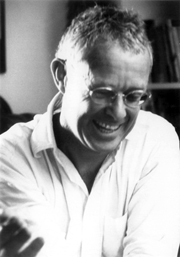
 Chris Stewart, the drummer from Genesis’ first album, is today better known as the witty author of Driving Over Lemons, A Parrot in the Pepper Tree and The Almond Blossom Appreciation Society. He visited Stanfords, in the company of Travellers’ Tales, to give a small talk on how to write travel books. It was a quick taste of the writing courses he leads for the company near his home in Granada, and gave us a chance to put a few questions to him.
I think it’s fair to say you’ve had quite a varied career, being the original drummer for Genesis, an under pig-man, sheep shearing and drumming with Sir Robert Fossett’s circus before you turned your hand to travel writing. What was it you were looking for in these different roles, what was it that appealed to you about them?
Under Assistant Pig-man as a matter of fact… well, my grandfather worked for the Bank of England all his working life. On the day he retired he told me that he felt as if he had just been released from prison. I never forgot that, and determined that I would be a jolly Jack of All Trades rather than a miserable master of one. And I have to say that each one of the occupations you mention… and there were others too… gave me an awful lot of pleasure.
Just before you started travel writing, you achieved an ambition to move to Spain, to your farm in the mountains near Granada. Firstly, why did you choose Spain and this particular area, and when making the move did you always have the idea of the book, Driving Over Lemons in mind?
I had fallen in love with Spain many years before when I studied guitar in Sevilla, propelled there by Laurie Lee’s As I Walked out One Midsummer Morning. Spain then contained enough wildness and beauty to satisfy my soul… the music, the language, the people, the architecture, the landscape… also there was just a hint of anarchy about the place that appealed to me. And then it was Gerald Brenan’s South from Granada that drew me to the Alpujarra… and once I had seen the place, I decided that here was where I wanted to lay my bones.
Nope… I had not the least intention of writing a book; that idea was foisted upon me many years later… much against my better judgement.
You have now produced three books. What was it that made you pick up the pen initially? How easy was it for you to put your family and friends in the books? And what do they and the village make of the success?
I was persuaded by my friends [see next question] who reckoned that our story was a good one and worth the telling. I protested that I knew nothing about the business of writing, but they suggested I give it a go anyway. I’m sort of glad I did as it happens… I love writing. Hmm, the family and friends… well, I think they’ve all got used to the idea that they are all material, and in general they don’t seem to mind. I must ask them what they think of it all. The village and its villagers are on the whole ecstatic about the fact that the success of the books has given a bit of a shot in the arm to the economy of the place, which before was a little on the stagnant side. Of course I have my critics and indeed my enemies, but that is only to be expected – all part of the fun.
You were, I believe, the first author published by Sort Of books, seemingly set up for you by Rough Guides’ Mark Ellingham and his wife Natania Jansz. How did that all come about?
Mark sent me to China in 1984 to write the Rough Guide to China… I had met him at a party and told him I could speak Mandarin, which to a certain extent I could. This was in the early days of the RG. We subsequently became good friends, and Mark and Nat came to visit us here at El Valero. That was the beginning of Sort Of.
When you came to Stanfords, with Travellers’ Tales, you were giving insight into how to write travel books and a glimpse into the courses run with you by the company in Granada. What made you want to begin teaching and why in this way? What, for you, are the bonuses in learning in the field and what do they learn on a night like those at Stanfords? And lastly, what’s your one big tip to budding writers reading this?
Ho… you ask questions like a Spaniard. When it’s question time at the book talks I give in this country, it goes on for hours, and each question usually has between five and nine parts, and by the time the questioner has got to the end of his composite question, you’ve forgotten what the beginning was about…
The teaching is a new departure… and great fun; I love it. It’s no bad thing for the poor timid nerd of a writer to be released from the penumbra of his lonely workplace and get out there and strut his stuff for the public once in a while. In my case it’s rather a matter of the blind leading the blind, but I do have an idea or two, and if I can help other aspirants in any way, then I’m pretty happy to do so.
The Stanfords thing… well, I wanted to make it fun and a bit lively, so I fished out a load of offbeat quotations and got the audience to participate as much as possible, which worked well. What did we learn… well, I think my main tips are to write naturally, as you would speak… and to be a listener to other storytellers as much as a storyteller yourself… and of course, read widely.
Finally, what’s coming up next for you? What will be your next book? What’s happening with the farm? And to come full circle, as you’re photographed with your guitar to advertise these events, what’s happening with your music?
More writing… It’s what I love doing best. I cannot describe the pleasure I get from writing when it’s going well… a bit like flying in a sense. I’m just back from Peru, where I spent a month wandering with a friend, Michael Jacobs, who is writing a book on the Andes [Ghost Train Through the Andes]. I hadn’t travelled for many years and sort of wondered if I was still up to it. I was, and though I had no intention of writing a book about it – I was only there for a month – the journey presented me with so much material that I think it might become part of a travel book… perhaps three or five journeys. Who can say? I loved the travel bit of The Almond Blossom Appreciation Society, the chapters in Morocco… I enjoyed writing those most and also reading them, so I think I might move in the direction of travel writing. I can’t keep banging out the same sort of books, I can already hear the critics filing their blades.
Ah, the farm… well, I’ve just been down chopping away with my mattock at the irrigation channels. I love it, but I fear it is a bit of an anachronism… a tremendous amount of work for a miserable return… apart from the incomparable quality of life that the place gives us, of course.
As for music… well, I’ve always been an atrocious musician and not fit to play with proper musicians… that’s one reason why they gave me the well deserved boot from Genesis. I just fool around with a guitar to amuse myself these days, and to annoy the womenfolk.
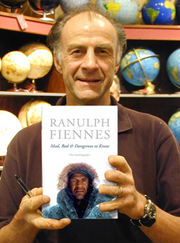 Ranulph Fiennes is one of Britain’s most famous expedition leaders, with such feats under his belt as reaching both poles by surface travel, crossing the Antarctic unsupported, and running seven marathons in seven days on seven continents. His most recent accomplishment was scaling the notoriously challenging North Face of the Eiger in Switzerland, despite a fear of heights. Fiennes, now 63, describes these adventures and more in his latest autobiographical book: Mad, Bad and Dangerous to Know. Ranulph found time in between adventures to stop into Stanfords to give some more insights into his fascinating life…


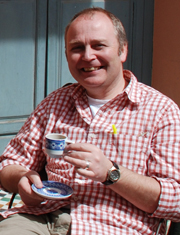
 As a highlight of Stanfords’ annual Travel Lecture season, Bill Bryson visited London to talk about his writing life and latest travels in front of 2,500 fans. We are delighted to present a full transcript of his live interview, with Douglas Schatz firing the questions.