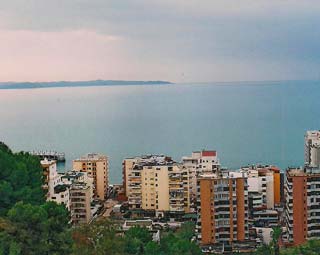
 Albania is not often on anyone’s itinerary but it is an intriguing and quite beautiful country to visit. I came across by bus from Orhid, Macedonia, and my destination was Tirana, the capital. Once the border crossing had been negotiated, which involved changing buses, helping a garrulous old woman with too much baggage, and being entertained by some blatant bribing of a customs official by a truck driver in a hurry, the bus was on its way.
The first part of the journey was spectacular. The bus meandered down through the mountains to the green countryside of small fields dotted with farms and buildings. Across the mountainsides and down into the lowlands were umpteen small toadstool-like cement lookouts – Enver Hoxha’s infamous bunkers – indestructible evidence of Albania’s isolation under his dictatorship.
Albania is poor by European standards and farming is clearly still predominantly small-scale and labour-intensive. There was a seemingly inordinate number of hens and turkeys taking the notion of free-range to its extreme. At a junction, I spotted a small wooden cart being pulled by a stocky white horse, the driver sitting behind; standing in the cart serenely surveying all around him was a thick-set brown and white bullock with a halter on. We passed through the town of Elbasan – its tall brick chimneys sticking up above the town, some smoking. In the centre, a great block of a building was almost completely covered in a huge banner proclaiming the town the home of the American University of Tirana. A little bit later, along the side of the road, nowhere in particular, was a man sitting in an armchair with a fire blazing away beside him.
The coach seemed to be taking a rather circuitous route to Tirana, for suddenly the coast appeared on the left hand side. A quick examination of my map and guidebook, and a questioning ‘Durrës?’ to a couple of my fellow passengers indicated that we were fact coming into that city before heading back inland to Tirana. Deciding I’d had enough of sitting on a coach (I’d been travelling since early morning and it was now late afternoon) and wanting to see Durrës anyway, I made a swift change of plan, and got off the bus when it pulled into the bus station. The driver looked most concerned, knowing I had a ticket for Tirana – ‘No Tirana’ he said to me several times, but I reassured him best as I could with lots of smiles and ‘Durrës, yes’. He shrugged his shoulders, unconvinced, and off I went to look for somewhere to stay.
It had been raining and was quite humid as I made my way round broken paving slabs, puddles, stray dogs, rush hour pedestrians and traffic. Durrës is a port city, and judging by the journeys being advertised by the travel shops that lined the bus-cum-train station, there doesn’t seem to be anywhere you can’t take a boat to. Despite its Communist-era architecture, Durrës is in fact an ancient city and so in between the modern and not so modern buildings, the mosques, the telegraph wires, the traffic and all the trappings of a busy if somewhat poor city, survives a large Roman amphitheatre, some evidence of a Roman basilica along with other bits and pieces, and an impressive stretch of sixth-century Byzantine town wall complete with citadel.
After getting off the bus, I hadn’t been walking for long when an elderly man with the air of a retired professor and pushing a bike appeared beside me. Albanians are reputedly incredibly friendly people and indeed this gentleman seemed to confirm the stereotype, and he spoke English. He was a violinist and worked for the local radio station; where was I going? He seemed unhappy at my choice of hostel and by way of explanation said the place was ‘mysterious for ladies’. Clarification was not forthcoming but he none the less took me to where it was. We navigated several dug up streets, dodging between holes and piles of sand and brick, before arriving at the end of a dark narrow street where the hostel I had been aiming at came into view. It didn’t look particularly inviting even if it was open, which it didn’t appear to be. The violinist suggested a hotel he knew, promising it was very close. Naturally, it was owned by ‘the son of the sister of my father’ and a good price. Hotel Nais (pronounced ‘nice’) was as he said, and a bit of gentle haggling on my part secured the good price.
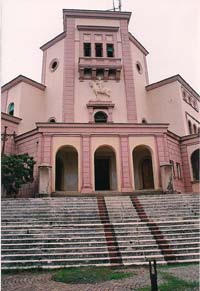 Although I am an archaeologist by profession, my interests have become somewhat warped into a fascination for derelict buildings and politically-controversial heritage. The highlight of my stay in Durrës wasn’t then so much the Roman Amphitheatre and other archaeological ruins that dot the centre of the city, as interesting as they are, but King Zogu I’s villa. Perched on a, now built-up, hill above the city, with splendid views out across the bay and the sprawl that is modern Durrës, is the grand but derelict house. It is surrounded by a high wall with the gateway blocked by great rolls of tangled barbed wire. I was standing there contemplating if there was any way I could get in when I heard a whistle. Looking up I saw a man leaning on the wall above. He asked if I wanted to come in and then disappeared, reappearing the other side of the barbed wired entrance a few minutes later. A metal bar through the tangle meant he opened it up with ease and let me in. We walked back up the drive in silence until I tentatively asked ‘anglisht?’ in my best non-existent Albanian. He shook his head and suggested ‘Italian?’. When I responded ‘Ireland’, he beamed a smile at me, shook my hand a second time and cheerfully said ‘Belfast!’… With which he waved me up the grand steps to the house and returned to his well-worn chair by the wall.
King Zogu’s villa was built in the late 1920s, designed by Kristo Sotiri in the stylised form of an eagle. After King Zogu fled, it was used by the Communist Party to entertain guests – apparently both Nikita Khrushchev and Jimmy Carter stayed there. It was returned to the Leka Crown Prince of Albania in 2007 but it had been badly damaged during the 1997 unrest in Albania and this is the state it was still in when I explored it.
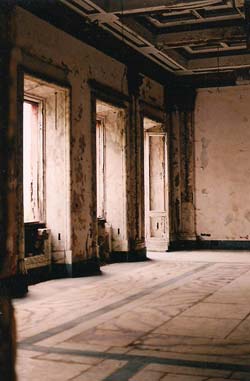 Even with the vandalism and decay – peeling paint, crumbling plaster, not a door or window surviving and all the fixtures and fittings long since ripped out – the grandeur of the place is still evident. From the full-height hallway is a marble staircase that divides in two and curves up to take you to some huge and grand rooms with marble floors, compartmentalised and moulded ceilings and long windows that look out over the bay. I wandered through rooms and up and down staircases, crunching over bits of fallen plaster and avoiding holes, imagining what it may have been like. A storm was brewing over the bay – the rumble of distant thunder and the dramatically darkening sky over a steely grey-blue sea adding a foreboding atmosphere to the derelict and empty house.
On leaving, I had planned to visit the amphitheatre but the great drops of rain beginning to fall suggested something to eat and finding out about train times for Tirana for the next day were better options. Taking the train to Tirana was to turn out to be an experience all of its own…
For my month-long Balkan trip, I used the Lonely Planet Western Balkans.
Author: Caroline Sandes
- Browse our collection of maps and guides to Albania:
- > Albania travel guides
- > Albania road maps and atlases
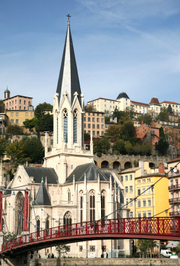 Thomas Morvan has come from France for an internship with us at Stanfords in London. Here, he shares the highlights of Lyon, where he is studying Business.
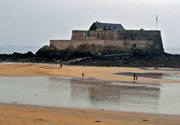 Our cycling trip began with an overnight ferry from Portsmouth to St Malo, and after this sleepy start, we began in earnest – cycling off the ferry onto French soil where we’d spend the following week pedalling past the beautiful coastline, canals and villages of north-east Britanny.
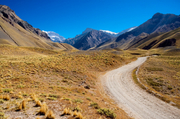 ‘Felices Navidad!’ hollered the voice at the end of the distorted phone line. Irritated at having Christmas lunch disturbed, the family was instantly placated by the sound of my brother’s voice coming down a satellite phone from camp one, high on the flank of Aconcagua.
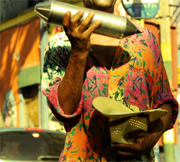 Since the collapse of the Peso, Argentina has gone from the most expensive country in South America to one of the cheapest. This has made Argentina into a hot destination for budget travellers for the first time.
 Here at Stanfords we use all types of mapping, and recently, we’ve become rather taken with digital mapping. Here, digital mapping specialist Craig Wareham makes the case for one of the latest developments for walkers – digital mapping on mobile phones.