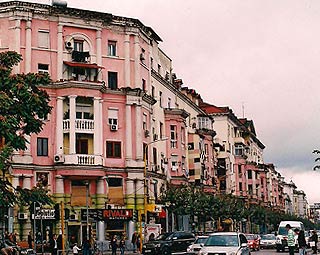
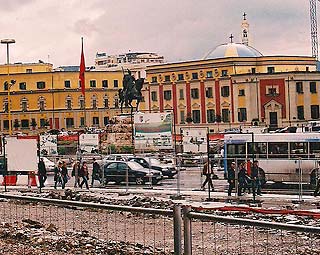
 Central Tirana was a building site. The magnificent statue of Skanderberg astride his horse in the main square, Sheshi Skënderbe, was marooned on a small island surrounded by dug-up streets, piles of sand and general roadwork chaos, and that was in addition to the four lanes of traffic.
I had taken the train from Durrës to spend the day in Tirana. The train journey was an experience in itself. I bought a ticket for the one-hour journey for the vast sum of 70 lekë, approximately 50p, and waited to catch the 08.45. The train eventually appeared, a huge rusty old locomotive pulling what were old, probably Italian, carriages. Albanians only take the train when they can’t afford to go by bus for what became obvious reasons. I clambered up from the low platform and looked for somewhere to sit. They were lovely old compartmentalised carriages, all wood and leather and sliding doors, but what a state they were in: broken and ripped seats, cracked and shattered windows and a general air of sad neglect. There were hardly any passengers and, finding a compartment with a usable seat and a window that could be seen out of, I joined an old lady. She was thin and slightly bent, carefully dressed in black and with her silver hair cut into a neat bob. She had a kindly face and wanted to talk, but as soon as it became clear that I could speak neither Italian nor Albanian (being completely dim when it comes to languages), we could only smile apologetically at each other, and make the journey in silence.
A conductor arrived to check tickets. As if to counteract her surroundings, she was very smartly dressed in jacket, skirt and high heels. She was clearly amused to find a tourist on her train, but her mobile phone soon distracted her and off she went, talking at high volume.
The train proceeded at a gentle jog of a pace that was perfect for being able to alternatively stare out the window and read but left it vulnerable to occasional stone-throwing children, which explained the cracked and shattered windows. There seemed to be no lights so every time the train went into a tunnel the carriage was plunged into darkness. Nevertheless it was a pleasant journey and we pulled into Tirana station more-or-less on time. Having checked what time return journeys were, I went off to explore central Tirana.
I decided first to visit the National Historical Museum of Albania, though the road works obscured the entrance and it was only after a full lap of the large modernist building, I finally found the way to the front door. Having deposited my bag and had my attempts at saying thank you in Albanian corrected by the lady at the ticket desk, I headed into the first section. Unfortunately I had managed to time my visit with a group of Germans being given a detailed guided tour, so I skipped ahead, happily if somewhat guiltily (I’m supposed to be an archaeologist) missing some of the prehistoric material. All the labels were in English and the museum went right up to the second world war and the Albanian Resistance. The gallery detailing the Enver Hoxha period was closed for renovations (or revision?), which was a pity as it is always interesting to see how national museums deal with the more complicated bits of their national history. In Zagreb, for example, the Balkan wars of the 1990s was a tiny section in a room at the end of a corridor, sandwiched between displays about the history of Croatian animation and a visit from the Pope. In Belgrade, the national museum was completely shut up and looked on the point of dereliction but you should see their Military Museum…. The German tour group caught up with me in the section on Albania’s struggle for nationhood. This was followed by the gallery on the second world war, at the entrance to which the museum guide ceased his detailed tour and disappeared, abandoning the Germans to their own interpretations.
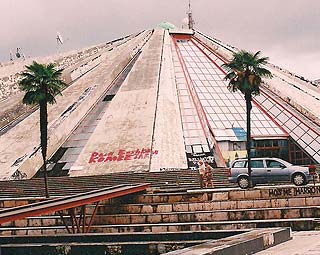
Having brushed up on Albania’s history, I wandered on towards the river, past the very pretty Et’hem Bey Mosque which had somehow survived destruction during Hoxha’s clamp down on religion in the 1960s, in search of a surviving section of Justinian city wall and on to see if I could find Hoxha’s residence. This was actually located in a very trendy and expensive part of Tirana – full of seemingly cloned people wearing the same things, brandishing the same designer labels and languishing about drinking expensive coffee (had I unwittingly stepped through a wormhole onto King’s Road, London?). I retreated back to the river, pausing to admire the huge, truly alien-looking pyramid-inspired and ugly as hell building that was once a museum to Hoxha. It was designed by his daughter, Pranvera, and her husband Klement Kolaneci and completed in 1988. Once marble-clad, this rather unique, architecturally as well as politically, building was looking very dilapidated and sadly is to be demolished. It is to be replaced by a new and, of course, much bigger building for the Albanian Parliament.
A torrential downpour from a heavy sky that had been threatening it all day drove me to return to the train station. Time to get back to Durrës to plan the next day’s travels. I wanted to go on to North Albania, to Shkodër to visit the amazing Rozafa Fortress, and from there cross the border into Montenegro…
For my month-long Balkan trip, I used the Lonely Planet Western Balkans guide book, the Lonely Planet Eastern European phrase book, and the Freytag & Berndt Balkans/South-East Europe map.
Author: Caroline Sandes
- Browse our collection of maps and guides to Albania:
- > Albania travel guides
- > Albania road maps and atlases
2ZUS25MSDMR