Laos is a spectacularly beautiful country, but it is also one of the poorest countries in the world. This makes for hugely sharp contrasts between devastating scenery and desperate poverty. With no railways to speak of and only 2,000 miles of paved roads, the infrastructure for tourism is very undeveloped. Running water and electricity are scarce, although pylons run the length of Highway 13 now and millions of kilowatts of electricity are exported to Thailand each year.
Despite the glaringly obvious hardships the people in Laos were wonderfully friendly. The sight of us all streaming through their villages brought everybody out onto the roadside – quite what they thought we were doing we’ll never know, but we were always greeted with great charm and enthusiasm.
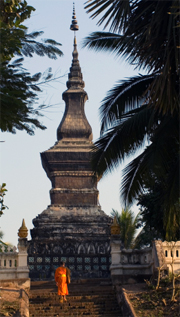
We started our ride in the Unesco World Heritage site of Luang Prabang and cycled all the way down Highway 13 to Vientiane, the capital of Laos. Luang Prabang is well loved by those who have travelled through it – it is a relaxed town up in the Annamite mountains, on the banks of the Mekong River. Monks in saffron robes stroll together between wats, visitors drink the ubiquitous Beer Lao in comfortably dilapidated cafes and somehow it feels like a monastic Cambridge or Oxford.
We left at dawn on a Monday, and could hear the drumming in the wats through the chilly mist rising off the river. Roadside food stalls were being set up as we pedalled through the town and out into the hills. We spent our first two days climbing here – 2,300m on the first day alone, punctuated by a Baci ceremony at noon.
At a village by the Nam Khan river, the bomber-jacketed headman recited words of blessing to us. A meal of sticky rice, a dried chicken and a petrol canister of the notorious lao lao fermented rice liquor was laid out on a wooden table, to persuade our body’s thirty-two residential spirits not to wander too far from us during our undertaking. The villagers then helped to tie white cotton threads or saisins around our wrists, which would offer us protection and luck. This is the single most important animist ritual in Laos, so powerful and integral to Lao culture that it is widely practised even among Lao Buddhists, who make up over half the population.
Although deeply forested, the mountains around us were almost silent. Birds here are seen and not heard – usually hanging brightly-feathered but dull-eyed from a doorpost, their feet bound with twine. The Hmong live in simple wooden huts on the edge of the mountain roads. Pot-bellied pigs, cows and turkeys rule the street, while children wriggle out of the glassless windows to shout ‘sabbadee!!’ (hello, we hope).
We stayed at night in the classrooms of local schools, burying ourselves deep into our sleeping bags as once the sun had set the temperature plummeted. Each morning we’d get up in the dark at 5.30, pack up, eat and be ready to set off at first light. Often we wouldn’t reach our destination until dusk – they were long days in the saddle! But magical – particularly the second morning where we were threading our way along the mountain ridge villages, and looking down into the cloud-filled valleys through the gaps between the huts. The descents were fantastic too – Highway 13 was paved in 1996 and carries little traffic so a 40km continuous downhill is pure cycling pleasure. As you start to drop into the plains incredible scenery presents itself in the distance – freestanding limestone karsts, clad in dense vegetation. Hazy in the heat you can also make out the highway like a river thousands of metres below you.
By Viang Vieng, a popular traveller’s haunt on a bend of the Nam Song River, you are out of the mountains and in the midst of this spectacular karst scenery. The children were coming out of school as we cycled into town, and the girls are dainty and elegant in their clean white cottons, pedalling gently with a parasol held in one hand for shade. We heard our first English here too, as the boldest of them asked, ‘How are you?’ and, ‘Where you from?’ as we pedalled alongside.
Out into the plains the next day, and it’s harvest time. It is mostly men and older boys working in the fields, watched lazily by water buffalo immersed in mud. We find ourselves longing to be water buffalo. The traffic is getting heavier as we near Vientiane, and a relative prosperity is becoming apparent – more people are travelling in motorized vehicles (scooters, cars, even the odd 4×4), the huts are now outnumbered by half brick, half wood houses with glazed windows. Adults at the roadside seem more reserved, even disinterested. The temperature soared in those last few days – at one point it was 36ºC in the shade – and we watched our forearms and legs cook in the constant exposure to the sun. This heat and an accumulated fatigue has blurred my memories of our arrival at Vientiane, although we did cycle past the immense golden temple complex of Pha That Luang, Laos’ most important national monument, and through Laos’ Arc de Triomphe, known as the Patouxi (Victory) monument.
But our journey didn’t quite end here – now garlanded with flowers it was back on the bikes for the final few kilometers to the much-dreamt of luxury of the Novotel Vientiane – with Lao massage and a swimming pool, perfect for showing off our Friesian suntans.
If you are going to cycle, take the TPC J-11D Central Laos, NE Thailand, Central Vietnam, a map which will give you contour lines and peak heights.
For general reference ITMB’s map covering Laos which includes a street plan of Vientiane, and the excellent Footprint Handbook to Laos.
Browse our collection of Laos Maps and Guide books here >
Laos travel information >
Author: Laura Stone
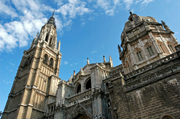 I was 14 the first time I visited Toledo. My school in Vitoria (Northern Spain) organised a cultural trip to Madrid and a visit to Toledo was included. I remember I didn’t enjoy the city that much: too much culture concentrated in the same place for a boy looking just for fun. We wandered around the city and we left early because most of my classmates were bored as well. Fifteen years later I felt that I was missing something from that visit to Toledo and decided to go back. I managed to catch a cheap flight to Madrid and stayed in a “pensión”. I have a special relationship with Madrid and before my visit back to the old capital of Visigothic Spain, I decided to stay for a couple of days in the capital of the Modern Spain, enjoying its weather, food and friendly people. Connections between Madrid and Toledo are plenty and regular, either by train or by bus, and the trip doesn’t take more than an hour. Toledo remains almost exactly as it used to six centuries ago. From the old town you can still see the council flats of new Toledo in the distance, but they’re as far away as they could build them from this wonderful gem of the “”Old Castille”. You could easily admire everything in one day but if you want to take in all that the city offers then you had better stay overnight. Accommodation is quite pricey though. Going up and down the narrow alleys you will be able to discover the three main influences and styles of the city: Christian, Jewish and Muslim. Mesquites, cathedrals and synagogues live now in perfect harmony one next to the other. On the top of the hill, the Alcazar de Toledo dominates the horizon. El Greco’s fans will be able to admire probably the most impressive of his works, Entierro del Conde de Orgaz, in the Casa-Museo de El Greco.
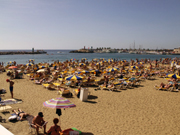 After deciding to break my own travel code, (never to visit the same place twice), I looked forward to visiting Puerto Rico in Gran Canaria once again.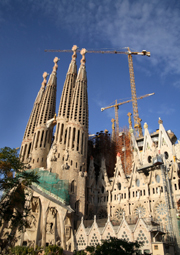
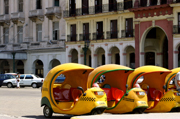 On the outskirts of the sleepy little beach town of Baracoa, in semi-tropical eastern Cuba, there is a chocolate factory. The local delicacy, somewhat bizarrely called Peter’s, is produced there – as all the guidebooks will inform you. What most of them don’t say is that this factory was inaugurated by none other than ‘El Che’ himself during his time as Minster of Industry (1961). There’s a great photo opportunity outside where a large billboard advertises the fact. Most taxi drivers will want to hurry you past with only a cursory glance but it is possible to arrange an impromptu tour – given the right relationship between dollars and palms! In town there’s a wonderful, shabby café that only serves chocolate, either in slabs with a knife and fork or as a rather glutinous hot or cold drink. My companion thought it was salty, I thought it was great – one thing’s for sure, it’s not Cadburys!
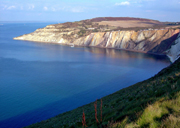 The Isle of Wight first became a popular holiday destination due to Queen Victoria. The building of Osborne House suddenly made the island the place to be seen, and the development of Cowes as a playground for international yachtsmen helped foster this image.