Live Large in Paris & London!

Live large in Paris and London without spending big. Frommer’s introduces Free and Dirt Cheap guides to two of the most expensive cities in Europe.

Most travellers, whatever their budget, are now looking for the best value-for-money options and Frommer’s is delivering the answers by searching out the free and best value deals in London and Paris. Frommer’s London and Paris Free & Dirt Cheap are two new practical and thrifty guides for those who want to enjoy the finer things in life for less.

The £12.99 guidebooks are written for residents as well as visitors, and offer readers a multitude of choices, fresh ideas, insider knowledge on local shortcuts and essential tips to maximise their time in London and Paris. Continue reading Live Large in Paris & London!

Essen, Germany

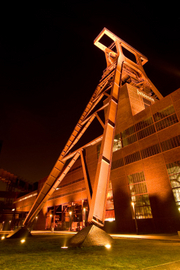
This industrial metropolis is catching up on the cultural scene and is really beginning to buzz, confirmed by its status as European Capital of Culture 2010. Admirers of engineering and architecture will be kept well occupied, yet Essen is one of Germany’s greenest cities, with 9.2% of its area claimed by nature. The city’s greenbelt follows the Ruhr River to the 9km-long Lake Baldeney, where sunny days can be spent swimming, windsurfing, or picnicking and sunbathing on the lakeside stretch of beach. Back in the city centre, there are plenty of sights and entertainment venues to make Essen a dynamic city break; here’s a taster…

Top 5 sights and attractions

Be stunned by the 1,030-year-old Golden Madonna in Essen’s cathedral. The cathedral’s sturdy octagonal tower dates from 1000 AD and miraculously survived World War II’s bombing raids.

See Germany’s largest synagogue, the Alte Synagoge, whose splendour reflects the former importance of Essen’s Jewish community, which at its peak in 1933 reached 4,500. Continue reading Essen, Germany

Nepal and China finally agree on Everest height

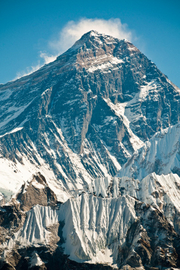
China and Nepal have resolved a long-running dispute over the height of Mount Everest.

They have now agreed that the world’s highest mountain – which straddles the border between the two countries – should be officially recognised as being 8,848m tall.

The Chinese previously argued it should be measured by its rock height, while Nepal said it should be measured by its snow height – four metres higher. During talks in Nepal’s capital Kathmandu, China accepted that claim. Nepal also recognises China’s claim that the rock height of Everest is 8,844m.

The mountain’s exact height has been disputed ever since the first measurement was made in 1856. The widely accepted height of 8,848m was first recorded by an Indian survey in 1955, which measured the mountain’s snow cap, rather than the rock beneath it.

But geologists say that both the estimates could be wrong as they say the mountain is becoming higher as India is gradually pushed beneath China and Nepal due to shifting continental plates.

In 1999 an American team recorded a height of 8,850m with GPS technology – a figure that is now used by the US National Geographic Society – although it has not been officially accepted by Nepal.

Browse our collection of maps, guides and travel literature:
> Nepal travel guides
> Nepal road maps and atlases
> Travel literature inspired by Nepal

Top Tips for a Tip Top Gap Year

Once you have fought off the doom-mongers who maintain that flitting off to a distant corner of the world on a gap year is irresponsible in these recessionary times, turn your attention to deciding where to go, what to do and who to go with (if anyone). The range of choices can be overwhelming – studying lemurs in Madagascar, backpacking around Indonesia, teaching English to Ecuadorian children, picking fruit in New Zealand to fund some adventure travel, working a season in a French ski resort, learning Spanish in Argentina, and so on.

The best advice is to do lots of research – starting, dare I say, with my book Your Gap Year. Let the ideas swill around in your imagination and see what floats up.

The next step is to do some hard-headed planning. The first question is always: how can I afford a gap year? Most gappers spend at least half the year working and saving hard, knowing that their reward will be a full moon party, a watersport instructor’s course on the Mediterranean, a bungee-jump in New Zealand or any of a thousand adventures.

Remember that you have only to take a firm decision for a crazy idea to become a reality. Once you have announced your travel plans to parents and friends and there is no going back, don’t worry about the odd moments of blind panic at the prospect of leaving ‘it’ all behind. These are guaranteed to evaporate within 48 hours of disembarking at your destination.

Whatever you decide, here are some handy practical tips to help your gap year go smoothly:

• Look at the advice concerning personal safety given by the Foreign Office (www.fco.gov.uk). On arrival in countries where embassy officials may need to track you down in the event of an emergency, register your details and itinerary on the FCO’s LOCATE service (www.fco.gov.uk/en/travel-and-living-abroad/staying-safe/Locate).

• Shop around for travel insurance and make sure you are covered for everything you intend to do e.g. working and sports. Expect to pay roughly £25 per month for basic cover and £30-£40 for more extensive cover for a policy that covers the whole world.

• Keep a record of travel document details, like passport number, insurance policy, driving licence, travellers’ cheque serial numbers, tickets, emergency number for cancelling credit cards, etc. Scan and email this information to yourself so that you can access it at any stage from an internet café.

• Have several ways of accessing money rather than relying on one bank card that can be lost, stolen or damaged.

• Carry valuable items (like passport, essential medicines and, of course, money) on your person rather than relegating them to a piece of luggage which might be lost or stolen.

• Only pack items you are prepared to lose. Flashy clothes and electronic equipment may attract the attention of pickpockets.

• Learn a few key words and phrases in the local language, so as not to seem arrogant in assuming everyone communicates in English.

• Be aware of the laws, customs and dress code for the country. Guidebooks should provide all this information.

• Online banking is a great way to manage your finances while you are away. But many internet cafés are slow and access may not always be easy so don’t leave important transactions until the last minute.

• If you are volunteering through an organisation, ask for the contact details of some recent volunteers on your project. They should be able to give you advice about the project.

• If you are staying in one country for several weeks, consider getting a cheap local mobile phone or a local SIM card for your UK mobile. Local texts and calls will be cheaper and incoming calls from abroad are free, which avoids the massive charges when using your UK mobile.

• Most importantly, have a ball! Pay attention to your instincts and aim to achieve that perfect balance between travelling safely and enjoying yourself. If you are over-cautious you might miss out on something amazing, but at the same time you want to avoid unnecessary risks.

Browse all books by Susan Griffith. Author: Susan Griffith Date: 06/04/2010

Walk of the month: Blagdon Lake, Somerset

Ranulph FiennesOur second Walk of the Month from writer and journalist Christopher Somerville, who lives and loves the Bristol area…

A male blackbird, yellow bill a-tremble, was making tentative inquiries of a drab brown female on a bough in the New Inn’s garden as I started down the hill towards Blagdon Lake. The celandines were still curled tight and green along the high-banked lane, but there was a breath of warmth in the low sun, more than Somerset had felt for the past three months.

For well over a century Blagdon Lake water has been piped to Bristol’s taps, ten miles over the hills to the north. Crossing the broad dam of the lake, I heard the subdued roar of the flood-engorged weir where snowmelt and swollen streams were sending their waters surging down the spillway. I followed the fishermen’s path through the trees along the north bank of the lake, then struck out across fields thick with the winter’s mud to reach the lane by Bellevue Farm – well named for its prospect of water and hills.

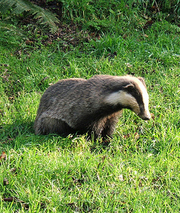
A little way up the lane I was pulled up short by the sight of a large badger squatting on its haunches in a cottage garden. It shouldn’t have been out of its sett this early in the year, and it certainly should have fled at sight of me, instead of fixing me with a sleepy stare. It was I who walked away, leaving the badger master of the place.

Blagdon Lake SomersetThe southward views grew better and better as the lane rose, until at the top of Awkward Hill I looked down over fields patchworked with green grass and red ploughland, out across the whole expanse of Blagdon Lake to the steep wall of the Mendip Hills beyond in early afternoon shadow.

The late winter light, already beginning to diminish, lay softly on the lake with a blurred sheen more like watered silk than the hard mirrored effect of a summer day’s sunshine.

Down by the lake once more, I squelched towards Blagdon over boggy meadows where wild geese went lumbering into the air at my approach, trumpeting reprovingly. It was almost time for them to be off to their mating and brood-rearing, 2,000 miles north of these green Somerset fields.

Back at the New Inn, sitting on the terrace with a cheddar ploughman’s and a kingly view over the lake, I heard the love-struck blackbird – or possibly another like him – still singing for spring.

Route map

Blagdon Annotated Map
Due to licensing restrictions in place on Ordnance Survey mapping the mapping extract must be removed prior to printing, or all printing must be limited to 10 paper copies or less and used for personal use only.

Chris’s map annotations:

1 – A368
2 – New Inn
3 – Park Lane
4 – Dam
5 – Awkward Hill
6 – Industrial Chimney
7 – Holt Farm

Route profile

Blagdon Route Profile
Use this GPX file: Bladgon Lake Walk (8 KB) for importing the route into digital mapping products, such as Memory Map and Anquet or drop it straight onto your GPS unit. Check the instructions for your particular model to see how this is done.
Use this KML file: Bladgon Lake Walk (46 KB) to see the route in Google Maps (under My maps) and Google Earth.

Start & finish

New Inn, Blagdon BS40 7SB (OS ref ST 505589)

Getting there

Road: M5 Jct 21; A 371, A368; left in Blagdon opposite Live & Let Live PH to New Inn.

Walk

5 miles, easy grade, OS Explorers 141, 154

From New Inn, walk down Park Lane, along the reservoir dam wall. On the far side, go right (504603) beside reservoir for half a mile, then forward (511608) to Bellevue Farm at West Town (517604). Left for 10 yards to road, right for three quarters of a mile; 300 yards past the top of Awkward Hill (nameplate), right over stile (527600), following path over stiles, down across fields to road (529593). Left for 250 yards; just before industrial chimney, right (531591 – footpath sign) into damp fields. Follow the footpath close to the reservoir for 1 miles; 500 yards past Holt Farm, bear left (510591) on an uphill path back to Blagdon.

Lunch: New Inn (tel: 01761 462 475), superb lake views from garden; NB no children indoors.

More info: Wells Tourist Information,tel: 01749 672 552; www.visitsomerset.co.uk.

See books by Christopher Somerville.
See his website: www.christophersomerville.co.uk.

Author: Christopher Somerville
Volcanic eruption in Iceland

A long-dormant volcano has erupted in Iceland. The volcano, near Eyjafjallajoekull glacier in the south of the country has been dormant for 200 years, and its eruption has ripped a 1km-long fissure in a field of ice.

With lava soaring hundred metres high, Icelandic airspace has been closed, flights diverted and roads closed. A state of emergency is in force in southern Iceland and about 500 people were moved from the area. Continue reading Volcanic eruption in Iceland

Belgium – Brussels

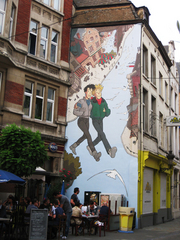
BrusselsLast year, I went to Brussels for six months to undertake an internship in a publishing house. I really enjoyed living in this European city and I would like to share my experience and feelings about that place.
Brussels is often described as a boring, untidy and dirty place, but if you take the time you will discover a really amazing and vibrant place. Here are the things that I enjoyed the most about this city…

Firstly, Brussels is a really dynamic place: The universities and the European commission attract a lot of students from the entire world, coming here to study or to do internships in the European institutions. On Fridays and Saturdays, going to the Delirium Café – a famous bier bar located in the medieval Rue des Bouchers – will allow you to feel the craziness of the student nights in Brussels! During the summer, there are also a lot of festivals and events organised by the city, like les Apéros Urbains or the famous Brussels Summer Festival, an entire week of concerts bringing together the best artists of the moment. Continue reading Belgium – Brussels

Gap Year Reads: Fiction to Fling in the Backpack

Wherever your gap year travels take you and however enthralling the trip, there will be moments when a good book to read is just what you need. Whether it is to fill time whilst waiting for a departure, to relax in a quiet moment away from all the excitement or just to close the chapter on your day’s activity, finding room in your rucksack for that work of fiction is something you won’t regret.

Some people opt for a mighty tome to last, such as Tolstoi’s impressively humongous War and Peace or A Suitable Boy by Vikram Seth, using the time away to embark on reading something that they haven’t found the opportunity to get through before. Others choose a slimmer volume, for example the cult classic Jack Kerouac’s On the Road or Gabriel Garcia Marquez’s One Hundred Years of Solitude, then look to trade it en route with fellow gappers when finished. Either way, something location specific can enhance a trip and inspire you with ideas and enthusiasms for your own travels. 

Shantaram by Gregory David Roberts is a current chunky favourite and is a modern-day saga based on a specific period of the author’s life. Encompassing everything from philosophy and ethics to underworld crime and war, and set in India and Afghanistan, it is something to keep your mind engaged and give you ideas to grapple with.

Other titles that I would add to the list of books designed to last you a significant chunk (if not all) of the way round wherever you are would be Cervantes’s tale of the noble knight, the errant Don Quixote, Olivia Manning’s The Balkan Trilogy – an epic evocation of a marriage and a breaking 20th-century world, James Clavell’s Shogun, set in Samurai Japan, and The Count of Monte Cristo – a classic tale of a miscarriage of justice, providence, retribution and fate by the 19th-century French great, Alexandre Dumas.

Alex Garland’s The Beach (set in Thailand) and Dan Brown’s The Da Vinci Code have been the choice of those wanting an easier, escapist read in recent years, with the more literary reading options often being something such as the Mann Booker winners Life of Pi and The White Tiger, Ian McEwan’s film-adapted Atonement or Rose Tremain’s Orange Prize-winner The Road Home which centres on Lev, a Polish migrant worker who journeys to London, both to seek and escape, on a path that leads him home to where his heart is.

A perennial favourite for the more surreal backpack is Mikhail Bulgakov’s Master and Margarita, a title harder than most to condense into a summary…suffice to say that the devil, in the guise of a magician, lands himself and his entourage (which includes a human-sized upright walking, talking, chess-playing cat) in 1930s Stalinist Moscow, with the general and targeted aim of prodding a few consciences and scoring a point or two for the artist’s right to self expression and freedom from state control.

Esther Freud’s Hideous Kinky has accompanied people to Morocco. Haruki Murakami has been the choice of those heading to the Far East with titles such as Blind Willow, Sleeping Woman and The Wind-up Bird Chronicle. With Rohinton Mistry’s novels A Fine Balance and Tales from Firozsha Baag and Salman Rushdie’s Midnight’s Children and Satanic Verses likely to accompany a trip to India. There is even the wide-reaching Edward Rutherfurd, whose epic tomes encompass the entire histories of Russia (Russka), Ireland (Ireland Awakening), London, and New York.

The chances are that there is a novel set either where you will be going, where you have been or where you might want to go in the future…so save a little space in your back pack and see whether fiction really is stranger than the reality that’s out there!

See also: Gap year gear – Top 10  Author: Sam Golding

USA – New York

I went to the largest city in the USA for New Year’s Eve, when the freezing wind blows all day long, piercing your skin.

It would be impossible to describe my whole trip, so here are the main places I went to during my stay in “the capital of the world”.

New York will not leave you indifferent. It astonishes by its gigantism and captivates by its diversity. And yet everyone knows New York. The photos and movies are endless and I felt I had already been here, but I soon realised that everything is more than I thought – bigger and higher!

One of the most amazing experiences I had in the Big Apple was to cross the Brooklyn Bridge that is suspended over the East River linking Manhattan to Brooklyn. Along two kilometres, traffic on the Brooklyn Bridge is on two levels, one for motor vehicles and one for cyclists and pedestrians. From the bridge, the view is beautiful, and you feel very small! Continue reading USA – New York

Five minutes; five questions with… Simon Calder

It’s been a while since our last interview with Simon Calder, so we caught up with the intrepid travel editor and broadcaster while he was shooting his latest travel film in our Covent Garden store.

What are you working on at the moment?

We’re filming for the One Show, we’re asking the question, do we really need British Airways in a time when the traveller has never had so many opportunities and where BA is going through some difficult time? We’re basically saying, well, do we still need you? Continue reading Five minutes; five questions with… Simon Calder