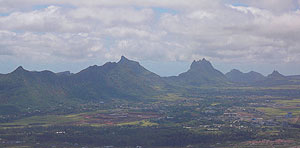
 It’s true; Mauritius is not usually thought to be a destination for hikers and mountaineers. Consider the tourist brochures depicting luxury hotels, fine white sands and blue lagoons. Think of the boredom of hearing that yet another couple is planning to take their honeymoon on a little bit of paradise in the Indian Ocean. Go on, you could even confuse Mauritius with the Maldives, and assume there are no mountains at all and that the country will soon be the first casualty of rising sea levels. Continue reading The Mountains of Mauritius
Castletownshend Travel Guide: West Cork, Ireland
It is advisable to be good at ascending and descending in this part of West Cork, whether on foot or in a car (or, if you are masochistic, by bicycle) as almost nothing is on the level. The small fishing village of Castletownshend is a case in point. The narrow main street is ridiculously steep – walking up it requires a sort of 45 degree lean forward – and even driving up and down it can be a tad challenging. There are the twin trees that grow in the centre of the road, about half-way down in their own large raised stone-walled plot, that drive all but the smallest of cars onto the pavement going down the hill. Coming up requires careful navigation both to get round the trees and to avoid hitting anybody coming out of a side street at that point. Any failure to stop at the bottom of the main street will take you either off the quayside into the sea or into the castle… Continue reading Castletownshend Travel Guide: West Cork, Ireland
Win an Olympus TOUGH Digital Camera

*This competition is now closed.*
We’re giving away an amazing Olympus TOUGH TG-1 digital camera worth over £350 in association with Lonely Planet.
To enter simply complete the form below
Second prize is either a Lonely Planet City guidebook or the Lonely Planet guide to Travel Photography. Good luck! Continue reading Win an Olympus TOUGH Digital Camera
The ‘Art’ of Travelling Solo
 ‘No suitcases and no boyfriends’ has been my (albeit tongue-in-cheek) rule since my first bit of extended travelling. Travelling light has its obvious advantages, but travelling on your own? The no boyfriends bit came about with a European Interrail trip at the tender age of 21. My then boyfriend morphed into a complete moron and was thoroughly uninterested in anything; ‘but I can see that in a book’ he moaned as I attempted to drag him round Pompeii. Enough said.
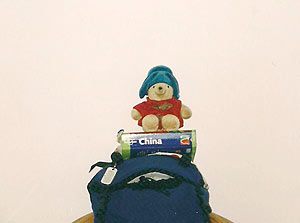
So, since then I have travelled on my own (if we don’t count Paddington Bear who always comes with me) all over the world – Asia, Middle East, Africa amongst other continents – some forty odd countries at this stage. Travelling on a low budget and with only the vaguest notion of an itinerary has meant that virtually all of my travel has been of the unorganised form – public transport and cheap places to stay that I find as I travel. It’s all added up to my having had a fantastic time, meeting many wonderful people, and with only, touch wood, a couple of hairy moments to date.
Recently, however, someone came into Stanfords asking for a non-existent book called ‘the art of travelling solo‘, which got me thinking. Is travelling solo an art, or simply a case of the kind of person you are? Arguably, if you are a bit introverted, persistently restless, have some odd interests (being an archaeologist with a bent for political heritage, modernist architecture, cities, or anything a bit quirky, for example), and have a tendency to worry about other people, travelling with anyone else can be quite stressful: no, I don’t want to spend hours on a beach or to go shopping (unless its a book shop or to wander around an exotic souk); I definitely do not want to spend all my time in one place or hang around some soulless resort or chain hotel with nobody but other tourists. I want to at least get a glimpse of how life is like in the country where I am, stay where I like, wander about, investigate that odd thing I’ve just come across, change my plans at the last minute, eat when I like, and have conversations with the people I meet and all the time not be worrying that my companion is bored, tired, hungry or why they are in a bad mood; nor do I want to worry about upsetting them when I’m feeling less than cheerful. But what kind of person should consider travelling solo, and how do you manage on your own?
Here are a few suggestions from my own experiences.
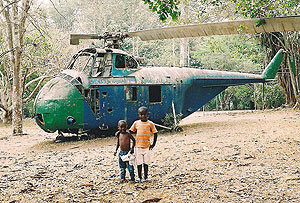 Perhaps the first rule of travelling alone is to be happy in your own company. I’ve gone for days and days without having a proper conversation and with only my thoughts and my book (and Paddington) for company. If you are someone who finds that spending anytime at all alone sees you reaching for the phone, logging onto Facebook, checking your email or needing to go and spend time with someone who knows you, do not travel on your own, you will be miserable. The second rule is being able to rely on your own resources: travelling can be quite stressful and there will be days when everything goes wrong and you will curse yourself for not being able to stay at home in the safety of your armchair. If you are the kind of person who finds it hard to manage any kind of crisis without calling a friend, your mother, the Samaritans, anyone else who can sort it out for you, don’t travel on your own. Having said that, solo travel is a wonderful opportunity to get to know yourself and to develop confidence in your own abilities; you may well surprise yourself.
The third rule connected to the above is avoid getting yourself into trouble in the first place and to know what you are going to do if it does all go wrong: take a reliable guide book, maps, a phrasebook; get your shots, malaria tablets etc; take out travel insurance; keep a photocopy of your passport, a credit card and some spare cash in some internationally recognised currency – e.g. US dollars or Euros – separate from your main stash; take the details of your embassy/consulate with you; leave copies of vital documents at home with someone you can call in an emergency. In short, know what you are going to do if all your money is stolen; you lose your passport; or you are struck down with some bizarre illness.
As a woman travelling alone and one without a lot of physical strength – petite let’s say – my general aim is to avoid drawing attention to myself. Now, I know for most women this is an anathema but trust me, if you are travelling on your own, particularly in more ‘macho’ or conservative /Islamic countries, this is important. It shows infinitely more respect both for yourself and for those women around you if you dress conservatively, and you will be afforded more respect for it. In some countries, western women are occasionally treated as sort of ‘honorary men’ – for example in Mali I was included in the tea-drinking and discussion that most men engage in; and while crossing the Syrian-Turkish border, I had been patiently standing in the women’s queue, when a elderly man appeared and ushered me up to the top of the men’s queue (which made me feel guilty, particularly when some of the other women scowled at me). In short, make sure you have some understanding of the culture of the country you are going to and dress accordingly. You’ll be much safer that way, though even I’ve had enough ‘propositions’ and marriage proposals that would have kept me in divorce proceedings for years so always be prepared to deflect any unwelcome attention, preferably politely. On the other hand if your primary interest is to get a tan and to saunter about in your bikini, get thee to a resort! And that goes for men too (especially if you want to wear a bikini…).
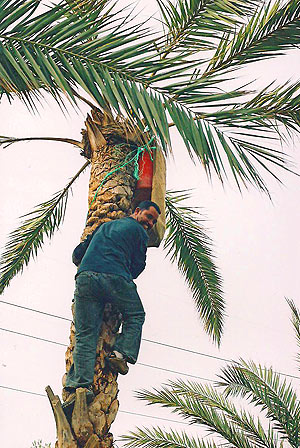 One of the great pleasures of travelling on your own is that you inevitably have all sorts of conversations. Travelling up the Yangzte in 2001, I spent most of a day talking with a woman called Lu. She could not speak English and I could not speak Mandarin but with the help of my phrase-book cum dictionary, and the occasional help from someone passing who had a smattering of English, we managed. Another time, a conversation with a chatty stall-owner in the small town of Gabès in Tunisia led to me spending an entertaining evening with a group of Tunisians in a palm grove eating fish cooked over a fire and drinking palm wine, got down from a nearby palm tree (the less said about the hangover the next morning the better). Then there was the time I was eating dinner in a small restaurant in Mysore when an Australian guy of Indian origin asked if he could join me. It turned out the poor man had been completely ripped off (never ever let your credit card out of you sight); he just wanted to talk about it with someone. At the end of dinner he gave me a book he had been reading – Shelia Paine’s – Afghan Amulet – which is superb and has remained one of my favourite books of travel literature.
I couldn’t begin to recount all the interesting people I’ve met and wonderful conversations I’ve had ranging from the philosophical to the obscure and hilarious with both fellow travellers and curious locals, particularly as a woman travelling on my own: what, your husband has let you go off on your own?; where are your children?; you have no husband or children: the end of the world is surely near! Stuck in a small village halfway up a mountain in Nepal due to a sudden storm, I had a memorable and quite funny conversation with the 20-something year old son of the family, whose small guest house it was explaining that, no, not all Western women behave like they do in the American movies – there was no suggestion on his part, he was genuinely curious. Or, they just want to know about where you come from and to practice their English. Gathered up by a group of Chinese school teachers on holiday in Lijang, I spent the day with them and had what seemed like the meal of a thousand dishes as they just kept ordering – I would never have had deep-fried dragon flies otherwise (they are crunchy but don’t taste of a lot, if you are wondering).
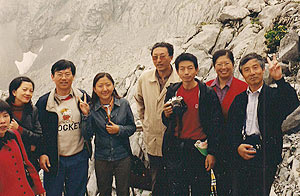 So I think that is the fourth rule for travelling solo – be open to those around you, though trust your instincts. If you have even the remotest sense that someone is dodgy, then get out of there. Having said that, on the odd occasion I’ve found myself in a difficult situation – hassled by a smuggler on a bus crossing the Nepalese-Indian border; abandoned in Nanjing as it was getting dark by a taxi-driver nowhere near where I wanted to be but with no idea where I was; surrounded by a group of increasingly aggressive boys in Skopje who wanted my bag – someone has miraculously appeared to rescue the situation. So be friendly, helpful when needs be, and polite; even if you are a complete incompetent like me when it comes to languages, learn to say hello and thank you at least; and take interest in and have some faith in your fellow humans – everyone has a story to tell and for the most part if you need help someone will help.
Lastly, some practical considerations. Travel light and take as few valuables as possible: there will be no one to watch your bag if you need to nip into that shop or, more challengingly, go to the loo. Do wear a money belt, and ensure that if you have to leave one of your bags out of view for a bit, that you have your essentials with you. Eating on your own in a restaurant can cause some people problems. Take a book with you; eat at non-peak times, such as late afternoon, and then get some bits and pieces and a few beers from a local shop to have in your room later. I often write my journal while eating in restaurants because apart from the advantage of having a table, I sometimes get excellent service, I suspect because they think I might be writing a review.
The very last though quite possibly the most important requirement for travelling solo is to never take anything too seriously and to have a sense of humour; you will need it as you struggle with the seemingly illogical logic of a different culture or have to deal with cultural misunderstanding number 563.
So is there an art to travelling solo? I think it is more an art of having a little faith in yourself. You are on your own and often so far out of your ‘comfort zone’ surrounded by a culture and language that is often entirely alien, that you can only be yourself. You are free from everyone else’s expectations and demands; you can step out of your life for a bit, sail with the wind for a while. Whatever it is, I just love it. And while there won’t be anybody to reminisce with when you get home, there won’t anyone to tell tales on you either…
Author: Caroline Sandes
Wales Travel Guide
Click here to buy the
Lonely Planet guide to Wales >
Wales at its best is tramping in splendid isolation across magnificent green hills and purple-heather moors, valleys ringing with the song of male voice choirs and poetry of 6th-century bards, local pubs beckoning with a pint of Best Bitter.
One man and his dog (and sheep by the millions) are the only souls for miles around; King Arthur fires the imagination with his treasury of ancient Welsh lore; and you can be sure it will rain. Political devolution has long dominated national politics and no one shows a greater pride in this raw, underrated land of heady rough-cut landscapes, mighty stone castles and lyrical morning mists than those fiercely patriotic, rugby-loving, song-mad, Welsh-speaking Cymry (Welsh).
Best time to visit
March to June, September
Top things to see
- Pontcysyllte, the world’s longest navigable aqueduct on the Llangollen Canal
- Snowdon, Wales’ highest and headiest peak at 1,085m
- The Six Nations Rugby Championships in Cardiff
- Conwy, Caernarfon, Harlech and Beaumaris castles
- The Brecon Beacons National Park – rugged hills, moors and fantastic pubs
Top things to do
- Hike, mountain bike, camp, get wet, feel alive in the Snowdonia National Park
- Shop for china in Portmeirion, a whimsical vision of Italian classicism
- Be roused by male voice choirs performing at Llangollen’s International Eisteddfod
- Follow the Pembrokeshire coastal path through quaint fishing villages and around secluded coves – play spot a puffin!
- Frolic across sandy beaches and limestone cliffs on the Gower Peninsula
Get under the skin
- Read – Random Deaths and Custard by Catrin Davydd, one of Wales’ best contemporary creative writers
- Listen – to operatic arias by Welsh tenor Aled Wyn-Davies
- Watch – Solomon and Gaenor, a turn-of-the-20th-century tale of forbidden love set against South Wales’ coalfields
- Eat – bara brith (tea-soaked fruit loaf); a Welsh cream tea (fruit scone with strawberry jam and whipped cream); or a lunchtime plate of Welsh rarebit (an 18th-century version of beer-soaked Cheddar cheese on toast)
- Drink – a pint of Cardiff-brewed Brains or ale from a local microbrewery
In a word
Bore da (Hello, good morning)
Trademarks
Mountains; sheep; coal mines; male voice choirs; rugby; tongue-twisting place names starting with double L; King Arthur and Merlin; leeks; the Welsh red dragon
Did you know?
Genuine Welsh products: Richard Burton, Anthony Hopkins, Laura Ashley, Roald Dahl, Tommy Cooper, Peter Greenaway, Alfred Sisley
Excerpt from an article originally published on lonelyplanet.com.

Win £100 Worth of Street Art Books or £100 of Stanfords Vouchers
*This competition is now closed.*
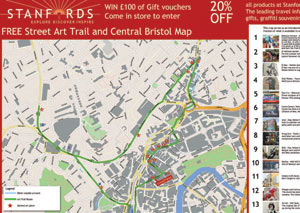
Enter our competition to win £100 worth of books on Street Art from Tangent Publishers, or £100 of Stanford’s vouchers by completing the walk and answering all 14 questions about the art pieces correctly.
- To Enter:
- Download your free Stanford’s Street Art Trail Map >
- Enjoy a 2 hour stroll around central Bristol taking in 16 pieces of inspiring street art .
- Pick up your entry form from Stanfords: 29 Corn St, Bristol, BS1 1HT.
- Complete 14 questions about the Art Trail. Continue reading Win £100 Worth of Street Art Books or £100 of Stanfords Vouchers
WIN Two Eurostar Tickets with Rough Guides
 2012 marks 30 years of great travel advice from Rough Guides, and to celebrate, we’ve teamed up with the iconic travel publishers to giveaway a pair of Eurostar tickets, ready to whip you out to the continent in comfort.
Visit our iconic Covent Garden store where you can get the Rough Guide to Britain for only 99p when you buy another Rough Guide* – that’s £17 off the 700 page, brand new, full-colour Britain guide!
PLUS Now Save 25% on Rough Guides Online & In-Store
*99p offer is valid in-store only
This competition has now closed.
Scotland Travel Guide
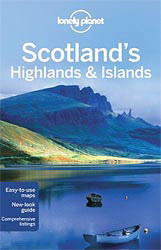
Click here to buy the
Lonely Planet guide to
Scotland’s Highland & Islands >
There is a particularly Scottish habit known as ‘Munro bagging’. This challenging — and somewhat competitive — sport involves climbing each of the peaks in Scotland that are more than 3000ft high. There are 284 of these ‘Munros’, named after Hugh T Munro, the Scottish baronet and keen mountaineer who compiled the first list of them. They vary from easy day walks that barely require a map to airy scrambles, best tackled by those with climbing and navigation experience — and a head for heights.
It is a badge of honour among hikers to have ‘bagged’ all 284 Munros, which to the uninitiated, might sound like a joyless mountain slog. But even for non-committed trekkers, a spot of Munro bagging is an infinitely exhilarating experience in the wildest corners of the British Isles.
The six hills below are some of the most approachable and rewarding of Scotland’s Munros. Included are also some of the loveliest places to stay, so you will not even have to put up a tent. Continue reading Scotland Travel Guide
Top 5 European City Breaks
Paris
The magical city of Paris leaves a lasting impression on visitors. Often described as the most romantic city in the world, it’s hard not to fall in love with its breath taking architecture, bohemian cafes, trendy bars and finest cuisine. Visit the iconic Eiffel Tower and famous Mussee du Louvre or simply wander the streets of the cosmopolitan capital soaking up the atmosphere.
> Browse our collection of travel guides and maps to Paris Continue reading Top 5 European City Breaks
Sarajevo: A Travel Guide
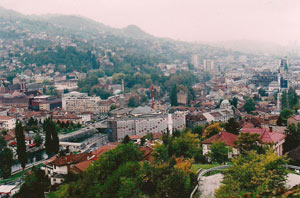 I arrived in Sarajevo, off a overnight bus from Montenegro, early on a Sunday morning. Having had to catch a taxi from the bus station on the outskirts into central Sarajevo, I was dropped off at the Latin Bridge, just near the spot where Franz Ferdinand and Sofia, his wife, were assassinated in 1914 – the infamous event that set off the hell on earth that was to be the First World War.
I went in search of the place I wanted to stay at. In the heart of the old town, Kod Keme is a guesthouse carefully fashioned from two old apartments (amazingly still within the budget section of places to stay) and run by an overtly cheerful lady with an Australian accent, though there seemed something sad about her. My room was enchanting – great thick walls with a curved window that looked out onto one of the narrow cobbled streets of the old Turkish quarter. I booked in for a whole two nights (as opposed to my usual one), as I wanted to spend some time in Sarajevo. Having published an academic book on post-war urban redevelopment and heritage conservation, Sarajevo was of definite interest to me. So, I dumped my bag and set off to explore.
Sarajevo is still under repair. It takes a long time for a city and its people to recover from war; the physical rebuilding will take at very least a decade, most usually several, and the collective psychological recovery will take at least a generation, especially in the case of internecine war. As is well known, when Yugoslavia viciously tore itself apart in the early 1990s, Bosnia i Herzegovina had the misfortune to be sandwiched between two ethno-nationalistic aggressors – Croatia and Serbia – who planned to divide up Bosnia between them. Sarajevo, as Bosnia i Herzegovina’s capital, was high on the hit list. Furthermore, Sarajevo is the kind of place ethno-nationalists hate – a city that is historically cosmopolitan to its core and home to people of a variety of religious persuasions and ethnicities and all getting on together, including intermarrying. It’s no coincidence that during the long and horrific Siege of Sarajevo between April 1992 and February 1996, the longest running siege of a city in modern times, that the Serbian forces surrounding the city deliberately shelled both the National Museum and the National Library in an attempt to destroy the historical evidence of such co-existence. There is quite a famous story regarding the BBC reporter Kate Adie. In September 1992, she interviewed Serbian gunners on the hillside overlooking that part of Sarajevo, wanting to know why they kept shelling the Holiday Inn when they knew all the foreign correspondents where holed up there. Apparently the commanding officer apologised profusely and explained they were aiming at the National Museum behind it.
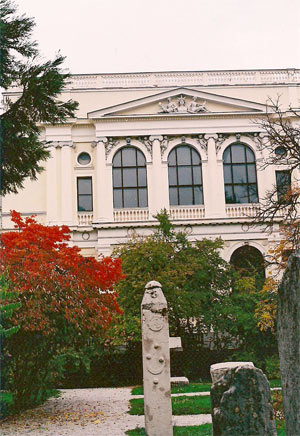 My first stop (after breakfast and coffee) was then the National Museum, a lovely old purpose-built building surrounding a peaceful garden and full of fascinating classical material – Roman and Illyrain – amongst other things. In the ethnographic wing the interior of a nineteenth century Ottoman family house has been reconstructed. Those wooden fronted-buildings usually with a screened first-floor balcony that you see surviving in the Balkans, Syria and Lebanon, and Turkey, though quite often dilapidated, are from the Ottoman era. Having seen them from the outside, it was quite a treat to see what one may have looked like on the inside – much of the material was salvaged from original houses. Despite the meticulous post-war restoration, the museum is now strapped for cash so if you are in Sarajevo, go and visit it, it’s well worth it.
In comparison to the love and care put into the National Museum’s restoration, across the road the History Museum of Bosnia i Herzegovina is another story altogether. Before visiting that, however, I couldn’t possibly miss the Tito Café underneath the museum, so stopped for an espresso. This café is entirely dedicated to Marshall Tito – full of photographs and other memorabilia but strangely dark with an intellectual, faux or otherwise I couldn’t say, feel about the place. I half expected the pair at the neighbouring table to start up a conversation on existentialism or something.
Fortified by my coffee, I made my way into the History Museum, buying a ticket from a pair squashed into a glass ticket booth drinking tea. The History Museum is housed in a very run down 1970s flat-roofed building. It is run down both due to lack of funding and because it was shelled during the Siege and has therefore been deliberately kept like that as a reminder. Unlike the National Museum’s traditionally neutral portrayal of the glorious past, the History Museum is much more political. Firstly it presents a clear case for Bosnia’s existence since medieval times at least – it is important for a nation so recently threatened with annihilation to demonstrate the historical evidence of existence. Over half of the exhibition space was, however, given over to the Siege of Sarajevo. Some 12,000 people, including 1500 children were killed or went missing, and 56,000 people including about 15,000 children were injured, out of a pre-war population of about 435,000. The Siege was only lifted with the signing of the Dayton Agreement. While neutrally presented, the photographs, the blood-stained and personal belongings, the detailing of the horrors of it and how people survived, were enough to bring tears to the eyes on occasion. On the other hand, people’s resistance and acts of heroism in such situations is truly inspiring, and there were plenty of examples of these as well.
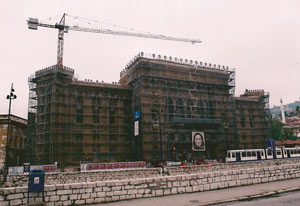 Of course the consequences of the Siege are still very much in evidence all over Sarajevo: there are large cemeteries across the city full of white headstones, all with tell-tale similar dates of death and many so young; the National Library is still being repaired, along with other buildings and there are some buildings that are still derelict. Abandoned properties in the Balkans take on a whole different air when one realises that they may be abandoned because their owners were killed or had to flee, never to return, during the wars of the 1990s and no one has since laid claim to them. Many buildings in Sarajevo still bear those characteristic pock-mark scars caused by shelling and bullets.
In need of some light relief, and because I’d forgotten to have lunch, I wandered back towards the carefully restored and very lovely old Turkish quarter for some coffee and cake. The range and deliciousness of cakes and pastries available throughout the Balkans is mind-boggling, but particularly so in the old Turkish quarter of Sarajevo; it was all I could do to randomly point at a chocolate concoction and wait until the waitress delivered a larger-than-life slice of it to my table. Delicious!
The other thing that needed to be done was discovering how I was going to get to Mostar, where I planned to go next. I wandered over to the bus and train station but ran into difficulties as my phrase book, in its wisdom, had failed to include the vital ‘Departures’/ ‘Departures To’ and ‘Arrivals’ / ‘Arrivals From’ in Serbo-Croat. I could decipher the train timetable, not so with the bus timetable. Thankfully a helpful person at the information desk spoke enough English to tell me that there was a daily 9am bus to Mostar with no need to get a ticket in advance.
Sarajevo is built in a valley – on the military defence front, a disaster as it is easily surrounded, but otherwise a beautiful location. Its long history – there is evidence for settlement here since prehistoric times –its occupation and development, in particular by the Ottomans and the Austrians, and co-existing Jewish, Christian and Islamic traditions mean it has some wonderful architecture and even a handful of conserved archaeological sites to peer into. As someone who has a particular fondness for random bits of odd information, I was interested to learn that Sarajevo was in fact the first European city to have a full-time, dawn-to-dusk, tram line and only the second city in the world to have an electric tramline when it began operation in 1885. The Austrians built it as a trial in advance of putting one into Vienna. Sarajevo still has trams but preferring to walk, I didn’t take one, and set out to climb up one of the streets that took me above the city and up to towards the city gates. There was an exhibition in one of the towers on Alija Izetbegović, Bosnia’s first president when the country separated from Yugoslavia, who struggled valiantly to keep his country together during the wars that engulfed the region, remaining in Sarajevo throughout the siege. A security guard had to unlock the room for me and then paced around the creaky wooden floorboards impatiently but I wasn’t going to be deterred from going through the small but fascinating exhibition that finished with Izetbegović’s huge and sad funeral in 2003.
From there, the security guard let me out through a side gate so I could carry on up and along to the Yellow Tower from where there is a splendid view west across Sarajevo. While I was up there admiring the view but also contemplating the horrors the city had suffered, a call to prayer went out from some of the mosques, giving the city a brief but almost unbearable air of poignancy.
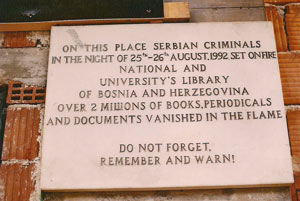 From my viewpoint, the roof of the National Library was obvious, and it was clear that work on its restoration had restarted, funded in part by Turkey, Austria and the EU. Amazingly, despite the fact that it is a building site, there was also an exhibition on in there and I was able to get in and wander round the ground floor at least, stepping over fallen columns and lose stone, and getting out of the way of the builders, while looking up to watch them working on the new glass dome. It was originally built during the period of the Austrian-Hungarian empire in the 1890s as the City Hall and is a curious combination of architectural styles, predominantly a kind of neo-Moorish style. On the night of the 25-26th August 1992, it was shelled with heavy artillery and incendiary bombs by Serbian forces, resulting in the building being completely burnt out, sustaining serious structural damage, and destroying virtually all of the primary archive of Bosnia’s history. Restoration is slow – it is a major undertaking for an historical building so extensively damaged – and costly, predicted to be €13 million. There is a firmly worded plaque in English on the outside that says it all.
By this time it was drizzling and it seemed fitting that I pay a visit to a large bookshop I’d noticed near where I was staying. I should have known better, of course, because while I have an almost pathological hatred of shopping, bookshops are another matter and it is hard for me not to come out with something. They had a good range of English language books and in the end I came out clutching ‘Sarajevo Throughout The History’ (yes, a Bosnian book translated as evident straight away by the European-wide problem with the English definite article), justifying the purchase as being for my research, but wondering how an earth I was going to get it into my bag.
Next day I was departing for Mostar; for all the repair and recovery still going on in Sarajevo, the city was to seem positively healed compared to Mostar, as I was to discover.
> Browse our collection of travel guides and maps to Bosnia-Herzegovina
Author: Caroline Sandes