It is advisable to be good at ascending and descending in this part of West Cork, whether on foot or in a car (or, if you are masochistic, by bicycle) as almost nothing is on the level. The small fishing village of Castletownshend is a case in point. The narrow main street is ridiculously steep – walking up it requires a sort of 45 degree lean forward – and even driving up and down it can be a tad challenging. There are the twin trees that grow in the centre of the road, about half-way down in their own large raised stone-walled plot, that drive all but the smallest of cars onto the pavement going down the hill. Coming up requires careful navigation both to get round the trees and to avoid hitting anybody coming out of a side street at that point. Any failure to stop at the bottom of the main street will take you either off the quayside into the sea or into the castle…
I fell in love with the place while on holiday there as child. It had hardly changed in the years since, when a friend and I flew to Cork airport, hired a car and drove west for the couple of hours it takes to get there; the countryside gradually changing from green and rolling to the wild cragged and windswept landscape of West Cork.
 Castletownshend’s main street was virtually all built about the same time in the eighteenth century. We stayed in one of these houses, Villa Mimosa, so named for a mimosa tree that once grew at the back of it. The village is situated on an inlet and does indeed have a small castle at the end of it, but Townshend is actually the name of the family long associated with the village – and who still live in the Castle, though it is now a B&B. In the summer the harbour, sheltered as it is from the fearsome Atlantic Ocean, fills up with yachts from all sorts of places. There is a small shop which provides the basics along with an impressive range of Irish and foreign newspapers, and, of course, a pub – Mary-Anne’s. The front part of Mary-Anne’s feels much like the inside of a boat, with its dark woodwork and low ceiling, and has a heavy front door that decisively shuts the world and weather out. It also doubles as a restaurant that serves excellent food, including local seafood.
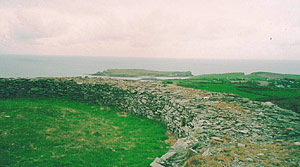 Close to Castletownshend itself but seemingly rarely visited is the Early Christian cashel (stone fort) of Knockdrum. As a child we would take the dogs up there for a run before going off for the day. This time, unfortunately, I had no dogs with me when we visited. We walked up from the village, following the road for about a mile and being careful to avoid fast-driving locals. The cashel is located at the top of some very steep stone steps, that lead up from a grassy farm track. It sits commanding a view for miles around, across coast and countryside. Even if you have no interest in archaeology, it is worth visiting it for this alone.
Another favourite haunt, and great dog-walking place, is the wooded hill that overlooks Lough Hyne Nature Reserve. It is a steep walk up to the top that stretches both lungs and legs. The morning we made the hike to the top it was a clear day. Once we had emerged from the trees, the spectacular views for miles in all directions spread out before us: the blues and purples of sea and mountain blending with the grey of stone walls and rock outcrops, and in between everything green.
Feeling virtuous for expending such effort, the next stop was the historic market town of Skibbereen, and Fields. Fields was once a small shop and bakery but is now a large supermarket. The important thing is that they still make the best jam doughnuts anywhere. Having stocked up on those, we also had a browse in the small but excellent Skibbereen Bookshop. It’s great for books on the area, and as the house we were staying in had, thankfully, no TV, some extra reading was needed.
Another day took us to the town of Baltimore. Baltimore, rather uniquely, was attacked by Barbary pirates from Algiers in 1631, when over a hundred of the village’s inhabitants were carried off, presumably to Northern Africa, never, with the exception of three women who were apparently ransomed a decade later, to be heard of again. There is a late medieval castle (or fortified house to be precise), Dún na Séad, overlooking the town, that has been lovingly restored inside and out and is open to visitors. We then wandered up to the Beacon, a great white-painted stone structure built about 1847, which sits high above the sea overlooking the passage between the mainland and Sherkin Island.
Before leaving Castletownshend to return to Cork and then to London we climbed up the fifty-two steps to St Barrahane’s Church that overlooks the village. Inside there is a huge stone-engraved plaque that gives the history of the area including when the nearby village of Castlehaven was bombarded and destroyed in the eighteenth century, and three stained glass windows by the famous Irish stained glass artist, Harry Clarke. There is also an oar surviving from the Lusitania, which sank, off the south coast of Ireland during the First World War by the Germans with the loss of over a thousand lives is credited with finally convincing the Americans to join the war.
The best times to visit West Cork are May and September – the weather is better and there are fewer tourists. You will need a car as there is little by way of public transport. Castletowshend is detailed in Thames and Hudson’s ‘Most Beautiful Villages’ series, titled ‘The Most Beautiful Villages in Ireland’. Most major guide books cover the region but the Lonely Planet for Ireland is one of the few that details Castletownshend. An Ireland Road Atlas such as that published by Ordnance Survey Ireland is essential as you will inevitably get lost once or twice and in some places, there is no mobile phone signal. To make the most of your time and your explorations, get the Ordnance Survey Ireland Discovery Series maps: number 89 covers Castletownshend and Skibbereen; number 88 Baltimore.
Villa Mimosa is available to rent, will sleep up to ten but if there are only two of you it is easy just to use the ground floor (there is an ensuite bedroom which, incidentally, is entirely wheel-chair friendly) and negotiate a price accordingly with Anne Cochrane-Townshend who lives in the castle. If you don’t feel like self-catering she runs the castle as a B&B, and also has a number of Irish Tourist Board standard houses in the village that she rents out .
- Browse our collection of maps, guides and travel literature:
- > Ireland travel guides
- > Ireland road maps and atlases
- > Travel literature inspired by Ireland
Author: Caroline Sandes