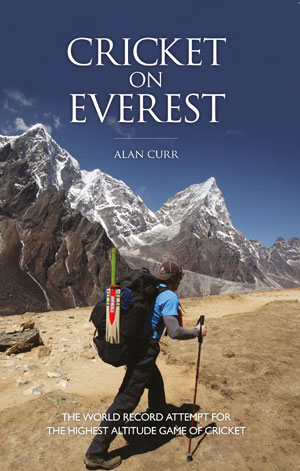
Four years ago, Alan Curr was a man on a mission. His goal? To play the world’s highest ever game of cricket on the slopes of Mount Everest. A plan that started over a beer quickly turned into record-setting adventure…
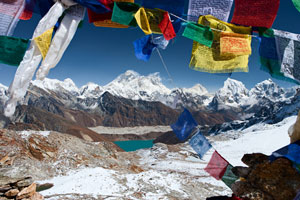
In 2006, Alan Curr’s friend Richard Kirtley completed the Everest Base Camp trek. Coming from a cricket family – his cousin played for England – he noticed a frozen lake bed during the climb and immediately visualised the world’s highest game of cricket. On his return, he pitched his thoughts to Alan.
“I loved the idea, and by 2008 we had put it out to as many people as we could, with the idea of starting in April 2009,” Alan explained.
Despite the eccentricity of the itinerary, the pair attracted an impressive 85 applicants, much to their surprise.
“It was a really mixed bag; generally we had a group of people in their 20s who wanted to go out and do something interesting. We took 50 people in total, many of whom didn’t know each other beforehand.
“Our youngest was 23; the oldest 37 or 38. We had guys who are married – one whose wife was pregnant, another who changed the date of his wedding. We had nine girls, insurance workers, teachers, and a number who were made redundant during the preparation.”
A key part of the group, Alan said, were the ‘trektators’ – girls who completed the trek but didn’t take part in the game, who he described as “the best fundraisers of the lot”.
After 18 months’ planning with Richard and Gareth Wesley, another friend – which included sponsorship deals with Nokia and Qatar Airlines – the party of 50 was ready to travel to Nepal to begin their Everest ascent, but things hadn’t all been plain sailing.
 “When we started, Nepal was still a monarchy. It only became a democracy in 2008,” Alan added. “Myself and Richard went there in the winter of 2008-09 to meet ministers and begin laying the foundations for the trip – we were coming up against a fair amount of opposition, and we were worried about being denied access.”
Fortunately, permission was eventually granted – but the pair decided to keep their bureaucratic wrangling from the rest of the group, just in case it affected morale during the build up.
While completing an Everest Base Camp trek is an achievement in itself, Alan said he didn’t want the focus to detract from the task at hand: a fully-recognised, Guinness World Records-approved cricket match.
“We had to take up our own pitch, we all wore helmets and we used proper bats and balls,” Alan explained.
“We had coloured uniforms made up by one of our sponsors, which all needed to be carried up. On top of that, we had to measure out the outfield and put up a scoreboard.
“Because we were worried that not everyone would make it, we took playing squads of 15 – four people from each side had to be left out on match day, which added incentive and motivation in the build up to make sure people contributed.”
When it came to picking the teams, Alan said it was a fine balance between making them competitive and trying to ensure tensions didn’t boil over. Two brothers were part of the group, and they were put on separate sides to ensure that competitive edge.
“We played a 20-20 match, which was the shortest we could do to constitute a match. Any longer would have been really hard work – the guys were struggling bowling and fielding because it was so competitive. It ended up being 120-odd against 130-odd, which made it more legitimate rather than a damp squib.”
But Alan was worried that the match might never go ahead – when the teams arrived, the weather was beautiful and clear. But on matchday, he woke up to a ground covered in mist. Fortunately, it cleared by 08:30 – just 45 minutes before the match’s scheduled start.
The game attracted a fair amount of media attention, with the 50-strong group accompanied on the climb by an ITV journalist, who sent back daily reports to London Tonight.
 What became officially the world’s highest cricket match raised approximately £100,000 for charity, which was split between the Himalayan Trust and the Lord’s Taverners. All the group’s cricket equipment was donated on their Everest descent.
So what does Alan make of his achievement?
“What I liked about the cricket idea is that it’s such a hospitable game, quaint in nature, and we took it to the most inhospitable place we could think of,” he said.
“We were in the shadow of Everest with landslides happening and yaks running around. The grey shale landscape looked like the moon.
“What I want Cricket on Everest to show people is that anyone can do something like this. We decided to take an idea, run with it and make it happen.”
Alan will be appearing at Stanfords Covent Garden on Thursday 18th October at 18:30 to talk about his world record-setting achievement. Please see our events page for more information.
You can buy Cricket on Everest by clicking here.