 The backlash against digital maps is underway. Whether people are conscious of it or not, increasing numbers of us want to travel back in time to see how things were in the days before Google Maps and sat navs.
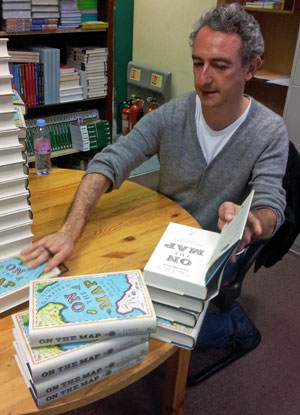
This is according to cartography enthusiast and author Simon Garfield, who visited Stanfords to sign copies of his new book On The Map; a work that explores maps’ influence in our understanding of the world.
“I think there’s a greater appreciation of the beauty of maps; a nostalgia for the way antique maps look,” he says. “And not just maps that you hang on the wall. There’s a line in the book about Stanfords, where you can buy pencils with antique maps wrapped around them. You can’t use them as maps, but they’re beautiful things to have.”
While the significance of paper maps as primary navigation tools has eroded, Garfield believes that a great love exists for old-style maps and traditional cartography. “People are absolutely devoted to them,” he explains, “not only because they help you find your way but because they’re very beautiful things.
“Cartography is a great British tradition – while the French invented nation mapping, the Ordnance Surveys are hugely important and significant in this country. The Brits have mapmaking in their hearts.”
The renewed appetite for analogue maps isn’t solely concerned with reminiscing about mapmaking’s golden age, though. Another trend emerging is the growing popularity of hand-drawn maps, which has given cartography a distinct human touch – an antidote to the uniformity of one-size-fits-all digital maps.
“I love the idea of personalising maps,” Garfield says, “There’s a whole artistic side, Grayson Perry being the leading light in terms of using maps to express his autobiography and to make political points.”
Among the Turner Prize-winning artist’s recent works is his Map of Truths and Beliefs, a large tapestry exhibited opposite a hand-crafted 1800 map based on Pilgrim’s Progress from the British Museum’s archives.
Fascinatingly, creating and utilising paper maps could be good for our brains – or so suggests Professor Richard Dawkins, who’s argued that the development of maps may have played a more important role in the evolution of the human brain than the development of language.
 “Maps enabled us to make the transition from the rest of the apes – if you wanted teamwork when you went out to kill an elk, that was the way you did it,” Garfield says. “You didn’t explain it in terms of language or latitude and longitude – you drew a map in the dust or on the cave wall.”
So will an over-reliance on digital maps negatively affect our brains?
“There’s no doubt that our spatial ability is being radically slimmed down because of digital maps,” the author explains. “You look at the experiments with London cab drivers and their ability to store the A to Z in their minds – this ability will eventually be eroded in line with the idea that the hippocampus expanded to accommodate this additional information.
“This won’t just happen to cab drivers using sat navs, but to us all. If we lose the ability to unfold a big map and look at a direction 10 miles ahead or 50 miles around – and all we’re doing is looking at 100 yards ahead on our phone – that’s really going to have an effect on our map-reading skills going forward. I think it’s a real loss and something that hasn’t been fully appreciated.”
Despite this likely side effect of digital cartography, Garfield reserves praise for Google Maps – particularly in the wake of the Apple Maps debacle.
“We take the mickey a bit out of Google Maps and its ubiquity, but I think we’ve only come to realise how great it is when people ‘upgraded’ to Apple Maps. It was extraordinary how they got it so wrong – I had a look today on my phone and I was surprised how difficult it is to use. It makes you think how much Google got right.”
The author’s own journey with maps began during his London schooldays and the iconic Tube Map. Despite travelling only one stop on the Underground each morning and afternoon, the young Garfield knew there was the potential to explore the whole of London and its suburbs.
 “It’s a bizarre thing to say you could fantasise going to Edgware or the end of the Piccadilly line,” he says, “and I began collecting the free maps that were occasionally updated – this is where it all started.
“Every day you’d see this map – it was the first one I was aware of, though I didn’t realise the significance of the Beck map, or rather the fact it was a diagram rather than a map.”
He added that his interest has always been in the stories behind maps, rather than cartography per se, and it was this passion that sparked the idea for On The Map.
“You couldn’t do anything like a definitive history of cartography so I had to be very selective, but there were certain things I needed to include.
“I wanted to go back to the Great Library of Alexandria to explore what humans knew about the world and how that was laid down in literary atlas form, and how the early maps developed and came alive again at the beginning of the Renaissance. That was the beginning, and I knew where I wanted to end – the Googleplex.
“On the Map is an accessible book for people who aren’t map experts but who want to read a new, visual account of the world’s history.”
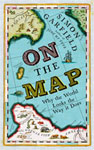
< Click on the book to buy a signed copy of Simon Garfield’s On The Map!
One thought on “Simon Garfield: On The Map Interview”