Volunteering in Malawi

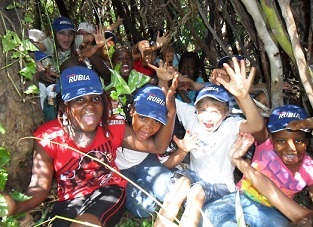
Volunteering in MalawiIn January 2011, I embarked on the adventure of a lifetime! It would be my first time away from home and certainly the first time I had ever been to Africa. I wanted to prove to my parents that I could look after myself, despite being unable to keep my bedroom tidy and I wanted to prove to my friends that I wasn’t going to settle for just any old course from UCAS. I wasn’t sure what I wanted to be but I knew what I wanted to do!

So of course, I was petrified. What was I thinking!? All those months of planning and waiting were over. I was finally going. Continue reading Volunteering in Malawi

Volunteering in China

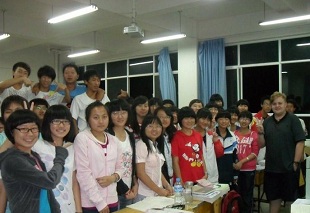
Volunteering in ChinaChina is one of the most mysterious and magical countries on the planet, full of culture and endless adventures. Shrouded in History and full of vibrant life, it was for these reasons that I chose to volunteer there. I spent 5 months with Lattitude Global Volunteering in the south of China in a town called Yuxi, in the province on Yunnan and it was the most incredible experience of my life. The time I spent there was so humbling and educational; it was everything I had hoped it would be and more.

My main role in China was to be an English teacher to students of all ages. The kids were amazing, they were all so willing to learn and work hard that it made every day enjoyable. The daunting task of teaching lessons to over 60 children slowly begins to, with time, become the highlight of your day. There is no greater feeling than knowing that a group of people are learning and improving by your teaching, the English Language plays a key role in the world and the people of China know that. The kind of kids I taught had the ambition of people who saw no end to what they can achieve and where they could take their lives. Before long I began to realise that, although I was the teacher, I was learning so much from the people I was meeting.

I had no end of invitations to visit the homes of the students and be involved within their families’ routine. Learning about culture and traditions here in the U.K. normally involves reading a book or watching a DVD in school, but being out in China, in the heart of the country, educates you in a way that you can’t forget. My eyes were opened to all kind of foods, traditions, scenery and history that made every day an adventure.

Although I was placed on my own in China, this was possibly the best thing that could have happened to me. It enabled me to have the determination and courage to completely drop my guard and fully immerse myself within the culture. I worked really hard on learning the language and tried to get the most I could out of the country. I got to experience things and explore places that I would never have dreamt of before I visited the country.

A word of warning, volunteering in a country, especially China, gets under your skin. It moulds you into a person that you could have never imagined you would become. The country will never leave your memory and you will always remember your time there as the best of your life. No matter how hard you try, you can never articulate to someone how amazing China and the time you spent volunteering there was.

I cannot thank Lattitude Global Volunteering enough for enabling me to travel to this most incredible place. I made lifelong friends, had experiences I will never forget and began to really understand what life is about and what exactly I want to do with mine.

I enjoyed it so much, I’m planning on going back again this year to visit my friends, the school I worked in and learn so much more about the most magical place I have ever been. Good luck to anyone planning on going there, you’re in for an adventure!

Plan your trip to Malawi with Stanfords, click here to see our selection of China maps and travel guides

By: Lewis

Volunteering in South Africa

Volunteering in South AfricaEven as I begin writing this, I know I am going to have a tough time reliving the wonderful experiences that I have had over the past six months. Although I am glad to be home with my family, it feels as though I have left behind a little piece of me with my second family in South Africa. When I first decided that I wanted to take part in a voluntary overseas placement, I did so in the complete knowledge that it would be one of the hardest things I have ever had to do. I expected to feel homesick, lost, out of place and out of my comfort zone. I did – but I got so much back in return.

My last four years have been spent at university working towards my law degree. After undertaking a module in environmental law and writing my dissertation on the various environmental challenges facing the modern world, I realised that my professional calling was to become involved in environmental law. However, aware of the fact that true environmental awareness can never be attained by sitting behind a desk, I decided to spend a little time getting knee-deep in the very things that I would soon be spending my working life trying to protect.

When I first arrived in the Drakensberg I couldn’t believe how completely remote it was. All around me were towering mountains, dark, brooding cliff faces, expanses of indigenous forest and miles upon miles of wetland. The nearest shop was almost an hour away. The first night I spent at Entabeni was both the most exhilarating, and the loneliest, night of my life. I was away from everything I knew and loved but could hear, see and smell things that I had never before experienced. Everything was new- terrifying and exciting!

After that first overwhelming night I quickly got into the way of life at Entabeni. As part of a small team, I was responsible for designing, coordinating and conducting environmental education programmes to groups of school children on short-term residential courses. This involved a variety of different activities including forest and wetland projects, interpretive hikes, captive crane studies and also more adventurous pursuits, such as abseiling, wall climbing and camping expeditions. Despite using a variety of teaching methods, all of the work that we did at the Centre was geared towards developing an awareness and passion for environmental and conservation efforts. Although the work was physically and mentally exhausting, experiencing a “light bulb moment” with even just one of the kids within your group made it all seem worthwhile (i.e. that moment where you actuallyseea child become imbued with the same passion for the environment that you feel).

Courses aside, the best thing about living and working within South Africa was the people you met on a daily basis. During my time there I experienced so many different forms of kindness from so many different people. When I mentioned that my feet were suffering from wearing hiking boots constantly, Sandi (my South African mummy), came back from the next town trip with foot cream. When I lost a bracelet, one of the maintenance staff, Thulani, searched high and low until he eventually found it lying in the dirt road. Knowing my weakness for all things sweet, one of our kitchen ladies, Nomusa, would keep me the mixing bowl from the chocolate cake. I will never forget how wholeheartedly and completely I was welcomed into the “family” at Entabeni.

Since returning from my placement I can honestly say that I have seen a massive change in myself. If it has taught me anything, it would be that when things go wrong you simply “make a plan.” When problems arose on placement, there was no time to cry, envisage the worst case scenario or phone my dad! I simply had to accept the problem, formulate a solution and get on with it. South Africans pride themselves on their ability to “make plans” and this is definitely something that I’m bringing back with me to the UK!

I am due to begin my postgraduate diploma in September and will then begin a job in Edinburgh involving environmental litigation. Spending six months in South Africa, getting knee-deep in wetland, lost in indigenous forest and watching endangered wild Wattled Cranes flying above me, has taught me more than I could learn if I spent a lifetime in a classroom. Not only that, but I have also learned that basic, simple acts of kindness can connect people, regardless of culture, race, background or life experience. When I said that I feel as though I left a little bit of myself behind in South Africa, I genuinely mean it. Perhaps I’ll need to return in the not-too-distant future to put myself back together again!

Hamba kahle South Africa, it’s been amazing!

I would like to thank the Lattitude Bursary Scheme for providing me with the means to have such a fantastic experience. I would never have been able to afford to go otherwise and I am hugely grateful for their assistance.

Plan your trip to South Africa with Stanfords, click here to see our selection of South Africa maps and travel guides

Click here for travel information to South Africa
Wilderness Lectures in Bristol 2011-2012

Stanfords have teamed up with Wilderness Lectures who bring travellers and explorers to venues in Bristol.
The Wilderness Lectures are a winter series of public lectures in Bristol, the theme of which is worldwide adventure. The lecturers are well-known explorers, mountaineers, travel writers, TV and adventure sports personalities or anyone who has an epic story to tell and can entertain the audience with a good story. The talks themselves usually including slides and/or film.

The tickets for this season of Wilderness Lectures are available on the Stanfords’ website and from our Bristol store. (up to 72 hours before each event) – see the programme guide below.

Wilderness Lectures Guide Winter 2011-12
Season tickets are no longer available. Continue reading Wilderness Lectures in Bristol 2011-2012

First Uruguay guidebook launched at Stanfords

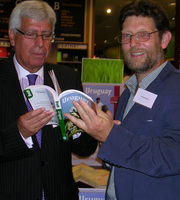
The Uruguayan ambassador hosted a prestigious event at Stanfords last week for the launch of the first English-language guidebook to Uruguay.
The guidebook’s author, Tim Burford, spoke to the crowd of exclusive guests about writing the first guidebook dedicated solely to this often overlooked country. The book is published by Bradt, a company renowned for covering parts of the world other travel publishers don’t reach. Mr Burford has written nine books for Bradt, specialising in backpacking and ecotourism in Latin America.

The evening continued with national delicacies and wine served to the sound of Uruguayan tangos, and the country’s ambassador, H.E. Sr. Julio Moreira-Morán, gave a speech. Continue reading First Uruguay guidebook launched at Stanfords

Walking from Amsterdam to Barcelona

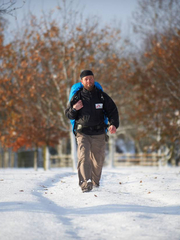
A nurse from North Yorkshire has taken up the challenge of walking 2000 miles across Western Europe for charity, using maps supplied by Stanfords. Andy Dennis, a staff nurse on the Intensive Care Unit at Harrogate District Hospital, will be walking from A to B – from Amsterdam to Barcelona – to raise money for Médecins Sans Frontières (MSF). MSF – or Doctors Without Borders – is an international humanitarian medical aid organisation that provides care to those affected by conflict, epidemics and natural disasters in over 60 countries around the world. Andy has previously worked for the charity on projects with displaced people in Uganda and Sudan.
So far, intrepid Andy has raised over £13,000 through talent contests, concerts, radio interviews and burlesque nights. He aims to bring this amount up to £16,800 with donations and further fundraising events. This money will then be used directly to fund two crucially important MSF volunteer placements abroad. Passionate about the vital work that the organisation does, Andy says: “I feel privileged to have had the opportunity to work with MSF and I now wish to help provide this opportunity for others.” Continue reading Walking from Amsterdam to Barcelona

Estonia, Soomaa National Park

EstoniaEstonia, a small country in north-eastern Europe, has neither grand landscapes of deep canyons, breathtaking mountains nor even proper uplands. The highest point of Estonia, and the Baltics – the Big Egg ‘mountain’ – is only 318m above sea level. Nonetheless, the country is a real treat for nature lovers and walkers with wonderfully bucolic and wooded scenery. About half of Estonia’s territory is forest, inhabited by many animals that are very rare or no longer found at all in western Europe, like wolves, brown bears, wild boars and lynx. Its national parks are great for wildlife spotting, and especially birdwatching, due to the country’s key position on north-south migration routes.
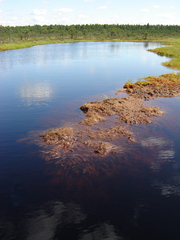
Soomaa National Park is one of the most alluring places to enjoy nature at its wildest. The name stands for ‘land of bogs’, and indeed, the land abounds with floodplain grasslands, meandering rivers, forests and raised bogs. The land is so susceptible to flooding in the spring that the floods are regarded as the ‘fifth season’ in Soomaa. The rivers cannot contain all the melting snow and the water flows over the flood plain creating islands from steep sloped bogs. Some springs have seen the water level rise several metres, leaving many roads flooded, thus effectively isolating Soomaa from the rest of the country. The park is a haven for rare species of wildlife such as black storks, golden eagles, flying squirrels and larger carnivores such as wolves and bears.

Soomaa and its waterways can be explored by canoe. Some tour operators offer traditional Estonian dugout boat excursions – called haabjas – on many of its rivers. Haabjas are one of the oldest types of canoes of the Finno-Ugric peoples, carved from a single tree trunk. Alternatively there are numerous elevated board trails for walkers. The trail that I took had oodles of mosquitoes and horseflies in the beginning, but as soon as I left the denser forest, the insects disappeared. The landscape was dotted with lonely pine trees and the terrain was really quite wet, interspersed with small lakes, and the higher ground covered in lichens, mosses, heather and cranberry bushes. The turf layer in the bogs has been forming for thousands of years (at just 1mm per year!) and is usually 6-9m thick; however in some places it can reach up to 16m. It is even possible to take a dip in the lakes. The water is brownish in colour due to the leaching of tannins from the peat moss, but as peat is used in water filtration and has beneficial functions in freshwater aquariums, it is perfectly safe to swim in.

There is limited accommodation available on the grounds of the national park, that’s why I would suggest staying in a nearby seaside resort town of Pärnu (about 40km away). It is the summer capital of Estonia with a lively entertainment scene and a wide sandy beach.

My recommended books and maps from Stanfords are the Lonely Planet guide to Estonia, Latvia and Lithuania and for maps, the Regio 1:150 000 Estonia Road Atlas and the Regio 1:100 000 Soomaa jõed/Rivers of Soomaa map.

See all our Estonia Guides and Maps >

Author: Vadim Tsaikovski

Belgium – Bruges

BrugesDay trips in my family tend to take the form of several hours in a hot car on the way to the south coast, followed by 40 minutes wandering aimlessly over sand-dunes as storm clouds gather, and then another couple of hours in the car, in order to arrive back home in a foul temper. The temper is partly induced by having to spend what seems an inordinate amount time in a confined space with our nearest and dearest, and partly by the fact that whenever we choose to make these day trips, every single restaurant, café and hot food stall on the south coast has closed for the day, forcing us to eat our ‘emergency’ bacon sandwiches, which have spent the journey down congealing in a sorry brown paper bag.
Perhaps one day I will reminisce about these trips as the crowning joy of my youth, but I sincerely doubt it.

It seemed almost too good to be true, then, when I was offered a family outing to Bruges for the day, prompted by the film ‘In Bruges’. Pouncing on the idea, I assured my father that the journey would be painless and cheap, and so we had booked and paid for the Dover-Calais Eurotunnel crossing within minutes of the mini-break being suggested – I use the word “mini-break” hesitantly, as it conjures up the image of couples ensconced in Paris hotel rooms, but I’ve run out of synonyms, so you’ll just have to grin and bear it. We decided to travel by car, as opposed to Eurostar, because the flexible ticketing system allowed us to deviate from our schedule as much or as little as we wanted.

I didn’t escape from the emergency bacon sandwiches, which were furtively packed into the well of the passenger seat just before we left home at five o’clock in the morning for Dover. The journey, however, was as painless as I had promised. Four hours door to door, most of it was spent on the fast-flowing, seamlessly flat motorway in Flanders which delivers you straight to the outskirts of Bruges.

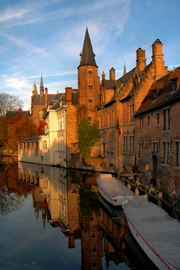
It must be noted that Bruges is a picturesque but very strange place. I have never been to a city before whose inhabitants subsist entirely on pralines and lace, or so it seems, at least, when you look at the shops in the city centre, which uniformly alternate between chocolatiers and haberdasheries. Having said that, I’m not entirely sure that I can claim to have actually seen any natives of Bruges during the eight or so hours we spent in the city, as there were more tourists than you could shake a Thomas Cook brochure at. But when you get used to the idea that Bruges is essentially a life-size version of Disney World, and actually buy into the whole thing, you begin to enjoy it. We took a boat ride along the city’s canals, and climbed the belfry, and lunched on traditional Belgian Waterzooi stew. We even visited the quieter residential districts of the city, with their architectural mix of modernist and traditional Flemish styles, and their liberating lack of Segway-touting tour groups, which plague the city’s two main squares.

For a city of such small stature, Bruges has an incredibly rich variety of sights, from the manicured Beguinage monastery to the enormous Gothic town hall, and the small but perfectly formed Groeninge museum, which houses one third of Belgium’s national collection of Flemish art. If you’re prepared to spend half a day travelling and half a day soaking up art, culture and food – and why not? – then Bruges could be the perfect day trip.

> Bruges travel guides and maps

Author: James White

Armenia

ArmeniaYerevan – a little slice of California in the Caucasus?
Ten minutes across the border from Georgia into Armenia, my taxi is pulled over by the traffic police. Out steps the archetype of the corrupt police official – big uniform, big hat, big belly. Who knew that being a policeman in provincial Armenia was so lucrative? Our crime, it seems, is that the taxi is Georgian-registered and the driver himself is Georgian. Spit spit. Actually, there’s no love lost between Armenia and any of its neighbours, certainly not Turkey because of the Armenian genocide, in which up to 1,500,000 Armenians were murdered. Definitely not with Azerbaijan, with whom the dispute over the territory of Nagorno-Karabagh does not look like being settled for a very long time to come. Armenia, then, would be isolated, if it weren’t for two things – firstly, its close relationship with Moscow, which posts its soldiers along Armenia’s sealed borders, and, secondly, the enormous Armenian diaspora, particularly in California, whose remittances keep the country well in the green.

After a ham-fisted attempt at bribery, my taxi driver goes on the offensive and threatens to call the Georgian embassy. That seems to do the trick, and the policeman suddenly remembers that it was another car which was supposedly speeding. We drive on, my driver fuming in broken Russian about Armenia and the Armenians. “You can’t trust them, they’re devious”, he says. In fact, I rather like them.

We stop off at the Unesco monasteries of Haghpat and Sanahin, high in the forested hills around the Debed Canyon. The scenery is stunning, with views from the 10th-century bell tower over lush ravines. In the cloisters of the complex, Khatchkars – intricate Armenian crosses – rise from the moss-covered floor, and birds nest in the delicately carved roofs of incense-filled chapels. The driver stays in the car with the window down, chain smoking.

After an eight-hour drive from Tbilisi, we arrive in Yerevan in the evening. Crossing into the city over the Hrazdan gorge, I see villas built by diasporan Armenians which seem to have been transported directly from some Florida holiday-home development. Their squat brashness is oddly out of keeping with the stark natural beauty of the surrounding landscape. The city itself again seems to have come from the States by way of the USSR. High-rise blocks are everywhere, but made in a distinctly Soviet fashion. It’s actually quite attractive, but in a perverse kind of way.

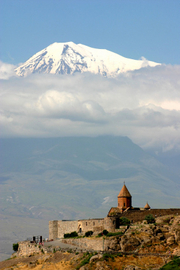
The opera is the centre of Yerevan, another Soviet megalith of a building. Around it there are stylish open-air cafes and basement clubs, where most of the city seems to congregate all day, drinking soorch – Armenian coffee. It’s a shock to discover that anyone actually does any work in Yerevan. Other highlights include the incredible Cafesjian Museum of Art on top of the monumental Cascade, a terraced series of fountains with views over to mystical Mount Ararat.

If the big city gets too much, a day trip to one of the ancient sites around Yerevan is an insight into a purer Armenian culture. But it still conjures up strong contrasts; at the monastery of Khor Virap, on the plain of Ararat, I climbed down the snake pit – where St Gregory the Illuminator was incarcerated for years on end – before witnessing a live goat sacrifice. Next to me sat a group of Armenian-American teenagers, who huddled together speaking English whilst their parents, guilty about abandoning their native land and heritage for the US, straddled the goat, knife in hand.

Take the Lonely Planet Guide to Armenia, Azerbaijan and Georgia, written by authors who have travelled for years in the region, plus provides interviews with locals. We stock a large, indexed street plan of Yerevan.

Browse our collection of maps and guide to Armenia >

Author: James White

Award nomination for Stanfords’ café

Stanfords’ in-store café is in the running to win the prestigious London Lifestyle Award 2010. Sacred Café, which can be found at the Floral Street entrance of our London store, has been announced as a finalist in the Coffee Shop of the Year category.

The London Lifestyle Awards aim to honour those whose work has made an outstanding contribution to London and to promote excellence and diversity for throughout the city.

Sacred Café is owned and run by New Zealanders Tubbs Wanigasekera and Matthew Clark, and they have been operating for over five years in London. Clark says, “This is a huge thrill for us and immensely gratifying to be recognised against other excellent cafes in London”.

The cafe has a reputation for high-quality coffee, friendly staff and stylish and comfortable interiors, and is a particular favourite with Antipodeans living in and visiting London. Sacred is also becoming known for their quality teas that come from Wanigasekera’s family-run plantations in Ceylon (Sri Lanka).