 Yerevan – a little slice of California in the Caucasus?
Ten minutes across the border from Georgia into Armenia, my taxi is pulled over by the traffic police. Out steps the archetype of the corrupt police official – big uniform, big hat, big belly. Who knew that being a policeman in provincial Armenia was so lucrative? Our crime, it seems, is that the taxi is Georgian-registered and the driver himself is Georgian. Spit spit. Actually, there’s no love lost between Armenia and any of its neighbours, certainly not Turkey because of the Armenian genocide, in which up to 1,500,000 Armenians were murdered. Definitely not with Azerbaijan, with whom the dispute over the territory of Nagorno-Karabagh does not look like being settled for a very long time to come. Armenia, then, would be isolated, if it weren’t for two things – firstly, its close relationship with Moscow, which posts its soldiers along Armenia’s sealed borders, and, secondly, the enormous Armenian diaspora, particularly in California, whose remittances keep the country well in the green.
After a ham-fisted attempt at bribery, my taxi driver goes on the offensive and threatens to call the Georgian embassy. That seems to do the trick, and the policeman suddenly remembers that it was another car which was supposedly speeding. We drive on, my driver fuming in broken Russian about Armenia and the Armenians. “You can’t trust them, they’re devious”, he says. In fact, I rather like them.
We stop off at the Unesco monasteries of Haghpat and Sanahin, high in the forested hills around the Debed Canyon. The scenery is stunning, with views from the 10th-century bell tower over lush ravines. In the cloisters of the complex, Khatchkars – intricate Armenian crosses – rise from the moss-covered floor, and birds nest in the delicately carved roofs of incense-filled chapels. The driver stays in the car with the window down, chain smoking.
After an eight-hour drive from Tbilisi, we arrive in Yerevan in the evening. Crossing into the city over the Hrazdan gorge, I see villas built by diasporan Armenians which seem to have been transported directly from some Florida holiday-home development. Their squat brashness is oddly out of keeping with the stark natural beauty of the surrounding landscape. The city itself again seems to have come from the States by way of the USSR. High-rise blocks are everywhere, but made in a distinctly Soviet fashion. It’s actually quite attractive, but in a perverse kind of way.
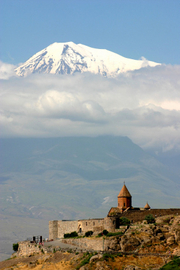
The opera is the centre of Yerevan, another Soviet megalith of a building. Around it there are stylish open-air cafes and basement clubs, where most of the city seems to congregate all day, drinking soorch – Armenian coffee. It’s a shock to discover that anyone actually does any work in Yerevan. Other highlights include the incredible Cafesjian Museum of Art on top of the monumental Cascade, a terraced series of fountains with views over to mystical Mount Ararat.
If the big city gets too much, a day trip to one of the ancient sites around Yerevan is an insight into a purer Armenian culture. But it still conjures up strong contrasts; at the monastery of Khor Virap, on the plain of Ararat, I climbed down the snake pit – where St Gregory the Illuminator was incarcerated for years on end – before witnessing a live goat sacrifice. Next to me sat a group of Armenian-American teenagers, who huddled together speaking English whilst their parents, guilty about abandoning their native land and heritage for the US, straddled the goat, knife in hand.
Take the Lonely Planet Guide to Armenia, Azerbaijan and Georgia, written by authors who have travelled for years in the region, plus provides interviews with locals. We stock a large, indexed street plan of Yerevan.
Browse our collection of maps and guide to Armenia >
Author: James White