 The Hotel Uzbekistan was Tashkent’s sanctioned ‘foreigner’ hotel during the Soviet Union, when – for a considerable donation – tourist parties were permitted to visit this most hermetic part of the USSR. Now that Central Asia is as free and easy as the rest of the world, The Uzbekistan still stands, an enormous hulking monolith on the edge of Independence Square, which has at its centre a statue of Timurlane, or Tamurlane, or Timur Leng depending on how keen you are to publicise his lameness (Timur Leng means Timur the Lame). Having stayed before at behemoth hotels throughout the former Soviet Union, I was surprised to discover that the staff at The Uzbekistan were pleasant, normal people. In true Uzbek style though, the cavernous hotel restaurant doubled up as a ballroom. This meant that having witnessed wedding-guests from as far afield as Afghanistan and India partying the night away, the hotel’s 30 or so overnight guests – mostly European tourists and Iranians – would sit the following morning at silk and flower-bedecked tables eating their cereal.
Stalin’s gerrymandering of Turkestan’s borders had few positive aspects – the Tajik Civil War, interethnic violence in the Ferghana Valley, etc. However, there has been one definite winner in the aftermath of the USSR – the Uzbek Tourist Board, which finds itself with three of the Silk Road’s greatest surviving cities on its territory. The names Khiva, Bukhara and Samarqand resonate with the most overblown and romantic images of camel caravans passing through the desert, laden with cargoes of oriental treasures bound for Istanbul and Venice. Khiva is a spectacular, but controversial museum town. The ‘Hotel Khiva’ is located in a medieval madrassah, with views from each of the rooms over the perfectly preserved and restored city. In fact, Khiva is almost too perfect; Unesco’s decision several years ago to make Khiva into a world heritage site led to the Uzbek’s government’s decision to throw all the local population out of the city and to proclaim the foundation of Khiva as a ‘museum ensemble’.
The cities of Bukhara and Samarqand are by contrast large and thriving metropolises – Samarqand, with its population of 500,000, is Uzbekistan’s second largest city. Both cities contain some of the finest Persian architecture in existence, most famously the Registan of Samarqand, which Lord Curzon called the world’s most “majestic” square, and the Gur-Emir, or Timurlane’s mausoleum, which almost quite literally drips with gold leaf.
The Khanate of Bukhara was the most bloodthirsty of the Central Asian states during the ‘Great Game’ of the 19th century, when the British and the Russians vied for power in Central Asia. Today you can visit the Zindan, or prison, in Bukhara’s citadel, where the young British officers Stoddart and Connolly were kept prisoner for several years before being executed on the orders of the Emir. After having my own battle with several hornets the size of small aircraft carriers – which, incidentally, are ubiquitous in Uzbekistan (hornets, not aircraft carriers) – I visited the Kayon minaret, also called the Tower of Death because prisoners were supposedly hurled 47m to their deaths from its top on market days during the time of the Khanate.
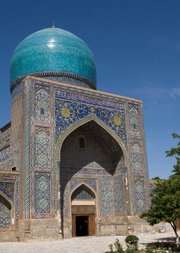
Uzbekistan is generally branded as a destination for those interested solely in blue majolica tiles. Whilst there is an awful lot of blue majolica about, I would argue that it is an adventurous enough place in itself, and full of enough incredible sights, to warrant a visit from anyone with a sense of curiosity.
The Odyssey Guide The Golden Road to Samarkand is the most comprehensive guide available dedicated exclusively to Uzbekistan. It combines well with the Roskartografia 1:1,500,000 map of Uzbekistan. Author: James White