 Estonia, a small country in north-eastern Europe, has neither grand landscapes of deep canyons, breathtaking mountains nor even proper uplands. The highest point of Estonia, and the Baltics – the Big Egg ‘mountain’ – is only 318m above sea level. Nonetheless, the country is a real treat for nature lovers and walkers with wonderfully bucolic and wooded scenery. About half of Estonia’s territory is forest, inhabited by many animals that are very rare or no longer found at all in western Europe, like wolves, brown bears, wild boars and lynx. Its national parks are great for wildlife spotting, and especially birdwatching, due to the country’s key position on north-south migration routes.
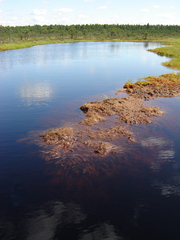
Soomaa National Park is one of the most alluring places to enjoy nature at its wildest. The name stands for ‘land of bogs’, and indeed, the land abounds with floodplain grasslands, meandering rivers, forests and raised bogs. The land is so susceptible to flooding in the spring that the floods are regarded as the ‘fifth season’ in Soomaa. The rivers cannot contain all the melting snow and the water flows over the flood plain creating islands from steep sloped bogs. Some springs have seen the water level rise several metres, leaving many roads flooded, thus effectively isolating Soomaa from the rest of the country. The park is a haven for rare species of wildlife such as black storks, golden eagles, flying squirrels and larger carnivores such as wolves and bears.
Soomaa and its waterways can be explored by canoe. Some tour operators offer traditional Estonian dugout boat excursions – called haabjas – on many of its rivers. Haabjas are one of the oldest types of canoes of the Finno-Ugric peoples, carved from a single tree trunk. Alternatively there are numerous elevated board trails for walkers. The trail that I took had oodles of mosquitoes and horseflies in the beginning, but as soon as I left the denser forest, the insects disappeared. The landscape was dotted with lonely pine trees and the terrain was really quite wet, interspersed with small lakes, and the higher ground covered in lichens, mosses, heather and cranberry bushes. The turf layer in the bogs has been forming for thousands of years (at just 1mm per year!) and is usually 6-9m thick; however in some places it can reach up to 16m. It is even possible to take a dip in the lakes. The water is brownish in colour due to the leaching of tannins from the peat moss, but as peat is used in water filtration and has beneficial functions in freshwater aquariums, it is perfectly safe to swim in.
There is limited accommodation available on the grounds of the national park, that’s why I would suggest staying in a nearby seaside resort town of Pärnu (about 40km away). It is the summer capital of Estonia with a lively entertainment scene and a wide sandy beach.
My recommended books and maps from Stanfords are the Lonely Planet guide to Estonia, Latvia and Lithuania and for maps, the Regio 1:150 000 Estonia Road Atlas and the Regio 1:100 000 Soomaa jõed/Rivers of Soomaa map.
See all our Estonia Guides and Maps >
Author: Vadim Tsaikovski