Rome: The Papal Election Process

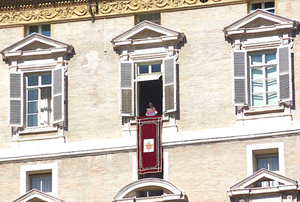
Pope Benedict XVI blesses the crowd from his window in the Vatican Palace, part of the traditional Angelus service which takes place at noon on Sundays.

With Pope Benedict XVI resigning his eight-year papacy on 28th February, Annabel Barber takes a closer look at the papal election process, and what it means for travellers heading to Rome between now and Easter.

It didn’t take long. A mere 24 hours after Pope Benedict XVI announced his abdication, portents were being seen in the skies above the Vatican. Jupiter, the great god of the Romans, began rattling his thunderbolts and lightning was recorded striking the cupola of St Peter’s – twice. This is the kind of thing that happened on the eve of Caesar’s murder. “Never till to-night, never till now,” says a trembling Casca, “did I go through a tempest dropping fire. Either there is a civil strife in heaven, or else the world, too saucy with the gods, incenses them to send destruction.” Is that what heaven is doing? Or is it a seal of approval?

After an eight-year pontificate, Joseph Ratzinger is voluntarily vacating the Throne of St Peter. It is not an unprecedented step, but it is a controversial one; something that’s not ‘done’. But Benedict XVI has never been afraid of controversy. While he lacks the charisma of his predecessor John Paul II and while he never inspired such fervent devotion in people’s hearts, he has been, in his thoughtful, mild-mannered way, revolutionary. Continue reading Rome: The Papal Election Process

Avoid All Travel to Whole Country: Preparing to Visit Iran

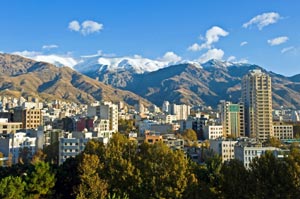
Iran mountain town

On Monday, the intrepid Caroline Sandes will travel to Iran – a country the Foreign & Commonwealth Office strongly discourages visiting. Having secured an Iranian visa and, more challengingly, travel insurance, how does one plan a trip to one of the world’s most volatile countries?

Iran has reached the top of my ‘places I want to go’ list – not least because I’m worried that due to the current political shenanigans of the Middle East, the opportunity for me to visit will suddenly disappear. I’ve always wanted to see Iran – Esfahan and Persepolis specifically – and I’ve heard great things about the country and its people from those who’ve travelled there. However, as a solo woman traveller, I’ve also always been aware that it probably would be fairly tough travelling and so I’ve put it off. Not anymore. The visa has been obtained and the flights booked and I’m off on Monday for three weeks.

Given the perceived difficulties of travelling in Iran at the moment, this trip has required considerably more planning and research than usual. I thought, therefore, that it might be useful to explain the process, as much of it is useful if you’re thinking of travelling anywhere you haven’t been before.

Getting an Iran visa

Firstly, due to the aforementioned political instabilities, the British Foreign Office advises against all travel to Iran. This advice is to be heeded and you should always check its Travel Advice section. In my case, however, I am Irish and the Irish Department of Foreign Affairs is advising to ‘Exercise Caution’, and the Irish Embassy is still open in Tehran, so I don’t feel too irresponsible. I will of course register my passport on its website as recommended.

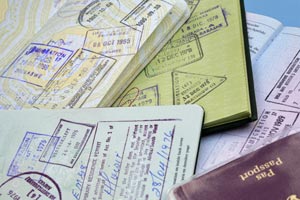
Iran visa

The British Foreign Office’s advice and the closure of the Iranian embassy in London means two problems. The first is obtaining a tourist visa for Iran and the second is getting travel insurance. Firstly, the visa – they aren’t difficult to secure but there is a procedure that needs to be followed. I needed one for at least three weeks’ travel, and they have to be collected from the embassy in Dublin. On the advice of David at Travel the Unknown, who had just come back from Iran, I used an agency, Persian Voyages, who were very helpful. The process actually took a couple of months (partly because I was a bit slow in getting the paperwork off and because Christmas was in the middle).

Firstly, you need a visa code (i.e. authorisation from Tehran) – then you fill out the paperwork, include some passport photos (if you’re a woman it’s strongly recommended to get photos taken with your head covered) and send them off with your passport and the fee. Eventually your passport reappears with a visa in it. I was very excited about getting mine – dragging my boyfriend off to the post office on a Saturday morning to collect it – as it finally meant I was definitely going.

Travel insurance for Iran

Next, the travel insurance. I can’t get travel insurance here because of the Foreign Office’s advice against all travel, and I can’t get travel insurance from a company in Ireland despite my parents being resident there because I am not resident there. There was a company that offered travel insurance for war zones but it’s stopped doing that – it recommended trying ihiBUPA, based in Denmark. Sure enough, for a bit more than your usual travel insurance, you can get cover for absolutely anywhere, though they do ask that you tell them if you’re going to Iraq or Afghanistan…

I don’t travel without insurance – having no desire to inflict emergency bills for having me repatriated or worse on my parents, and I’m certainly not travelling to Iran without it; not just because Iran is an earthquake hotspot but because the Iranians, although reputedly lovely people, are also considered some of the worst drivers in the world!

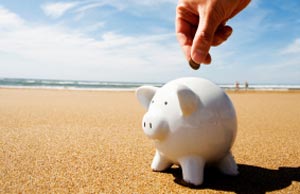
Iran travel budgeting

Budgeting

Iran is presently suffering from sanctions by the West, which means its currency, the rial, is dropping in value. This should make it cheaper for me to travel there because I’ll have foreign western currency (euros), but several things need to be taken into account here. Firstly, there are no international banking connections with Iran so I will not be able to access any other money while I’m there, so much more careful budgeting than usual will be required. Secondly, because of rising inflation, things could become much more expensive and lead to social unrest – the latter definitely to be avoided. As it turns out I shall be there for International Women’s Day on the 8th March, the small parades for which are heavily policed affairs. So, all fun and games then…

Do your homework

When going to somewhere like Iran it’s important to keep up to speed with what’s going on up to the point of departure. This is where the internet and friends and contacts come in handy. Apart from keeping an eye on the travel advice from both the Foreign Office and the Irish Department of Foreign Affairs, and on the news – specifically Al Jazeera – I’ve also used Lonely Planet’s Thorn Tree travel forum, which provides useful advice on current costs and so forth from returning travellers.

One of the many joys of living in London is there are people here from pretty much every country in the world and unless you lead a very insular life, you’ll inevitably know someone or know someone who knows someone who’s either been to or come from the country you’re visiting (failing that, drop into Stanfords – between us we’ve covered a significant proportion of the world’s countries). In this case I tracked down an ex-PhD colleague who is Iranian and asked her advice. She was brilliant, explaining places I should go and where I shouldn’t, what I should and shouldn’t do, and even giving me a contact in Persepolis.

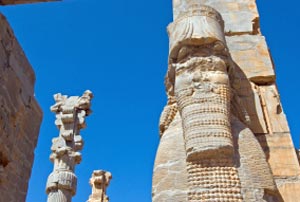
Iran ancient sculpture

There are a couple of websites that I find useful for preliminary dreaming and for topping up the guidebook – wikitravel.org and seat61.com – but the other crucial factor, usually decided upon the minute I’ve decided which country I’m visiting, is which guidebook to take – a question we get asked a lot in Stanfords.

Iran guidebooks and maps

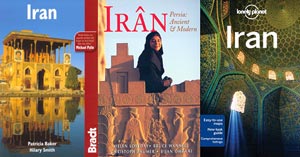
Different guidebooks do different things and have their own specialities and quirks, so the trick is to match one up to the type of holiday. For Iran there isn’t a huge choice: a Bradt, an Odyssey and the ubiquitous Lonely Planet. Bradt guides can be very good and quite individual – I’ve used them successfully in Ghana and Luxembourg – but the Iranian one starts out by assuming you’ve sorted your travel plans already. That’s no good for me as beyond getting to the country in question and maybe booking the first night, I book nothing else, so logistical information is important.

The Odyssey is lovely and definitely good for either pre-trip research or if you’re on a tour, but no good on logistics – so that left the Lonely Planet. To be honest the LP is the guide book I usually use as it has good reliable maps, information and options for where to stay – useful if you’re like me and tend to turn up somewhere with nothing booked. In this case it was also the most up-to-date guide. Another pre-trip guide I’ve found useful is the Culture Smart for Iran, for obvious reasons.

I never travel without a map, but again – which map? Maps, like guidebooks, come in different shapes and sizes and once again it depends on what you want them for – driving, orientation, pre-trip planning etc.

Iran travel guides

At the moment I have the Freytag and Berndt stuck on the wall because of its quite large scale, while the entire country is on one side of the page which makes it easier to get a grip on Iran’s geography and transport routes. However, it’s very big and since I really only need it for orientation, I’ll probably opt for something smaller – for example the Reise Know-How.

So, those are the main things sorted out: passport and visa, money, guidebook and map, and what’s going on. My flight is booked – one way to Tehran and return from Ankara as I’m hoping to take the train from Tabriz – and I’ve decided on what books I want to take with me. That just leaves the small matter of clothing… what am I going to do about a hejab?

His and Hers Guide to the Globe – Part 3: Siem Reap

Matt and Sharon Ward in Cambodia

Our round-the-world couple Matt and Sharon Ward have spent the next stage of their journey exploring the delights of Siem Reap in Cambodia. Here’s what they had to say about the world-famous Angkor region from a his and hers perspective…

A very early flight took us to Siem Reap in Cambodia, where we were surprised at how nice the small, modern airport was with its beautifully-landscaped grounds. You need $20 each and a passport photo to purchase your travel visa – ours were processed via a handful of officials who sat in a line, stamping and passing them onto the next official: a seamless and efficient process. A quick taxi journey took us to the Bun Nath Guesthouse, which was our first accommodation away from friends and the big city lifestyle.

Matt’s ‘His Guide’

After a quick power nap due to our 3am start, we ventured out to take in our new surroundings. Siem Reap has a long main street and many side streets off it with shops, bars and restaurants. I wasn’t too sure what to make of it at first, but as before I was prepared to give it a chance. We arranged our tuk-tuk driver through our guesthouse rather than going with the pushy airport driver. Mr Dano was polite and happy to drive us around for our stay and at a very good price ($15 per day).

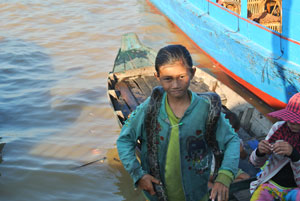
First off we headed towards Tonle Sap Lake, which involved a relaxing but occasionally bumpy 40-minute ride. Here we purchased tickets for a one-hour boat trip, which saw us take in the Floating Village & Crocodile Farm. This was a real eye opener for me with the sight of children begging with snakes wrapped around their necks, infants in tin bowls sailing the filthy river and people asking for help at every turn. There were hardly any adults to be seen – our guide mentioned that a lot of parents never returned alive from fishing trips. The tuk-tuk ride back to the guesthouse was a quiet one as I tried to make sense of what we had just witnessed. I felt very humbled and fortunate with the childhood I had.

That night we took a walk down to Pub Street, which is the main hub for food and drinks. We experienced our first power cut as we sat patiently in the dark awaiting our meal at Tigre De Papier – unfortunately, my chicken in basil with rice wasn’t worth the wait. From here we stopped off at a rooftop bar called Purple Mangosteen, a great place to take a few night-time pictures of the busy streets, before finishing off our first day at the Night Market.

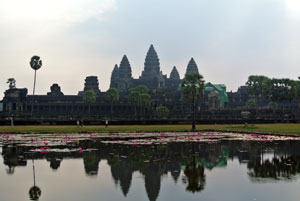
The following morning we had a 5:30am pickup taking us to Angkor Wat for sunrise. For $20 each we made our way in darkness towards the temple. A massive crowd had started to form, which felt a bit like a rock concert with fans eagerly awaiting the headline act to enter the stage. As the sun began to rise the temples looked stunning as they took on many different forms. This is something I would definitely recommend seeing. We spent about three hours walking around the temple before jumping back into our tuk-tuk and making the short trip to Angkor Thom. By late morning we were hungry, tired and a bit ‘templed out’, so decided to head back and grab some food and rest.

Angkor Wat

That night we popped into the Cambodian Soup Restaurant to try the Khmer Curry. With poor service, dirty tables and miserable staff, we quickly moved next door to the Khmer Family Restaurant for a curry and a few Angkor Beers with the bill coming to a whopping $9!

For our final day we decided to have a lie in before venturing out to the Red Piano for breakfast and coffees (our guesthouse didn’t provide meals). We popped into a bookstore and picked up a few books on the Khmer Rouge Regime and Cambodia’s struggles as neither of us remembered being taught this at school. From here we took in the Royal Residence and National Museum, which for me was slightly overpriced at $12, as was the café inside.

As a whole, I felt that Siem Reap really came to life at night with the overhead neon street lights, busy night markets and a packed Pub Street. Our informative day tours also contributed towards a thoroughly enjoyable trip and one that I’d recommend to anyone.

Sharon’s ‘Her Guide’

From outside the terminal building we easily picked up a taxi. Our driver was very friendly but tried desperately to get us to book him for tours. Matt was having none of it, but I eventually gave in, as I was feeling both tired and a little vulnerable. We agreed with him to pick us up at 3.30pm for our first tour. When we arrived at our guesthouse, we realised its tuk-tuk driver was in fact $2 cheaper ($8), so we arranged for him to pick us up at 3pm, avoiding the airport taxi driver. When we got to our room I immediately noticed a rancid smell; Matt having no sense of smell was oblivious to it. I made my way out to the balcony and below our room appeared to be an open sewer. We had already been told that we were moving to another room in the morning, so I just put up with it.

Our tuk-tuk driver called Mr Dano picked us up for our Floating Village tour. This is when we got to experience the real Cambodia. There were huts at the side of a dirt track road built up on sticks, children running around in the middle of the road and although they appeared to be living in real poverty, they all looked very happy. The Floating Village tour cost $20 each and we are taken by boat along the river, with houses, schools, shops and even a basketball court floating around us. From there, we were then taken to a Crocodile Farm, where we witnessed some of the children selling photos of themselves with snakes round their necks for a dollar. The journey back to the guesthouse was subdued as we both sat reflecting on what we had seen, and for me I realised how lucky I actually am.

Cambodia snake

That evening we made our way to Pub Street and noticed how the city had suddenly come to life. The streets were lit with neon lights and the night markets were a hive of activity.  We ate in Tigre De Papier, which seemed a little grubby with mosquitoes buzzing around us.  We then tried our hand at some haggling at the night market. I wasn’t quite sure if I came away with a bargain or not, but I did leave with two very nice sarongs for $10.

The next day we got picked up by Mr Dano at 5:30am to see the sunrise over Angkor Wat, which cost us $20 each for the full day. We stood patiently with the rest of the gathering crowds and watched the silhouette of Angkor Wat gradually paint itself out as the dawn broke behind it. We spent several hours walking around trying to find Angkor Thom from the map, when we eventually realised that it’s a lot further away. We made our way back to Mr Dano, who was waving and smiling at us and ready to take us to wherever we want to go next. By 11:30am we are both hungry and exhausted.  We decided to head back for lunch at the Blue Pumpkin and then get our heads down for a couple of hours.

That evening we had a refreshing cold shower which was not through choice, unfortunately I had (accidentally) booked our rooms without hot water, which easily explains why the rooms were only £3 each a night. We made our way down to Pub Street for some dinner. The first place we tried was the Cambodia Soup Restaurant.  We were rudely pointed towards a table, menus thrown down at us. One glance at the unclean table, flies and mosquitoes buzzing around us, and we walked out. Next door was the Khmer Family Restaurant where we were greeted with a welcoming smile, taken to a clean table and gracefully handed our menus. We both had the Khmer curry and beers. Although lacking a little in chicken it was tasty and I enjoyed it.

On our final day we enjoyed a long lie before heading out for breakfast at the Red Piano. We came across a bookstore where we both bought books on Cambodia. We spent the rest of the morning walking through the Royal Residence and National Museum. At $12 each, I thought it was over priced; though modern, small and easy to get around.  It was mainly based around the temples and Buddhism, but there wasn’t much else on the history of Cambodia, nor anything about the Khmer Rouge Regime.

I really enjoyed my time in Siem Reap. I felt safe and loved the idea of Pub Street. The night markets were just fantastic for bargains and there were foot massages available everywhere for something crazy like a dollar. My only regret was not stopping for a foot massage while I had the chance.

> Cover more of Cambodia with our collection of travel guides and maps.

Chicago: Top 10 Things to Do

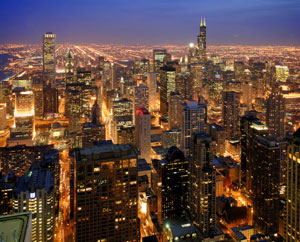
Chicago skyline

Chicagoan Molly Loeffler takes an in-depth look at her home city to reveal her Chicago top 10

Frank Sinatra got it right when he said Chicago was “My kind of town”. I have lived here for 20 years and truly love Illinois’ largest city – one that’s big to tackle but easy to manoeuvre thanks to buses, cabs, water taxies, free trolleys, and the infamous L – our elevated rail system. If you’re planning a visit here but aren’t sure where to visit, here’s my Chicago top 10:

1. Michigan Avenue

Busy yes, but here it’s definitely worth fighting the crowds. Michigan Avenue’s northern section is known as the Magnificent Mile (Mag Mile among locals) and is filled with high-end shops, popular department stores and wonderful restaurants. One shopping highlight is Water Tower Place – an eight-story shopping mall that’s home to Foodlife, an ‘eating experience’ featuring legendary Chicago restaurants.

Also at the northern end is the Water Tower – one of the few surviving buildings of the Great Chicago Fire of 1871. Follow the Mag Mile further north and you’ll hit Lake Michigan and Oak Street Beach – in the spring it’s lovely to walk the paths along the lakefront and enjoy the picturesque views. When things hot up in the summer you can lie in the sand, play beach volleyball, and, if the water’s warm enough, take a dip.

> Mosey on down to Michigan Avenue with Chicago Map Guide.

2. Millennium and Grant Park

After a day’s shopping it’s time to visit Michigan Avenue’s southern section and Millennium Park. A major tourist spot it might be, but locals still love it here. Jay Pritzker Pavilion is the first thing you’ll notice en route to Millennium Park – a gorgeous steel band shell with 4,000 fixed seats and a large lawn accommodating 7,000 more. During the spring and summer, the pavilion hosts many concerts, performances and events such as free yoga on the lawn.

Another Millennium Park must is the Cloudgate sculpture, known to Chicagoans as ‘the Bean’. A three-story steel structure with a highly-polished exterior, it gives stunning reflections of the skyline and the Chicago cityscape. Walk down the stairs from the Bean towards McCorkmick Tribune Plaza and the Plaza at Park Grill. In the warmer months you can eat outside on the plaza, while in winter there’s an ice skating rink regarded as among Chicago’s best people-watching spots. When it’s time to get away from the park’s crowds, stroll through Lurie Garden – home to the world’s largest green roof.

Next to the pavilion is the Pedestrian Bridge that crosses over Columbus Drive and ends at Grant Park – the perfect way to walk from Millennium Park to Grant Park, aka ‘Chicago’s front lawn’. This 319-acre park is greener than Millennium Park and hosts many concerts and events, including Taste of Chicago and the Lollapalooza music festival. At Grant Park’s centre is Buckingham Fountain – a Chicago icon and one of the largest fountains in the world.

> Gravitate to Grant Park with Red Maps’ Chicago.

Sears Tower

3. Willis Tower (or Sears Tower, as it’s better known)

Willis Group holdings purchased the naming rights to the Sears Tower in 2009, but away from corporate bigwigs no-one calls it by its official name. This 108-story skyscraper is the tallest building in the US (though it may be surpassed by New York’s One World Trade Center later this year) and a huge Chicago attraction – visitors should take the 60-second lift ride to the Skydeck and bask in the views of Illinois (and on a clear day, Michigan, Wisconsin, and Indiana). A new Skydeck feature is the retractable glass balcony boxes, allowing people to look down 108 stories at the streets of Chicago.

> Walk to Willis Tower with Hello Chicago.

4. Museums

Take your pick! The Art Institute of Chicago is the second-largest art museum in the US with more than 260,000 exhibits, including the likes of Monet, Renoir, Grant Wood, Edward Hopper and Matisse. Also recommended is the Museum Campus – home to the Field Museum of Natural History, Adler Planetarium and the Shedd Aquarium. Here visitors will see everything from Sue, the largest and most complete Tyrannosaurus Rex skeleton, to the stars and planets, and, if they so desire, an exhibition on jelly fish. Another institution worth visiting is the Museum of Science and Industry, where the many interesting and interactive exhibits make for a fun afternoon.

> Meander to the museums with MapEasy’s Chicago.

5. Lincoln Park Zoo

This is a fun (and best of all, free) attraction in the Lincoln Park neighbourhood of Chicago. It is One of the oldest zoos in the US, Lincoln Park is home to a wide variety of animals – and best of all, it doesn’t cost a dime to get in!

> Be led to Lincoln Park Zoo with the National Geographic Chicago map.

6. True Chicago Food

It’s a must for visitors to eat the food Chicago is famous for. Fancy a deep dish pizza? Head to Lou Malnati’s or Gino’s East. For a famous Chicago hot dog, go to Portillos or Superdawg – just don’t ask for ketchup. Want a good Italian beef sandwich? Al’s Beef, which does the best beef sandwich in Chicago, has it covered. If you head to the branch on Taylor Street, cross the street after your sandwich for some Mario’s Italian Lemonade – only open in the spring and summer, this little shack has the best lemon ice in the city./p>

One of Chicago’s most famous food attractions is Garrett’s Popcorn. A line may form outside each of its branches, but the popcorn is definitely worth the wait. You can order cheese, caramel, butter and many other flavours, but the most popular item on the menu is the Chicago Mix – a combination of cheese and caramel flavours.

> Roam to Chicago’s restaurants with the Chicago Eyewitness Guide.

7. Navy Pier

This 1,010 m-long pier alongside Lake Michigan was once a navy training centre, but it’s now home to many attractions, shops and restaurants. Travelling with children? Take them to the award-winning Chicago Children’s Museum right at the pier’s entrance. They’ll also enjoy the Navy Pier Ferris Wheel, which runs year-round, weather permitting. During the summer, Navy Pier hosts a fireworks show every Wednesday and Saturday night – watch them from the pier or a boat on the lake!

> Navigate to Navy Pier with Frommer’s Chicago: Free and Dirt Cheap.

8. Wrigleyville and Lincoln Park

If downtown is a little busy, take the ‘L’ out to one of the outer neighbourhoods. Two of my favourite are Wrigleyville and Lincoln Park – both on the north side. Wrigleyville surrounds the famous Wrigley Field, home of the Chicago Cubs baseball team. In the summer when the Cubs are playing, the streets are packed with people going to the game or to a nearby bar like the famous Cubby Bear to watch. On non-matchdays, Wrigleyville is a fun place at night with lots of bars and clubs.

Lincoln Park is another great neighbourhood and the home of Lincoln Park Zoo. It’s filled with many nice shops and delicious restaurants, as well as a great nightlife scene thanks to the plethora of bars here. If you’re paying a visit, I highly suggest going to CBA: Chicago Bagel Authority for breakfast or lunch. This quirky stop has just about every combination of sandwich toppings on a freshly-steamed bagel.

> Walk to Wrigleyville with Lonely Planet’s Chicago City Guide.

9. Shows and theatres

Chicago is always hosting different musicals and plays as well as concerts and comedians. Heading to an event can make for a very fun night and tickets are fairly easy to purchase. My favourite part is the theatres themselves – Chicago is home to many gorgeous old theatres dating back to the early 20th century. Among my favourite are The Chicago Theatre, Ford Centre for the Performing Arts also known as The Oriental Theatre, Bank of America Theatre, and The Cadillac Palace Theatre. All have gorgeous interiors and make the price of a ticket well worth it.

> See a show with the Chicago Wallpaper City Guide.

10. Second City

To understand the sense of humour of Chicagoans, a show at Second City is the thing to do, with this city specialising in sketch comedy and improv. Many hilarious actors and comedians have been discovered at Second City such as Tina Fey, Chris Farley, Steve Carell, Amy Poehler, Mike Myers, Stephen Colbert, Bonnie Hunt and many others.

> Catch up on Chicagoan culture with Chicago Culture Shock.
The European Capitals of Culture: A Closer Look at Marseille and Košice

It’s become one of the continent’s most high-profile cultural events: the awarding of European Capital of Culture status. Dating back to 1985, more than 40 cities have so far been recognised, and this year the mantle is being shared by Marseille and Košice. With both only a few hours away, we take a closer look at their cultural offerings…

Marseille Culture Capital

Marseille

France’s second-largest city isn’t renowned for being picturesque. A Mediterranean location is belied by Marseille’s lack of gentrification, its grittiness and a stark contrast to the serenity of neighbouring Provence. But a reputation defined on aesthetics alone is unfair, for Marseille is one of Europe’s oldest cities – founded by the Phoceans way back in 600 BC. And as its nickname Port d’Afrique suggests, it happens to be a melting pot of different cultures, from north Africa and Comoros to Italy and Spain – a city that, despite a sub-culture of crime, has earned a reputation for racial and religious tolerance, of colourful street markets and souks, and sun-drenched beaches and coves. Continue reading The European Capitals of Culture: A Closer Look at Marseille and Košice

A Geek's Day Out in NYC

NYC street

Gregor Swiderek travelled to New York City five years after his maiden visit, and while he didn’t fall in love with the Big Apple first time around, he found the city’s charms irresistible on his return.

I recently returned to New York almost exactly five years after my first visit. By coincidence I entered the city in precisely same way as the first, driving Interstate 95 from New Jersey across the George Washington Bridge and following Henry Hudson Parkway south towards Midtown Manhattan. It really gave me a strange feeling of deja vu.

The big difference from the first trip was that back then I didn’t really know what to do or see – despite so many things to do in NYC, I simply followed a random path across the city, while now I had a list of attractions I really wanted to visit. Continue reading A Geek's Day Out in NYC

Valentine's Day in London: Top 5 Tips

London Valentine's Day

In London for Valentine’s Day? Not sure where to go? Ronny Lavie reveals five of the most romantic, or not, venues in the capital on 14th February.

Valentine’s Day is almost upon us and, single or attached, London is full of exciting, romantic and quirky ways to fly the flag for true love. These are some of the options, whether you are an advocate of old-school courtship or a more modern approach to sweeping that special someone off their feet (and, for one option in particular, I mean that in the literal sense)…

For the traditionalist:

Simple and classy, dinner and a movie is the ultimate date night. For the most romantic atmosphere, head to Gordon’s Wine Bar on Villiers Street – an intimate underground bar with soft lighting and an impressive wine selection, or Julie’s Restaurant in Holland Park – a hidden gem with several rooms, all with different decor and atmosphere; head to the Garden Room or ‘Pink’ Room for pure romance, or the ‘Snug’ for a cosy drink. After dinner, there are many cinematic specials to choose from around town. Cineworld is bringing Moulin Rouge back to the big screen for one night only, while the Prince Charles Cinema, the BFI, Hackney’s Roof Gardens, Riverside Studios and even Kensington Palace are all showing some of the most iconic examples of devotion ever seen on screen.

For the hopeless romantic:

Nothing says romance like a champagne river cruise, and the Thames is being put to excellent use this Valentine’s Day. Multiple companies, including City Cruises and Bateaux London, offer couples the chance to spend the evening taking in some of London’s most famous sights from the unusual angle of the River Thames. Most packages also include champagne, fancy food and a suitably romantic soundtrack.

For the thrill seeker:

For adrenaline junkies, The Ghost Bus Tour provides the perfect excuse to cling to each other as you are driven through the streets of the city, while a creepy conductor tells you about its gruesome history. Actors and technology will provide the scares onboard, making this a bus ride you will never forget. And if that’s not enough to get your blood pumping, the Lover’s Leap Tandem Bungee Jump package deal surely will be. While the jump itself cannot take place on V day, it will make a great setting for you and your other half to really, ahem, fall head over heels for each other (sorry, I couldn’t resist!).

For the non-conformist:

If you and your partner want to experience the way love was celebrated in yesteryear, you should take yourself down to the Museum of London for its Valentine’s @ Late. The theme is the roaring 20s and attendees are invited to dress in the spirit of the era. Swing Dance UK will be giving Charleston lessons, and there will also be art lessons to help you create funky accessories and Valentines cards, plus a Literary Saloon and a talk by Beatrice Behlen about fashion and sexuality in London at the time.

For the anti-valentines:

Those of you who’ve recently had your heart broken must see Valentine’s Day as some kind of torture. For a scientific approach to matters of the heart, head to St Bartholomew’s Pathology Museum for its Mending Broken Hearts Seminar on February 13th. There will be a discussion about heart surgery and a talk about the benefits of wine and chocolate. They will also be giving out free samples of both and, at the end of the day, single or not and whatever time of the year it is, what more does one need?

Valentines Gift Ideas

Chinese New Year: A Little Bit of Everything

Chinese New Year fireworks

Shanghai-based writer and teacher Tim Neesham takes an in-depth look at the Chinese New Year celebrations as the country welcomes in the year of the snake.

The furore that surrounds China’s annual Spring Festival celebrations certainly eclipses anything I’ve ever seen anywhere at Christmas in the western world. It is a highly anticipated season of celebrations, traditions, festivities, food and fireworks for countries across the Far East but for the Chinese in particular, New Year is a big deal.

Visiting China around New Year offers a completely different angle to normal life in this country. For a start, everything stops. It’s not easy to get a day off work here but for the place dubbed the world’s factory, manufacturing all but shuts down, the skies clear and roads – on a daily basis so perilous with every crossing – are deserted a la a Hollywood zombie movie.

A place like Shanghai ticks due to its large migrant workforce, but with the arrival of Spring Festival everyone packs up and heads home. This leads to what is, by some margin, the largest annual migration of human beings on Earth. Airfares skyrocket and trains are booked up long in advance as in a country this size, going by plane or train is almost always more preferable than automobile.

This leads to its own set of complications. Train companies deliberately sell far more tickets than there are seats, which leads to overcrowding usually only seen at one of Colonel Sanders’ battery farms. Getting a seat is arbitrary – as trains are so tightly packed, it’s physically impossible to stand up and stretch your legs, go to the restaurant car or even the bathroom. To combat this problem, it is not uncommon for fully grown adults to enter a long-distance train journey during the lead up to Spring Festival wearing a nappy!

That said, there is more than one kind of Chinese New Year to enjoy and this is no better highlighted than in the use of fireworks – something that’s rooted in mythology and superstition, as the ancient Chinese (who, let us not forget, were the early pioneers of gunpowder) believed the noise of the fireworks scared away monsters that would otherwise come and eat your kids.

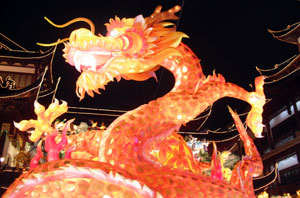
Year of the Dragon

The local governments of urban centres such as Shanghai and Beijing have tried to put a blanket ban on the general public’s use of fireworks and while this law is impossible to fully enforce, the best fireworks displays are generally found in the outlying provincial cities which enjoy much looser restrictions.

February 10th 2013 waves goodbye to the year of the dragon and ushers in the year of the snake. For many Chinese, the last 12 months (well, technically the nine months before, too) will have been a race against time to conceive in order to give birth in what they consider to be the luckiest of all the zodiac animals. This again is due to mythology and superstition, as the dragon was one of the first nature gods to be worshipped by the ancient Chinese and, in what is still a very patriarchal nation, is a symbol of masculinity and power. Incidentally¸ the dragon god allegedly evolved from a snake god and is the only mythical creature to grace the zodiac.

Indeed, such is the superstitious importance of astrology to the Chinese, people often plan their pregnancies around which animal their child will be attached to. I once heard a story from a former colleague of mine who has worked as a teacher in a junior high school in Hebei province for over 20 years. She told me that during the year of the sheep (2003) she had 88 students enter the junior high school exams but the year before, during the year of the horse, she had 136; a difference of over 50 per cent and simply because the horse is considered more desirable than the sheep.

Chinese New Year

As with any trip to China an open mind and a set of ear plugs are two of the most valuable travelling tools and this is no more fitting than during Spring Festival. But on the flip side, visitors will see an altogether more relaxed, peaceful China as most of the people who contribute to the everyday urban rat race jump at the chance to stay at home with the family, eat extensively and take a break from the world outside.

Bearing these, and many other things in mind, any travellers planning a trip to China around New Year are therefore advised to plan carefully, get ready to roll with the punches and be prepared for literally anything in what is one of the most unique celebrations in the world.

新年快乐!

> Want to find out more about China? Take a look at our unrivalled collection of maps and travel guides.

Top 5 Valentine's Day Gifts for Him and Her

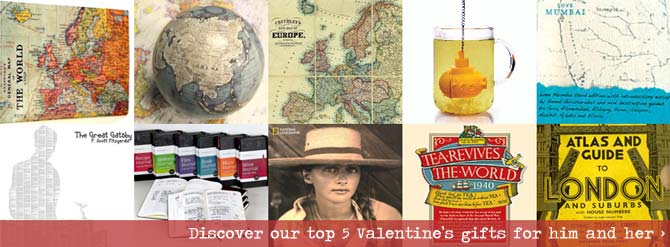
The most romantic day of the year is fast approaching, and no doubt you’re thinking of sourcing a travel or literary-themed gift for your loved one. To help make things a little easier, we’ve compiled our top five Valentine’s Day gifts for him and her:

Valentine’s gifts for him:

Stanfords World Map Wallet

1. Stanfords World Map Wallet

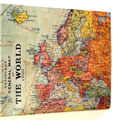
Launched only at the start of this year, the Stanfords World Map Wallet celebrates the world as it appeared in the early 1920s, with Europe on the wallet’s cover and Africa on the inside – two continents that have undergone huge changes and that, incidentally, will now do an excellent job storing your other half’s change. Two full-size partitions provide space for banknotes, while two front pockets will happily accommodate credit cards.

> Buy the Stanfords World Map Wallet! Continue reading Top 5 Valentine's Day Gifts for Him and Her

His and Hers Guide to the Globe – Part 2: Kuala Lumpur

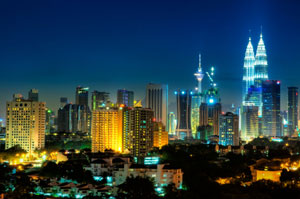
Kuala Lumpur skyline

Round-the-world adventurers Matt and Sharon Ward have been busy exploring Kuala Lumpur from a his and hers perspective. Here’s what they had to say about the Malaysian capital…

We were keen to try the train from Singapore to Kuala Lumpur so we could take in some of the countryside. Strangely enough, it worked out cheaper for us to fly the 45-minute journey at a total of £57, rather than £34 each by train. With the airport only 15 minutes away by bus, and being on a tight budget, we decided to fly to the Malaysian capital. On arrival, we were looking forward to free digs thanks to one of Sharon’s KL-based friends. Continue reading His and Hers Guide to the Globe – Part 2: Kuala Lumpur