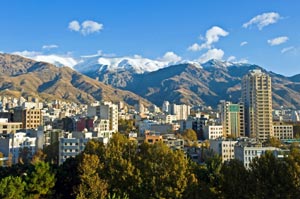
On Monday, the intrepid Caroline Sandes will travel to Iran – a country the Foreign & Commonwealth Office strongly discourages visiting. Having secured an Iranian visa and, more challengingly, travel insurance, how does one plan a trip to one of the world’s most volatile countries?
Iran has reached the top of my ‘places I want to go’ list – not least because I’m worried that due to the current political shenanigans of the Middle East, the opportunity for me to visit will suddenly disappear. I’ve always wanted to see Iran – Esfahan and Persepolis specifically – and I’ve heard great things about the country and its people from those who’ve travelled there. However, as a solo woman traveller, I’ve also always been aware that it probably would be fairly tough travelling and so I’ve put it off. Not anymore. The visa has been obtained and the flights booked and I’m off on Monday for three weeks.
Given the perceived difficulties of travelling in Iran at the moment, this trip has required considerably more planning and research than usual. I thought, therefore, that it might be useful to explain the process, as much of it is useful if you’re thinking of travelling anywhere you haven’t been before.
Getting an Iran visa
Firstly, due to the aforementioned political instabilities, the British Foreign Office advises against all travel to Iran. This advice is to be heeded and you should always check its Travel Advice section. In my case, however, I am Irish and the Irish Department of Foreign Affairs is advising to ‘Exercise Caution’, and the Irish Embassy is still open in Tehran, so I don’t feel too irresponsible. I will of course register my passport on its website as recommended.
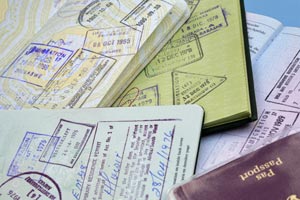
The British Foreign Office’s advice and the closure of the Iranian embassy in London means two problems. The first is obtaining a tourist visa for Iran and the second is getting travel insurance. Firstly, the visa – they aren’t difficult to secure but there is a procedure that needs to be followed. I needed one for at least three weeks’ travel, and they have to be collected from the embassy in Dublin. On the advice of David at Travel the Unknown, who had just come back from Iran, I used an agency, Persian Voyages, who were very helpful. The process actually took a couple of months (partly because I was a bit slow in getting the paperwork off and because Christmas was in the middle).
Firstly, you need a visa code (i.e. authorisation from Tehran) – then you fill out the paperwork, include some passport photos (if you’re a woman it’s strongly recommended to get photos taken with your head covered) and send them off with your passport and the fee. Eventually your passport reappears with a visa in it. I was very excited about getting mine – dragging my boyfriend off to the post office on a Saturday morning to collect it – as it finally meant I was definitely going.
Travel insurance for Iran
Next, the travel insurance. I can’t get travel insurance here because of the Foreign Office’s advice against all travel, and I can’t get travel insurance from a company in Ireland despite my parents being resident there because I am not resident there. There was a company that offered travel insurance for war zones but it’s stopped doing that – it recommended trying ihiBUPA, based in Denmark. Sure enough, for a bit more than your usual travel insurance, you can get cover for absolutely anywhere, though they do ask that you tell them if you’re going to Iraq or Afghanistan…
I don’t travel without insurance – having no desire to inflict emergency bills for having me repatriated or worse on my parents, and I’m certainly not travelling to Iran without it; not just because Iran is an earthquake hotspot but because the Iranians, although reputedly lovely people, are also considered some of the worst drivers in the world!

Budgeting
Iran is presently suffering from sanctions by the West, which means its currency, the rial, is dropping in value. This should make it cheaper for me to travel there because I’ll have foreign western currency (euros), but several things need to be taken into account here. Firstly, there are no international banking connections with Iran so I will not be able to access any other money while I’m there, so much more careful budgeting than usual will be required. Secondly, because of rising inflation, things could become much more expensive and lead to social unrest – the latter definitely to be avoided. As it turns out I shall be there for International Women’s Day on the 8th March, the small parades for which are heavily policed affairs. So, all fun and games then…
Do your homework
When going to somewhere like Iran it’s important to keep up to speed with what’s going on up to the point of departure. This is where the internet and friends and contacts come in handy. Apart from keeping an eye on the travel advice from both the Foreign Office and the Irish Department of Foreign Affairs, and on the news – specifically Al Jazeera – I’ve also used Lonely Planet’s Thorn Tree travel forum, which provides useful advice on current costs and so forth from returning travellers.
One of the many joys of living in London is there are people here from pretty much every country in the world and unless you lead a very insular life, you’ll inevitably know someone or know someone who knows someone who’s either been to or come from the country you’re visiting (failing that, drop into Stanfords – between us we’ve covered a significant proportion of the world’s countries). In this case I tracked down an ex-PhD colleague who is Iranian and asked her advice. She was brilliant, explaining places I should go and where I shouldn’t, what I should and shouldn’t do, and even giving me a contact in Persepolis.
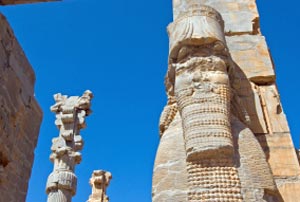
There are a couple of websites that I find useful for preliminary dreaming and for topping up the guidebook – wikitravel.org and seat61.com – but the other crucial factor, usually decided upon the minute I’ve decided which country I’m visiting, is which guidebook to take – a question we get asked a lot in Stanfords.
Iran guidebooks and maps
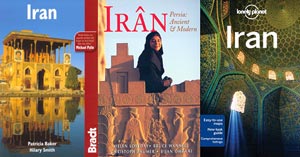
Different guidebooks do different things and have their own specialities and quirks, so the trick is to match one up to the type of holiday. For Iran there isn’t a huge choice: a Bradt, an Odyssey and the ubiquitous Lonely Planet. Bradt guides can be very good and quite individual – I’ve used them successfully in Ghana and Luxembourg – but the Iranian one starts out by assuming you’ve sorted your travel plans already. That’s no good for me as beyond getting to the country in question and maybe booking the first night, I book nothing else, so logistical information is important.
The Odyssey is lovely and definitely good for either pre-trip research or if you’re on a tour, but no good on logistics – so that left the Lonely Planet. To be honest the LP is the guide book I usually use as it has good reliable maps, information and options for where to stay – useful if you’re like me and tend to turn up somewhere with nothing booked. In this case it was also the most up-to-date guide. Another pre-trip guide I’ve found useful is the Culture Smart for Iran, for obvious reasons.
I never travel without a map, but again – which map? Maps, like guidebooks, come in different shapes and sizes and once again it depends on what you want them for – driving, orientation, pre-trip planning etc.
At the moment I have the Freytag and Berndt stuck on the wall because of its quite large scale, while the entire country is on one side of the page which makes it easier to get a grip on Iran’s geography and transport routes. However, it’s very big and since I really only need it for orientation, I’ll probably opt for something smaller – for example the Reise Know-How.
So, those are the main things sorted out: passport and visa, money, guidebook and map, and what’s going on. My flight is booked – one way to Tehran and return from Ankara as I’m hoping to take the train from Tabriz – and I’ve decided on what books I want to take with me. That just leaves the small matter of clothing… what am I going to do about a hejab?