A brand new book gracing the shelves at Stanfords is Philip Parker’s History of World Trade in Maps. In this beautiful book, more than 70 maps give a visual representation of the history of World Commerce, accompanied by text which tells the extraordinary story of the merchants, adventurers, middle-men and monarchs who bought, sold, explored and fought in search of profit and power. The maps are all works of art, witnesses to history, and have a fascinating story to tell.
To celebrate the launch of his new book, we asked Philip to write this blog post to give us all a taster of what we can expect:
Trade and Diplomacy by Philip Parker
In an age when trade negotiations – or the lack of them – seem to degenerate into political point-scoring or abstruse technical arguments over the cocoa content of chocolate – it is easy to forget that without trade, our way of life would collapse. Every country, even North Korea, has to trade the goods it can produce in exchange for those it needs but cannot produce. A trading advantage can be gained by a reputation for quality, specialization, sharp-tongued merchants or skill in spotting shortages. Above all, however, diplomacy acts as a multiplier of trading success.
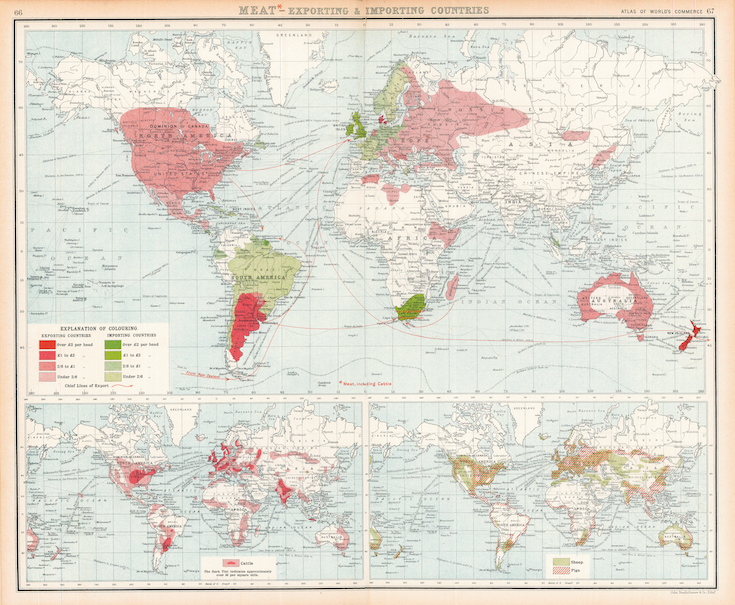
(Image credit: Bartolomew’s Meat-Exporting & Importing Countries map, pages 66-7,
Atlas of the World’s Commerce
, 1907.)
In 1875, the New York meat magnate Timothy C Eastman succeeded in sending the first shipment of refrigerated beef across the Atlantic in the cold chamber of a steamboat. Part of that pioneering consignment was sent to Queen Victoria who dined on it and, fortunately for Eastman’s future prospects, declared it “very good”. Eastman had his eye more on the mass market than the elites, and by the 1890s he and his British partners were running over 300 meat-carrying cargo ships, but this deft piece of private diplomacy smoothed the way.
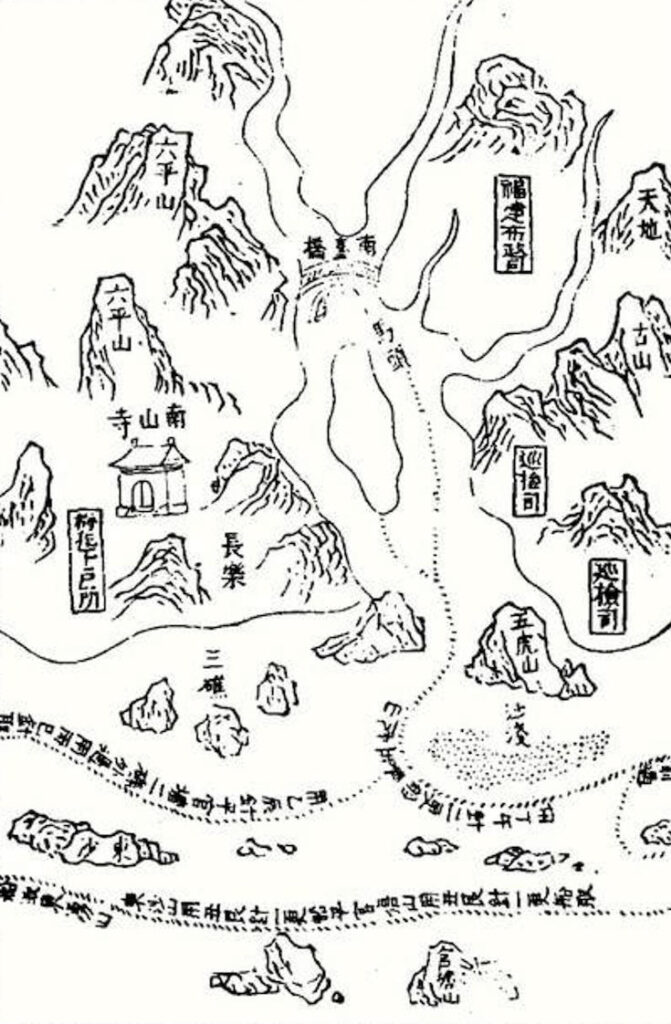
The map shows the initial stages of one of the medieval world’s most spectacular journeys of exploration, which linked China to the East African coast in a brief, tantalising set of voyages
, whose discoveries were never followed up. Accompanying Ma Huan’s 1416 Overall Survey of the Ocean, an account of those voyages, it shows the coastline of Fujian Province with, in its centre, the port of Changle, from which several of them departed.
(Image credit: Map of coastline of Fujian Province and port of Changle, 1416; accompaniment to Ma Huan’s Overall Survey of the Ocean. The Picture Art Collection / Alamy Stock Photo.)
The Chinese Admiral Zheng He, who led seven voyages on behalf of his Ming imperial masters between 1405 and 1433, understood this. His magnificently apparelled “treasure ships”, up to 300 feet in length, made his fleet a virtual floating city with thousands of sailors, and a powerful diplomatic statement. Rulers as far as Sumatra, Arabia and the East Coast of Africa duly made (doubtless insincere) professions of obedience to the Chinese emperor and gave showy and exotic gifts such as giraffes, whose resemblance to the qilin – a creature of Chinese myth thought to bring great good fortune – provoked immense excitement back home. It is an intriguing thought that had Zheng He pushed further down the coast, he might have been the first mariner to round the Cape of Good Hope, seven or more decades before the Portuguese – in the shape of Vasco da Gama – came from the opposite direction.
The Chinese have long been masters of trading diplomacy. The Silk Road carried their traders – along with innovations such as paper and gunpowder – into Central Asia and beyond, while foreign merchants such as Marco Polo and foreign religions such as Buddhism went in the opposite direction. It was a system originally built, in the 3rd century BC, on gifts of silk to local rulers who developed a taste for its luxury and became locked into a tributary relationship with the imperial court. The tradition of using trade for diplomatic purposes is continued almost two thousand years later with the Beijing government’s 21st-century promotion of its multi-billion dollar “Belt and Road Initiative” which funds infrastructure projects throughout South, Central and Southeast Asia in the hope this largesse will tie the region tightly into a Sinocentric trading system.
Of course, trade can sometimes become indistinguishable from plunder, which the Vikings were prone to in the 9th and 10th centuries as barter and the axe proved handy companions, and imperialism – when European nations secured new lands and their resources through occupation – was in many ways simply a more organised and enduring form of it. Yet the most successful trading nations throughout history, such as Venice or Singapore, have prospered because they understood their small size and exiguous manpower meant they had to develop other skills; those of the trader and the diplomat.
The art of trading is to persuade the other party of a need of which they were previously unaware, and it was this skill that, in the late 18th century, persuaded the British to slurp copious quantities of tea laced with the sugar that, not uncoincidentally, the plantations in new British colonies in the Caribbean produced in huge amounts. The accompanying increase in tea-trading to North America, did, though, have the unfortunate side-effect of creating a storm over tariffs that helped spark the American Revolution. Whatever the key trading goods of the future, whether mundane, exotic or even virtual, it will require a hefty dose of diplomacy to lay the groundwork and promote the work of our 21st– century Marco Polos. Those nations whose political leaders possess it will inherit the future. Those who do not may find, like the Tokugawa shoguns of Japan who expelled almost all foreign traders in 1639, that when they eventually do try to reconnect with the trading mainstream, it has far outpaced them.
History of World Trade in Maps by Philip Parker is available to buy now.
Additional recommended reading: History of Britain in Maps: Over 90 Maps of our Nation through Time by Philip Parker.
You can listen to Philip Parker talking about the History of Britain in Maps at the 2020 Stanfords Travel Writers Festival here.