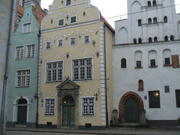
Budapest, Kisalföld and Lake Balaton

For a good mix of history, culture, food and relaxation, Hungary offers its fair share of attractions for tourists. My trip to Hungary took in quite varied pleasures, from relaxing in the Turkish baths of Budapest (try jumping from a boiling hot sauna into a pool of cold water) to intrepid quad driving through the beautiful, verdant fields and woods of the north-eastern Kisalföld region.

The Kisalföld offers not only nature, but also the pretty city of Györ and the historically rich Pannonhalma Monastery, perched on a hill with fine views of the surrounding area.

Budapest was an inspiring city to visit. The architecture along the banks of the gorgeous Danube is radiant both in the daytime and at night, and walking the banks of the river was a refreshing way to start my visit. Walking the streets of the city throws up pretty squares, historic buildings (try Europe’s largest synagogue in Pest), proud statues and outdoor cafés, bars and restaurants. Late-night revellers might enjoy a trip to an outdoor club in Buda, where you can dance in the warm air and sample fine lagers and the peculiar Unicum, which is a dark, herbal Magyar spirit.

After the capital, my excellent hosts took me to visit Lake Balaton. A gorgeous milky blue lake, Balaton offers not only relaxed bathing, but also delightful small towns on the northern shores where you can visit museums, palaces and climb up to the ruins of a hilltop castle on the Szigliget peninsula. Life in this area seems very relaxed, especially while you recline in a dimly lit winery, sip red wine and listen to live violin performed by a Roma gypsy band.

Other, more random activities included enduring a concert by the long-established Hungarian rock band EDDA and a trip to an ice-cream factory. Here, I participated in a company table-tennis tournament, bowing out in shame after being challenged by a former national champion. I consoled myself with a tour of the factory, tasting the ice cream and seeing how the flavours are created by scientists in a Willy Wonka-style setting.

Any gastronomes should bear in mind that Hungary is a nation of meat-eaters – meat is eaten in copious amounts even at the breakfast table – and goulash, spicy stews and cold meats are a staple. But this need not put off any vegans or vegetarians, since you’ll find dishes with glorious combinations of ingredients you never would have dreamt of. As a vegetarian, my favourite meal comprised of a fruit soup, followed by a cherry strudel and a shot of lethal plum brandy (pálinka).

For any trip to Hungary, I would recommend some decent books and maps. The Rough Guide to Hungary was extremely informative and the Bradt Travel Guide to Hungary gave me inspiration and interesting facts (particularly about Hungarian naming conventions and a history of the Rubik’s cube). For travel literature, you might enjoy reading sections of Patrick Leigh Fermor’s Between the Woods and the Water, which recounts his walk across central and eastern Europe in the 1930s. The Insight Fleximap of Budapest offers clear mapping of the key tourist destinations. And if you’re hoping to explore other areas of the country in more depth, particularly if you are hiking or trekking, you could try Hungary’s own mapping from Cartographia. But before any of this, try acquainting yourself with the strange and beautiful Hungarian language – for this, the Rough Guide Hungarian phrasebook served me very well.

Browse our collection of maps, guides and travel literature:
> Hungary travel guides
> Hungary road maps and atlases
> Travel literature inspired by Hungary
> See all our maps and guides to Budapest

Author: Tim Cleary

Montenegro

The travel supplements have long been asking, ‘Where is the new Prague?’ (My vote would be for Ljubljana, the Slovene capital). Today the question should be, ‘Where is the next Croatia?’ Croatian tourism has really kicked off in recent years, and the coast is saturated from Istria down to Dubrovnik. And yet, just a few miles south of Dubrovnik is a beautiful, secret country, crying out for tourists.

Montenegro was the smallest Yugoslav republic, and the last to break away from big brother Serbia as recently as June 2006. Until then, Montenegrin coastal resorts, such as Budva and Herceg Novi, relied on Serbian tourists. But since the split, Serbs have got the hump and Montenegro’s hoteliers and guesthouse owners are crying out for new guests.

The coast is just as beautiful as Croatia, but with a more spectacular mountain backdrop. It’s up in the mountains where Montenegro’s soul lies, particularly in Cetinje – the ancient capital – with its Ruritanian royal palaces and long-deserted embassies. It’s so much prettier than the modern capital, Podgorica (formerly Titograd), down on the plain.

Another unique feature of Montenegro is the Bay of Kotor (Boka Kotorska), the biggest fjord in the Mediterranean. Here the coast and the mountains come into direct contact, and deep in the chasm lies Kotor, a walled Venetian city dwarfed by the towering walls of the fjord.

There are no cheap flights to Montenegro’s Podgorica or Tivat airports (yet), but that is irrelevant when Dubrovnik airport is just 18km from the border. Or you can do as I did – get a boat from Bari in Italy to the Montenegrin port of Bar. I could give you the address of a good guesthouse owner there – she’s my mother-in-law!

The Bradt guide to Montenegro is the only guide to the country published in the UK. As a series, they are highly personal guides that cover countries overlooked by other publishers, including all the Balkan nations.

Lonely Planet’s Western Balkans covers Montenegro. Hungary’s Gizi Maps do a national map of Montenegro, while Slovenia’s Geodetski Zavod Slovenije (GZS) 100k map of the Montenegrin Coast (Crnogorsko primorje) is excellent. Don’t rely on any locally produced maps.

Browse our collection of Montenegro Maps and Guide books here >

Montenegro travel information >

Author: Guy Bristow

Maribor, Slovenia

‘Pozdravi iz Maribor’ – Greetings from Maribor! Ryanair’s latest destination, which personally I’m very happy about, because since I left Stanfords’ employ, I have been living and working in the Maribor area.

Slovenia’s second city is not much more than a small town, and consequently Maribor Aerodrom is much smaller than Ljubljana’s Brnik Airport. There is no luggage carousel, for example, just a table where your baggage is handled.

So, a second front has been opened on the tourist invasion of Slovenia. Ljubljana and Lake Bled are already overrun with easyJet weekenders, but Maribor is still mostly tourist-free. A proud city, and rival to the capital, but is it prettier than Ljubljana? Well no, but it’s not without its own charm. Its best feature is the riverfront. The River Drava wends its way slowly from the Austrian Alps down to the Danube in far off Serbia. The Old Town is a cluster of red-roofed mediaeval buildings on the left (north) bank, although the best views are from the right (south) bank. Particularly from the terrace of the Europark Shopping Centre, the only place you don’t have to look at this monstrosity. Continue reading Maribor, Slovenia

England – Manchester

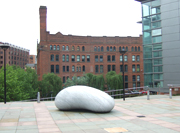
ManchesterSidestepping the clichéd comments about rain and industrial gloom, there are strong arguments for choosing Manchester as a city break destination. There is the social and cultural history of one of England’s great urban centres, the sense of vibrancy and vitality of a place in flux, and the architectural wonders of a city with one foot in the past and the other firmly marching forward into the 21st century.

Since it has a relatively compact city centre, Manchester is an ideal option for a weekend getaway. Shops, restaurants, music venues and clubs are a-plenty, especially in the areas between the Arndale Centre, Deansgate, Piccadilly and the famous Canal Street. For those with less disposable income, it is a delight to just walk the streets and soak up the atmosphere of the place. I would definitely recommend a visit to the splendid John Rylands Library and a walk around the canals and bridges in the Castlefield area of town. You could even visit the Lowry arts centre, the City Art Gallery or any of the smaller galleries to be found in the city. In Manchester, delights can be found in the most unlikely of places, where side alleys, backstreets and canal paths reveal hidden spires, public art and music venues.

My favourite area was the Northern Quarter, with its boutiques, trendy record shops, edgy pubs and classy bars. It was here that made me think most of my musical heroes who hail from Manchester: Joy Division, New Order, the Stone Roses and the Smiths all grew out of the vibrancy of this city.

For my trip, the Manchester Time Out Shortlist guide was invaluable for up-to-date practical advice and maps to find my way around. Also very useful were Clare Hartwell’s Manchester Pevsner Architecture Guide and an eccentric walking guide called Morrissey’s Manchester, which details the haunts of Manchester’s favourite miserabilist and his chums from his former band, the Smiths.

There may be rain, and Morrissey and Marr may not be everyone’s cup of tea, but Manchester is a breath of fresh air for anyone looking for a stimulating short break.

Browse our collection of maps & guides:

> England travel guides

> England road maps and atlases

> Travel literature inspired by England

> See all our maps and guides to Manchester.

Author: Tim Cleary

Cameron Highlands, Malaysia

Not far from the hectic capital Kuala Lumpur  is a green and pleasant land, where tea and scones are served in mock-Tudor restaurants, and it’s prone to rain now and again. Yes, there is a small patch of England in Malaysia.

Harking of course back to colonial times, the Cameron Highlands were established as a hill station for the poor old British retreating from the heat. And when I left the bus from KL in Tanah Rata, it seemed very little had changed.

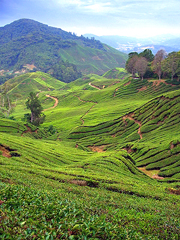
I headed for a guesthouse on top of a hill, where the accommodation occupied Nissen huts used by the British army in World War II. Now with a modern cafe and reception area, the guesthouse was surrounded by well-tended, flower-filled gardens and scenic views of lush green hills.

Perusing the information boards, I read numerous warnings against setting off on treks alone or unprepared. Jim Thompson, who set up the Thai Silk Company, set off for a walk one evening, while holidaying in the Cameron Highlands in 1967, and never returned. His disappearance remains a mystery to this day, with various theories trying to solve the riddle, ranging from kidnapping to tiger attacks.

I decided to put off doing a jungle trek, and instead opted for a more genteel tour of a tea plantation. The Boh Tea Estate is one of the biggest producers of tea in the country and we were shown the passage from leaf to cup. Nearby are other opportunities for gentle pursuits, including visits to butterfly, honey bee and strawberry farms.

Later that day I discovered yet more reminders of England, with the mock-Tudor ‘Ye Olde Smokehouse’ hotel and restaurant that even has a red British phone box outside. Stepping inside the house, the several thousand miles back to the UK disappeared as I was met with floral furnishings, wooden beams and old furniture. It seemed only appropriate to try out the cream tea, complete with scones, and of course the locally produced tea and strawberry jam.

The next day I felt ready to tackle a trek through the jungle. I followed a steep forest trail, sometimes climbing almost vertically up tree roots, to finally reach a mountain summit. And while in places it was tough-going, I’m pleased to report I did not disappear, but instead returned to civilisation in time for tea.

Maybe I was saved by using the Rough Guide to Malaysia, Singapore & Brunei. If you’re prone to getting lost, please do take along a good map such as Freytag & Berndt’s map to Malaysia. There is also the Lonely Planet Malaysia, Singapore and Brunei, with a brief synopsis of each hiking trail in the Camerons.

Browse our collection of maps, guides and travel literature:
> Malaysia travel guides
> Malaysia road maps and atlases
> Travel literature inspired by Malaysia

Author: Rachel Ricks

Sumatra

After a terrifyingly choppy five-hour ferry trip across the Strait of Malacca from Malaysia, then a lost number of hours with a minibus driver negotiating dusty, potholed roads at top speed, I eventually started my exploration of Sumatra in Bukit Lawang. Here, thanks to the Bohorok orang-utan reintroduction centre, backpacker cafes and guesthouses once lined the riverbanks, until almost the entire town was destroyed by a flash flood one night in 2003.

Now, the resilient locals are even more welcoming than ever as they are starting to rebuild their businesses. I stayed at Jungle Inn, a brilliantly constructed jumble of fairytale accommodation, with log cabins overlooking waterfalls, and furnished with oversized carved wooden tables and chairs. It is also in an ideal location, right by the river crossing over to the orang-utan centre on the opposite bank.

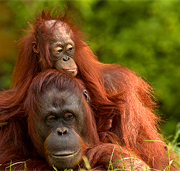
We had barely crossed the rushing waters in the dug-out canoe when we spotted an extremely hairy orang-utan leisurely sitting on the riverbank, trying to get the last sips from an abandoned can of fizzy drink.

At this reintroduction centre, the orang-utans are semi-wild, having been released from captivity into the jungle but returning for twice-daily feedings at a specially built platform. And it’s here that visitors have the privilege to view the feedings. On the footpath through the trees up to the platform by a particularly friendly orang-utan who insisted on holding someone’s hand to help her up the steep path.

One of the centre’s workers carried the bucket of food onto to the platform, and we stood waiting in suspense, peering into the treetops, for the animals’ arrival. It wasn’t long before we heard the distant rustling of branches with the first diner swinging towards us.

We all stood in silent awe as a mother orang-utan, with her baby clinging onto her, lumbered a few feet from us, took the food and then deftly made her way up a tree, to settle on a branch above our heads. The mother let go of the baby, leaving him to dangle from the branch by one spindly arm, spinning one way and then the other until finally slowing to a halt where he continued to dangle non-chalantly. That sight alone already made it well worth that bumpy journey.

For more information on the plight of the Sumatran orangutan, see the websites of the Sumatran Orangutan Society: www.orangutans-sos.organd the Sumatran Orangutan Conservation Programme: www.sumatranorangutan.org.

The Lonely Planet guide to Indonesiawill give you the low-down on where to stay and how to get there. I recommend taking along an Lonely Planet Indonesian Phrasebook in handy pocket size. To help you get around, take along the ITMB map of Indonesia, or the more specific Nelles map of Sumatra, complete with insets of its main city centres. For a beautiful insight into the plight of the orang-utan, check out Thinkers of the Jungle.

Browse our collection of travel guides and maps to Sumatra >

Author: Rachel Ricks

Uganda – Kampala

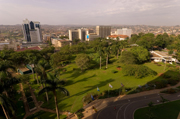
It was February and my dad and I wanted to escape cold, grey London so we headed south to Uganda. We landed at Entebbe and got a taxi to our hotel The Sheraton – I wanted to stay somewhere more African but my dad did not. The airport had huge piles of dead mosquitoes on the floor and other strange bugs – the reason it is particularly bad at Entebbe is because it is on the huge freshwater lake that is Lake Victoria. The weather was hot, humid and cloudy, which was better than the cold and cloudy weather in London. Continue reading Uganda – Kampala

China – Beijing

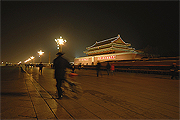
ChinaWhen I first arrived in Beijing the first thing that struck me was the pollution and the haziness of the skies. My dad and I hailed a taxi at the airport – my first chance to practice my basic Chinese. Luckily the driver seemed to understand what I was I was saying however if you can’t speak any of the language I advise you to get the hotel or a Chinese friend to write it down for you on paper because the taxi drivers know little or no English. Huge highways congested with trucks and cars waited in a long traffic jam heading towards the city centre. Our hotel was situated in an ideal location, only a five-minute walk to Tiananmen Square on a long busy road; you should pay around 120 yuan to go from the airport to central Beijing. There are many things you could say about Beijing but one thing you can’t say is that it is boring – during the summer everyone stays out late, eating at small noodle bars and cafes.

Everyone there wakes up early and often jog before work or school while the older generation do tai chi in large leafy parks – there is a dominant habit of old men in Beijing to make a huge flemmy noise and then spit every few minutes. The streets and other public places are full of life and many people spend much of their day here because the majority of the population are crammed into small rooms in massive blocks of flats. Many of the tourist attractions in Beijing are overcrowded and overrated, however, the Summer Palace and the Temple of Heaven are definitely worth your while. It is a good idea to visit the more touristy sites as early as possible as crowds become unbearable after 8 o’clock.

As I found out, if a taxi driver thinks you can speak Chinese they will speak quickly and they like to shout when they speak to foreigners, however most of them were extremely friendly and helpful. Walking from place to place is nearly impossible due to the size and the spread of the city – but you can quite easily walk if you want to find a restaurant or a park because there are restaurants on nearly every street. Good places to go for dinner or lunch are in the small hutongs (side roads) that can be found in the north of the city and in some parts of the centre. These more authentic slightly shabby narrow roads are what real Beijing is like – old men playing Chinese chess, young children playing out and very good street food without any illnesses to follow.

These areas date back hundreds of years and are far more traditional in architecture and daily life than any other part of Beijing, and are virtually tourist-free. A good place to go out after you eat is KTV, which is the Chinese version of karaoke. You hire a small room with a TV for as long as you want and you sing along to Korean and Taiwanese pop music. If, for some reason, you get bored of Chinese food – if you stay for a long period of time – go to a Hanguo kao rou restaurant where they give you a variety of very good quality meat and you roast it yourself over hot coals. It is also popular to go to one of the many tea houses in Beijing before or after a meal.

If you travel to anywhere in China take the opportunity to buy as many DVDs or any electrical things because it is far cheaper and their technology is far ahead of what we have in the West. Not just electrical equipment but everything in China, except things that they see as exotic such as coffee, are cheap, 15 renminbi to the pound.

If you don’t want to take a taxi everywhere take a bus – it is the cheapest mode of transport and is efficient. However, like any vehicle in Beijing it will get caught up in traffic a lot of the time. Do take into account that the buses are usually ridiculously crowded, as is the small subway system which would be confusing enough even if it was in English. Beijing can sometimes be a confusing city but it isn’t too hard to find your way around, however if you ask any of the locals a direction in Chinese they will always tell you North, South, East or West so be sure to ask what road to take.

Anyone who comes to Beijing almost always eats at a roast duck restaurant – there are huge duck farms outside Beijing where the animals are fattened up to be roasted until there is a perfectly crisp skin and succulent inner flesh. Beijing duck tastes completely different to the Cantonese version we have in London. If you want to go to a duck restaurant just wander around until you find one as there are restaurants everywhere – it is pretty obvious to tell a duck restaurant because they tend to have a picture of a cartoon bird.

In some restaurants they carve the duck in front of you and they are extremely hygiene conscious as they wear a plastic mask and gloves whilst touching food. When I was in Beijing I had noticed that in many restaurants they give a free bottle of mao tai which is a 53% bottle of rice-based alcohol. Drinking here is quite acceptable and many business men smoke or drink whilst chatting. The best way to take in Beijing life is to spend time in a school or college as I did, you get a completely different view of the city from the eyes of the local people but the main reason I did it was to improve my Chinese speech. But I recommend it to anyone, however the government can make it quite hard for you to do so.

Stanfords’ recommendations for a trip to Beijing are the ITMB Beijing map and Lonely Planet’s Beijing guide.

Browse our collection of China Maps and Guide books here >

Author: Angus Lee

Riga, Latvia

Sitting astride the banks of the river Daugava, the city of Riga is one of mystery, beauty and contradiction. Latvia gained its independence from the last death throes of the Soviet Empire in 1991 and with this newfound freedom Riga has in recent years emerged as an increasingly popular destination. Spurred on by its inception to the EU and recent Eurovision ‘success’, Riga symbolises a Latvia intent on building a reputation as a vibrant, modern city open to the west once more.

Dubbed the ‘Paris of the north’, Riga is a hauntingly beautiful city. While the ghosts of Soviet and Nazi occupation still linger beneath the surface, there is a real sense of purpose and intent on building a new legacy for itself after the dark days of the 20th century. This is enforced through the keen contrast between old and new, best symbolised in the imposingly tall, modern, glass TV tower that blinks unflinchingly across the Daugava to Riga Castle and the heart of the old city; a bridge of time that most accurately defines the conundrum at the heart of Rigan life.

Staying outside the walls of the old city, a 15-minute walk from our hotel illustrates the steps the city has made since independence. Brand new boutiques, coffee shops and an intriguingly large number of hairdressers are housed within the newly restored facades of Soviet buildings. Meanwhile, faded blue, Sixties trams silently roam the streets like a team of ants, still the lifeblood of a city where nearly 70% of the inhabitants are Russian.

Riga’s spiritual centrepiece is her Freedom Monument, a 100-foot female figure holding aloft three gold stars, built to commemorate Latvian freedom in the early ’90s and still guarded by impressively attired ceremonial soldiers. The monument sits among carefully landscaped gardens, populated by traditional folk bands and chess grand masters, the area a legacy worthy of one of Europe’s first garden cities. These gardens, bisected by a seemingly deserted canal, act as a natural entry point into the carefully preserved old city, where Riga’s greatest treasures lie.

The old city itself is remarkably preserved considering its turbulent and violent history. Easily navigable by foot it lies a short distance from the river, where dramatic masses of ice glide ominously in from the Baltic, a reminder of the city’s bitter winters. Along the waterfront stands The ‘Latvian Riflemen’, a starkly bleak monument built to commemorate those fallen in war, which aptly stands guard outside one of Riga’s must-see sites, the Museum of Latvian Occupation. Housed in an unattractive, gleaming black building (deliberately to suit its purpose) the museum remembers the twentieth century occupations of the Soviets and Nazis. Shocking in its depiction of the Baltic countries’ struggle against various outside aggressors, it is equally revealing of Latvia’s determination to document her past struggles. Our young guide was unrelenting in our two hour tour; mindful of keeping their memories fresh but also in looking to the future.

Riga has one of the largest art nouveau heritages in Europe, comprising of a web of streets to the north of the old town, though still in easy walking distance. After dining on a lunch of caviar, kidneys in a pot and the obligatory vodka, we ventured into adjoining Art Nouveau maze of streets. The results were surprising. Doubting that a city ravaged by war could still boast any extensive architectural memory, the first street we ventured upon, Alberta Iela, had an unspoilt grand parade of buildings dating back to the 1900s, complete with ornate buttresses, gilded facades and seemingly all individually designed by Mikhail Eisenstein, father of the film director Sergei; famous for Battleship Potemkin. Ranulph Fiennes These flamboyant architectural gestures somehow belie their modern purpose, providing social housing and shelter for the poorer elements of Rigan society. The grandiose nature of the entire Art Nouveau district appears temporarily forgotten by the majority of the city. However, its close proximity to the heart of Riga’s old city suggests that could soon be fully renovated to serve as expensive designer boutique hotels for Russian oligarchs and the increasing numbers travelling from Western Europe.

It was in our determination to sample the Latvian beverage of choice; Black Balsams, (a bitter mixture of roots, herbs, fruit), that we stumbled on a relic of Riga’s proud 17th century mercantile past. Located next to the Swedish Gate build by Gustavus Adolphus to commemorate the Swedish annexation of Latvia into its empire, Torna Iela exudes the spirit of medieval wealth that made Riga a valuable crossroads for the exchange of goods between Scandanavia and Russia. Although it is no longer used for its original purpose, the street’s original merchant housing and cobbled stones is particularly atmospheric; one almost expects to be accosted by a bearded Swede peddling his wares from across the Baltic. Apparently one restaurant is now a haunt of the American ambassador, though the most glamorous frequenters we saw were scowling Russian dignitaries clad in black guarding the oaken bar.

In our quest to sample the bitter ‘balsams’ we discovered an underground bar that attracted an increasingly Westernised yet staunchly patriotic younger crowd of Rigans. This included a spectacular drinking ‘fire show’, consisting of a fire extinguisher, fireman’s helmets and liquid flame powered by a Bunsen burner from behind the bar. Jaws agape, we watched as the barman poured liquid flame over the sides of a reveller’s helmet from on high, yet appearing not to scorch their ears to turn them into ash. I could imagine the ring of fire such an act would elicit in the Health and Safety bureau in England.

As with many of the eastern European capitals that have opened up for mass tourism, Riga now stands at a crossroads. Caught between the lure of the easy ‘Lats’ in the form of clubs and bars geared towards the stag night industry and preserving an old town peppered with beautiful churches and soaring architecture, the paradox is evident. A relatively small city, Riga currently balances the historical and the modern quite dramatically, but it is in its rich cultural traditions and hard won independence that its main attractions lie. A recent newcomer to the EU, only time will tell whether the capital city of this young independent nation will continue to bloom.

As we wended our reluctant way slowly back to our hotel on our last night, hundreds of Riot Police formed a human chain around the Freedom Monument. Cornered on one side of the heavy police presence, a group of late middle aged Russians chanted, their unfurled banners proclaiming that Riga says ‘No to Nazis’. As the light gradually dimmed, a torch bearing party numbering a thousand, young and old, carried extravagantly coloured flowers of red and white to the monument, celebrating the withdrawal of Soviet forces from Riga but also to commemorate the spirit of independence so long cherished by its people. Having carefully placed their flowers and flags on the monument’s steps, they joined together in a circle and in ghostly voices intoned their national anthem, ‘Dievs, Sveti Latviju’ in the gathering gloom.

The Bradt Travel Guide to Latvia is excellent for detail on the nation’s history and general information. For navigation, take the Jana Seta Street Plan of Riga.

Browse our collection of travel guides and maps to Riga >

Author: Thom Wood
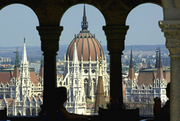
Marrakech

Marrakech – the streets have no name, the maps are a picture of noodle soup and the whole city is an assault on all the senses.

Single-serving friends pop up around every corner and yet it seems that round the next bend there’s danger lurking.

Moustafa, a teenager in a dusty, orange tracksuit, complete with a single yellow toothy grin found me by the Marché des Épice. Here, spice sellers congregate to the rumble of mopeds and twittering birdsong. In the centre of the square traders pile their stock in tall neat stacks, careful to keep them inside their designated zone marked with yellow paint on the new grey brick floor.

The square is apparently authentic but those in the centre take aim at the tourist – all keen to take a little bit of Marrakech home. Unsurprisingly the spice sellers that encircle them are happy to prosper from them too.

Moustafa led me away to see the truth of the city. Tripping along the pink alleyways and skipping over the open drains, dodging donkeys, cyclists and piles of cement we made our way to the real market. Veiled women size up chickens, men haggle over fish and carpenters throw dust up over the fruit sellers in the stall next door.

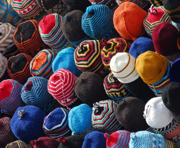
The senses take another knock when Moustafa leaves me at a doorway. Another man approaches in a white skull cap, a flowing, if slightly short, brown jalaba and sandals. His socks sport the badge of some European football team.

He offers me some mint sprigs and I take them gladly to mask the smell of the tannery I’m entering. Men splash up to their waists washing goat skins in the carcinogenic replacements to what used to be animal fats and vegetable dyes. Beyond them, other men toil alone in darkened crumbling buildings, scraping at the drying leathers.

Back out on the street Moustafa meets me again to lead me back to the Medersa Ben Youssef. He leaves early to get back to his mosque for the call to prayer. My offer of thanks by way of money is met by animosity – it was not enough.

A city of friends then, but a city of strangers too.

Take with you the Time Out Guide to Marrakech, Essaouira and The High Atlas, I found it to be by far the best. The Hedonist’s Guide to Marrakech is a good one too, to find the really chic bars, plus it has great maps of the souks – you may actually be able to navigate with these.

I took the Laura Kane map of Marrakech with me. It’s good to see where you’re staying and where you’re going but don’t expect to be able to use it to navigate or show it to locals and expect them to know the way – they don’t. They will help you though, for a few dirham, or a pen if you’re lucky.

The Rough Guide map of Morocco was great for going out over the High Atlas and towards the desert.

Also you should read Desert Divers by Sven Lindqvist – whether you’re going there or not as it’s one of the best pieces of travel writing ever written.

Browse our collection of travel guides and maps to Marrakech >

Author: James Innes Williams