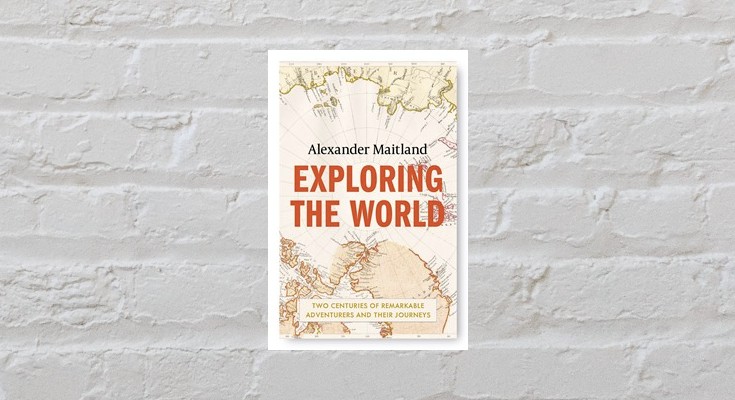
Filled with epic tales of endurance and perseverance, Exploring The World: Two Centuries Of Remarkable Adventurers And Their Journeys by Alexander Maitland celebrates a group of exceptional individuals possessed of indomitable courage, boundless determination and adventurous spirit. It portrays a variety of fascinating lives driven by curiosity, wanderlust and the pursuit of knowledge – and, in doing so, provides a unique overview of two centuries of exploration. Here is an extract about one of the most well-known explorers, Sir Douglas Mawson.
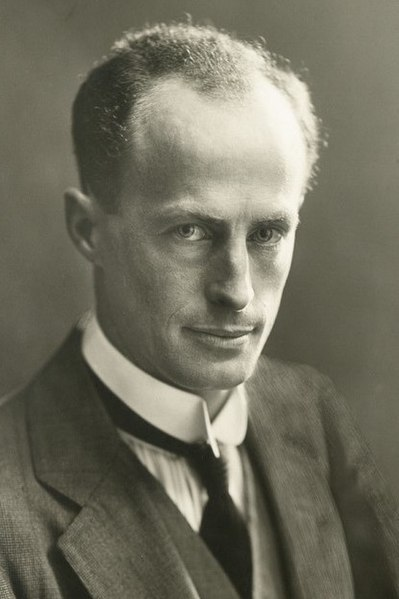
Sir Douglas Mawson (1882–1958)
Douglas Mawson was barely two years old when his parents emigrated from the West Riding of Yorkshire to Australia, where he was brought up first in Rooty Hill, a western suburb of Sydney, and from 1893 in Glebe, a district closer to the city centre. He attended Forest Lodge Public School and Fort Street Model School, followed by the University of Sydney, where he graduated in geology and mining engineering in 1902. His mentors, Professor Edgeworth David and Professor Archibald Liversidge, infl uenced his career as a geologist and gave him valuable encouragement.
In 1903, Mawson joined an expedition to the New Hebrides (now known as Vanuatu) and wrote one of the first comprehensive reports on the geology of the islands. A geological survey of Mittagong in New South Wales followed the same year, and in 1905 Mawson was appointed a lecturer in minerology and petrology at the University of Adelaide.
Accompanied by Edgeworth David, Mawson gained his fi rst experience of the Antarctic as a member of Shackleton’s Nimrod Expedition in 1907–09. When Shackleton left at the end of summer, Mawson, Edgeworth David and Alistair Mackay stayed on for another year, when they made the first ascent of the active volcano, Mount Erebus, and the first journey overland to the South Magnetic Pole.
To an extent, Mawson’s popular fame as an Antarctic explorer rests on the outcome of a terrible journey he was forced to undertake, alone, while surveying King George V Land in November–December 1912.
He had refused an invitation to join Scott’s Terra Nova Expedition in 1910, and determined instead to organise and lead an Australasian Antarctic Expedition across previously unexplored areas, and carry out scientific research, in King George V Land and Adelie Land, part of the Antarctic continent that lay due south of Australia. Financed and provisioned by the British and Australian governments, and private concerns interested in mining and whaling, Mawson’s expedition arrived at Commonwealth Bay in January 1912, aboard SY Aurora. They established their main base at Cape Denison, which Mawson named after one of his sponsors, with another permanent camp on the ice shelf in Queen Mary Land, further west. Mawson had planned to carry out aerial surveys, using a Vickers single-engine monoplane, the first aircraft to arrive in Antarctica. Unfortunately, during a test-flight at Adelaide two months before the expedition left Australia, the monoplane crash-landed and was badly damaged. The engine and fuselage were repurposed as a tractor on skis but the lubricant solidified in the extreme cold, causing the engine to seize. It was returned to Vickers in England, and the fuselage had to be abandoned.
The exploration of King George V Land and Adelie Land was undertaken by five parties from Main Base, and two parties from Western Base in Queen Mary Land. The Far Eastern Party, consisting of Mawson and his companions, Dr Xavier Mertz and Lieutenant Belgrave Ninnis, with two sledges pulled by Greenland huskies carrying their supplies, set out on 10 November 1912 to survey King George V Land as far as Victoria Land on the Ross Sea. For five weeks they made good progress, mapping the coastline and collecting geological samples. As they were crossing a glacier about 300 miles east of Cape Denison – Mertz on skis, Mawson riding the lighter of the sledges – Ninnis, who was walking briskly alongside the other sledge, plunged through the frozen snow bridging a deep crevasse, taking with him six dogs, the sledge, their tent, most of their rations, and other supplies including food for the dogs. Mawson and Mertz saw one injured dog and one dead dog on a ledge 150 feet below them; but Ninnis was never seen again.
After a short service of prayer for Ninnis, Mawson and Mertz sledged west for twenty-seven hours, without a break, to a campsite where they had left a spare tent cover, and for this they made a frame from skis and a theodolite. Scarcity of food was now a serious problem, and they had to kill their huskies, one by one, to feed the remaining dogs and themselves. To each portion of tough and stringy dog meat, Mawson and Mertz sometimes added, for variety, a little pemmican; but they were always starving, since most of the meat, as well as skin and bones, was fed to the surviving dogs. Mertz had difficulty eating the tough dog meat and, as a result, he ate considerably more dog liver than Mawson. Each husky liver weighed about two pounds and contained exceptionally high levels of vitamin A. Having eaten most of the liver from six dogs, it appears that Mertz contracted hypervitaminosis, which also affected Mawson, but far less severely. Both men lost some of their hair, skin and fingernails; their skin and the whites of their eyes turned yellow, and they suffered from abdominal pain, dizziness, nausea and confusion.
Before very long Mawson noticed alarming changes in Mertz’s behaviour. He refused to move or get out of his sleeping bag, suffered from diarrhoea and fits of delirium. To prove that he did not have frostbite, he bit the top off his little finger. Eventually Mertz’s outbursts of mad fury became so violent, that Mawson had to sit on his chest and hold down his arms for fear that he would destroy their precious tent. The violent seizures lasted until, on 8 January 1913, Mertz drifted into a coma and died. Xavier Mertz was thirty and Belgrave Ninnis twenty-five at the time of their deaths, and the Mertz and Ninnis Glaciers were named after them.
Mawson buried Mertz’s body in his sleeping bag, covered with blocks of snow, before setting off on foot on the final 100-mile stage of his journey to the expedition’s base at Cape Denison. On the way, he almost shared the same fate as Ninnis, when he fell into a crevasse, but was saved when his sledge wedged itself in the ice, and he managed to haul himself out, using the leather straps that harnessed him to the sledge. After tramping alone, exhausted and hungry, for more than a month, Mawson arrived back safely at Cape Denison, only to find that SY Aurora had sailed for Australia a few hours before. The party of six men who had stayed behind to search for Mawson and his companions recalled the Aurora by wireless telegraph, but the vessel was unable to rescue them due to bad weather, and Mawson and his companions had to winter at Cape Denison for a second year.
Back in Australia, Mawson married Francesca Adriana Delprat, daughter of the metallurgist G.D. Delprat, on 31 March 1914 at Holy Trinity Church in Balaclava, Victoria. Mawson was knighted that same year, and in 1915 the Royal Geographical Society awarded him its Founder’s Gold Medal. During the First World War he served as a major in the British Ministry of Munitions, and in 1919 returned to the University of Adelaide, where he was installed as professor of geology and mineralogy in 1921. As a result of the joint British, Australian and New Zealand Antarctic Research Expedition which Mawson led in 1929–31, the Australian Antarctic Territory was established in 1936. He spent much of his later life researching the geology of the northern Flinders Ranges in South Australia, and was made emeritus professor of the University of Adelaide when he retired from teaching in 1952.
On 14 October 1958, Sir Douglas Mawson died, aged seventy-six, at his home in Brighton, South Australia. His expedition papers had not been fully edited, and this task was completed by the elder of his two daughters in 1975. After Mawson’s expedition records and journal were released, some historians questioned his leadership skills, navigation and apparent recklessness, none of which diminished his reputation or achievements.
The Heroic Age of Antarctic exploration lasted for twenty-five years, from 1897 until 1922. Of the explorers who led major expeditions during this period it is generally accepted that Scott, Amundsen, Shackleton and Mawson were by far the greatest of them all.
Exploring The World: Two Centuries Of Remarkable Adventurers And Their Journeys by Alexander Maitland is available now for £25.00