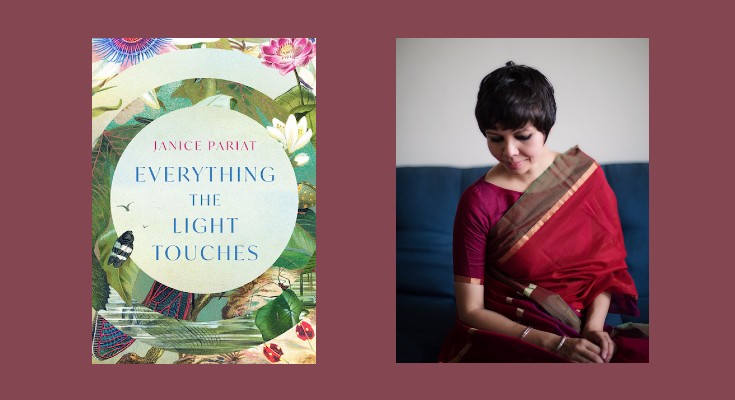
Janice Pariat is the award-winning author of Boats on Land: A collection of Short Stories, Seahorse, and the international best-seller The Nine-Chambered Heart. Her new novel Everything the Light Touches is out with Borough Press, HarperCollins UK. She lives in India. Here she discusses travel fiction:
“What is travel fiction?” a friend asked.
We were chatting about my book, and he was puzzled. He thought the words sat slightly oddly together. After all, wasn’t travel writing an attempt at faithfully reproducing one’s experiences of a particular place, while fiction, well, tends to fictionalise?
It is a bit puzzling perhaps; maybe “travel literature” is the more popular, better-known genre, covering exploration and adventure, travel-related memoirs, travel features in magazines, travel essay anthologies. But there is also, of course, and has been, for the longest time, travel-centric fiction. Books, novels mainly, in which place plays as important a role as the protagonist.
What does that mean? Isn’t place almost always important?
Well, yes, but in some more than others. Conrad’s Heart of Darkness, for example. Or Hemingway’s For Whom the Bell Tolls.
This feels incomplete though; this can’t be all. Travel fiction could also include books that have shaped the way we see a place. Joyce’s Dublin in Ulysses. Rushdie’s Bombay in Midnight’s Children. Lahiri’s Pennsylvania in well, mostly everything she’s written.
“And yours?” my friend asked. “What kind is it?”
The kind in which the characters themselves undertake a journey. Like Don Quixote or Huckleberry Finn or Odysseus. In my novel, though, we meet many travellers.
Shai, a young Indian woman who journeys “home” to India’s northeast. Evelyn, an Edwardian student at Cambridge who, inspired by Goethe’s botanical writings, embarks on a journey to the sacred forests of the Lower Himalayas. Linnaeus, Swedish botanist and taxonomist, who embarked on an expedition to Lapland in 1732. And Goethe himself, who travelled through Italy in the 1780s, formulating his ideas for a revelatory yet little-known text called The Metamorphosis of Plants. This quartet of travel narratives entangle and intertwine across the centuries, with each section beginning at a point of departure, an airport, a dockyard, a coach station, and someone on foot leaving behind the city gates.
“Each character heading out to find themselves?” my friend intervened, smiling, hinting that the most common theme in travel fiction was self-discovery.
“Something like that,” I said. To find themselves and a mysterious plant.
“And they return changed somehow?”
I knew what my friend was getting at—the hero’s journey, or quest, where the hero must set out from their familiar surroundings, undergo difficult trials, and return with some sort of a gift that will help in their ordinary life.
“Maybe not all,” I muttered.
What is perhaps interesting is that in order to write travel fiction one must rely on real travel narratives. For Everything the Light Touches, among many others, I drew from Francis Kingdon-Ward’s In the Land of the Blue Poppy, Marianne North’s A Recollection of a Happy Life, James Dalton Hooker’s Himalayan Journals, and Journals of travels in Assam, Burma, Bootan, Affghanistan and the neighbouring countries, by the rather curmudgeonly William Griffith.
It gets slightly more complicated with the Goethe and Linnaeus sections.
For those were historical journeys that I “fictionalized”—from their own travel memoirs, Italian Journey and Tour in Lapland, both endlessly fascinating in offering up glimpses of particular places at particular long-ago times and also both revealing of character, Goethe fleeing from the complications of court life in Weimar, and young, wonder-filled Linnaeus on his first solo trip abroad.
“Why must your characters travel?” my friend asked, and this I thought was a good question. At the heart of my novel, I explained, lay an attempt to question a particular way of seeing—a “Linnean” way, that tended to split and fix and categorise—while also offering up an alternative. A “Goethean” mode of perception that sought instead to connect and unify. That believed that the natural world, every living being, animal or plant, was in a perpetual state of “becoming”. Travel, and my characters undertaking their various journeys, then, became a vehicle through which to explore a worldview that endorsed movement, fluidity, and un-fixity.
“It’s true,” he said, nodding. “Everything in the universe is moving. Us and the stars.”
Us and the stars.
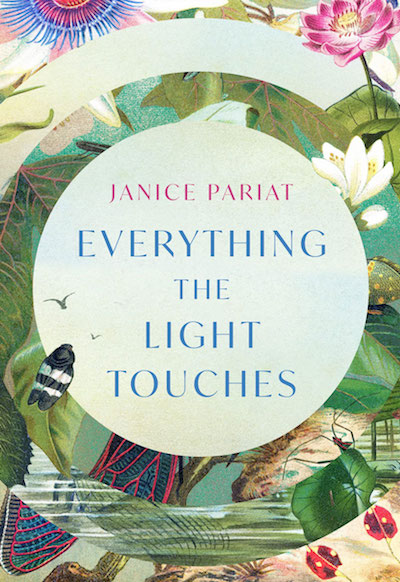
Janice Pariat Everything the Light Touches by Janice Pariat is available now for £14.99.