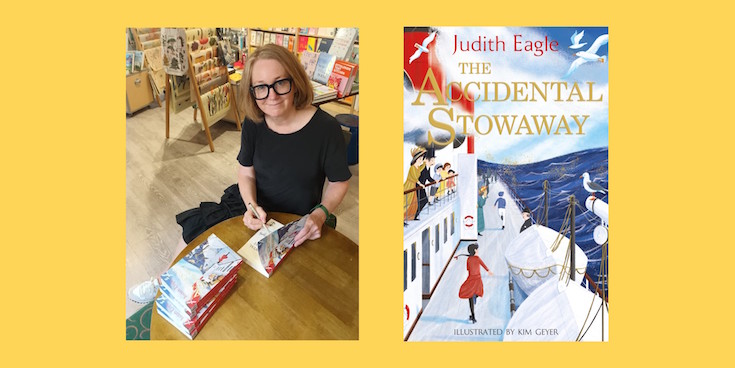
Judith Eagle, author of Children’s Book of the Month, The Accidental Stowaway, describes what life was like on board an ocean liner at the beginning of the Twentieth Century.
In The Accidental Stowaway, Patch stows away on RMS Glorious, a ship that is sailing from Liverpool to New York. RMS Glorious (or Glory, for short) is based on the steamships that went back and forth across the Atlantic in Edwardian times.
The transatlantic liners were nicknamed ‘floating palaces’ because they were so luxurious. They were fitted out to look like the grandest hotels in Europe, with electric elevators, restaurants, libraries, music rooms, and lounges. They were decorated in the latest styles; the menus were created by the most fashionable chefs; and some of them even had special ‘extras’ like newspapers printed at sea!
RMS Mauretania, the ship that directly inspired the RMS Glorious, was enormous: 790 feet long and propelled by four steam turbines. She carried 563 First Class passengers, 464 Second Class passengers and 1138 Third Class passengers. An army of staff was needed to look after this amount of people! On the Mauretania there was a crew of 938, including stewards and stewardesses, bakers, butchers, storekeepers, waiters, porters, sailors, and cooks. The passengers were divided into First, Second, and Third Class and there was strictly no mixing.
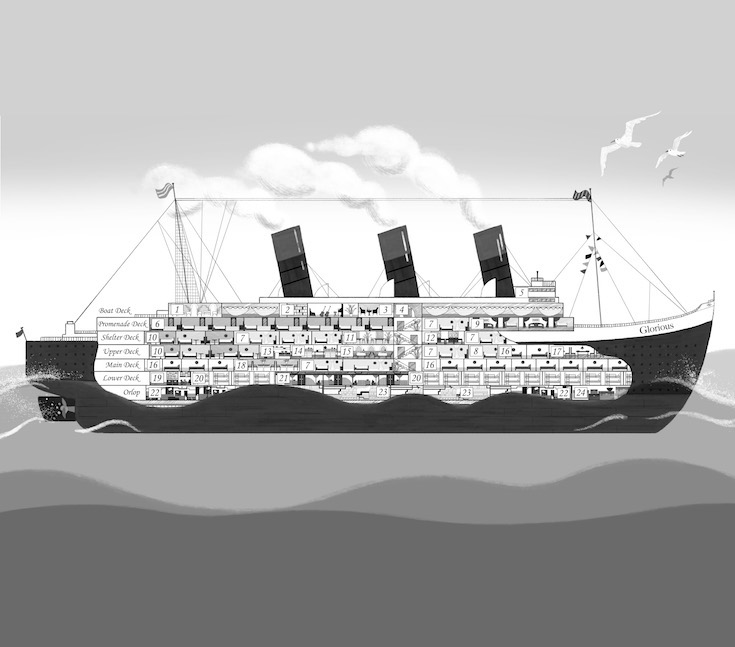
The most coveted accommodations on board were the First Class Regal Suites. These were the height of sophistication, with a drawing room, a dining room, two bedrooms and a bathroom. Meanwhile in Third Class most people slept in four or six berth cabins with shared facilities. It wasn’t luxurious by any standards, but it was a great improvement on the cramped conditions of steerage, common just a few years previously. Crossing in steerage was NOT a pleasant experience, with passengers herded below decks to sleep in one room with at least fifty other people.
Without the stokers (sometimes called firemen, or trimmers) the ships would not have sailed. The stokers were the toughest men with the toughest job in the world. They shovelled the coal, to feed the furnaces, that powered the ship. On average the stokers shovelled 1000 tonnes of coal a day. It was back breaking work.
The Blue Riband was the award given to a ship that crossed the Atlantic in record time. The RMS Mauretania won the Blue Riband in 1909 and she held that prize for 20 years. Her fastest time was four and a half days at an average speed of 24 knots. A great deal of vibration could be felt when she was speeding along.
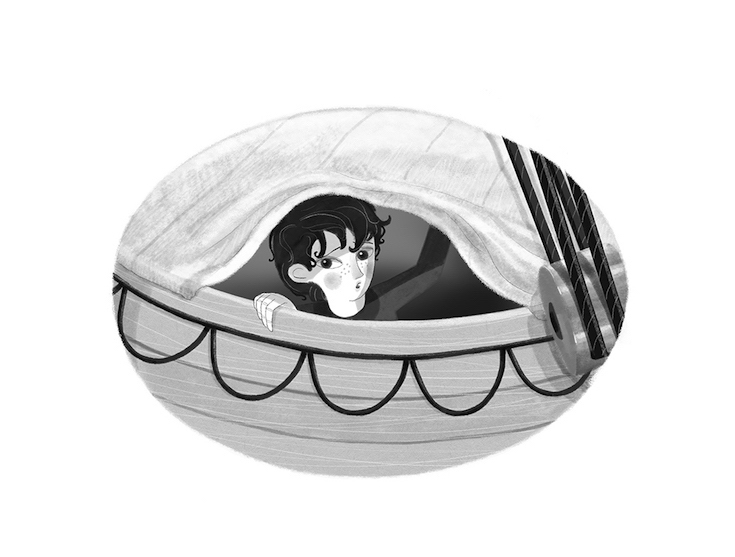
Stowing away was all the rage in Edwardian times. One woman buried herself in 200 tonnes of ballast with nothing more than a piece of German sausage and a bottle of water for sustenance. Another man got his friends to nail him into a box labelled Household Goods. Then there was the man who tried to squeeze his way out of a porthole, got stuck half way through, and had to be sawed out! The stowaway’s favourite hiding place was in the lifeboats that lined the Boat Deck. Conveniently, they were often kitted out with blankets and bread and water.
The amount of food that was needed to feed over 2500 passengers and crew on a transatlantic crossing was phenomenal. The average ship could easily get through 1200 eggs, 300 barrels of flour and 40 tons of potatoes. On one ship 25 fowl were regularly used just in the soup for a single dinner!
Some of these facts appear in The Accidental Stowaway. Read the book to find out more!
The Accidental Stowaway is available now for £7.99 and Stanfords has signed copies (while stocks last).