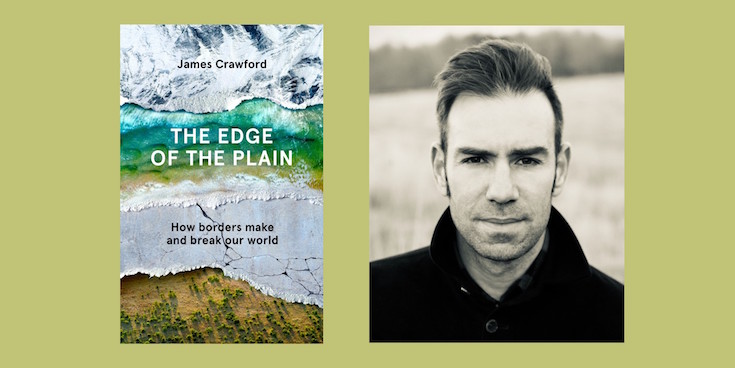
In this extract from The Edge of the Plain: How Borders Make and Break Our World, James Crawford goes in search of the Grafferner glacier in the Italian-Austrian Alps. Straddling the border between the two nations, when this glacier moves, the border moves too. It is what is known in Italian as a confine mobile – constituted in law by Italy and Austria as a ‘moving border’. A border defined and shaped by gravity, and now melting at an alarming rate due to the impacts of climate change…
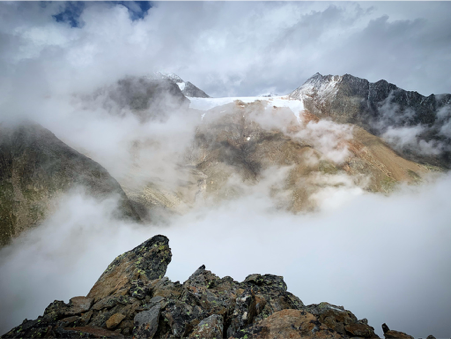
It was seven in the morning, early September, just a few hundred metres north of the Italian–Austrian border on the Hochjochferner glacier.
I was roped to the mountain guide, Robert Ciatti. Robert is now in his sixties, a lithe, sinewy, almost elfin figure. He had thick, wavy grey hair and his skin was a deep, nut brown, save for a patch of mottled, sun-damaged pink on the end of his nose. He led the way and I followed, our crampons crunching through the snow, occasionally ringing out high, discordant notes as the metal hit patches of exposed stone.
The Hochjochferner, Robert told me, has shrunk in size by more than two thirds over the last century and a half. He gestured down into the valley, waved his hand along the dark-brown funnel of exposed rock that ran far off into the northeastern distance.
‘Once,’ he said, ‘the ice filled up all of it.’
At that moment, a long thread of white cloud was nestled on the valley floor. Like a taunt. Or a visitation. A ghost of the glacier now gone.
Ice cover in the Alps reached its greatest recorded extent around the mid-nineteenth century, at the end of what is known as the Little Ice Age. The trend since then has been accelerating disappearance. Half of the glacier landscape from 1850 has vanished. Two thirds of this reduction took place over the course of a century and a quarter. The remaining third has happened in just the last thirty years. Where I was, in the Ötztal Alps, the total glaciated area decreased by just over 30 per cent between 1983 and 2006: from some 130 square kilometres of ice down to a little over ninety.
It was fascinating to follow Robert as he moved across the ice. Our progress was steady and methodical. Every so often he stopped, prodded at the way ahead with his hiking sticks, checking the solidity of the ground. We met a river, just a metre or so wide, running fast and true downslope. The water snaked side to side, cutting into the ice and carving banks of smooth, impossibly perfect curves. At times, the sound that dominated was not the wind or our footsteps, but the rush of water. Even if I couldn’t see it, I could hear it, hurtling through channels and tunnels below my feet.
In the last thirty years, over the whole of the South Tyrol, nineteen glaciers have melted away to nothing. The number of glacier ‘parts’ has increased – from just over 200, to just over 300. But this is no sign of a resurgence. Rather, it shows the inevitability of ice-sheet fragmentation. Glaciers are splitting off into smaller and smaller pieces, becoming a fractured mosaic of sheets and plates, all dwindling and receding.
To reach the highest section of the Hochjochferner, we had to climb. The way up was by via ferrata – ‘iron path’ – a series of steel cables, rungs and ladders fixed tightly to the rock of the cliff. At nearly 3,000 metres, it was hard, breathless going. The cables were still coated with a film of clear ice, the rocks slick underfoot. By the time we reached the top, the sun had broken through and the clouds had dissipated. Ahead was the largest remaining section of the glacier. It had caught and held the previous night’s snowfall and appeared as a blank white sheet.
The reflected glare was fierce, even with sunglasses. It was just after nine o’clock now and I could feel the heat building. The snow was already softening, melting into tiny pools all over the glacier’s rocky margins. As we set off across the surface again, I could see that it was not as pristine as I had first thought. In places, where the slope steepened, it broke apart into a series of long wrinkles.
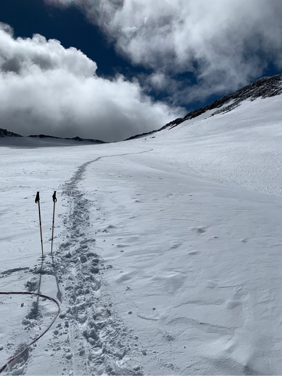
‘Crevasses,’ Robert said, noticing where I was looking. Line after line of them. Narrow fractures, a few hundred metres long by, at most, just a metre or so wide – but they dropped down deep.
Not long after, Robert held up his hand for me to stop. He poked at a patch of snow with his sticks and it gave way a little, then disintegrated, dropping down into a small black hole. He tested the surface around it and then nodded to himself.
‘It’s okay,’ he said. ‘Just watch your feet.’
He stepped across and I followed. The hole was half a pace wide, but I made the mistake of looking down into it as I passed over. There was no bottom. It just descended into a profound, dizzying nothingness. A tiny breach, yet I heard the echo of my movement come back up as I walked away, calling after me.
We passed around a long spine of rock which rose to join the high ridgeline, and turned to move alongside it, beginning to walk directly upwards. We had left the Hochjochferner behind now, and were on the surface of another glacier, the Kreuzferner. There was a kilometre to go to reach the ridgeline, up a glaciated slope that rose in altitude by another 300 metres. The snow was deeper and softer, and it started to feel very warm out on the bright-white mountainside. But Robert kept up his steady pace, our crampons crunching in rhythm. We talked little, just concentrated on moving, snatching breaths from the thinning air.
Up above us, in the near distance, I could see a black outcrop, topped by a tall wooden post. Soon we were stepping off the glacier and onto rock. We made our way up towards the post, which juts up from a tiny plateau. Now, at last, we could rest. This was as high as we would go: 3,278 metres above sea level.
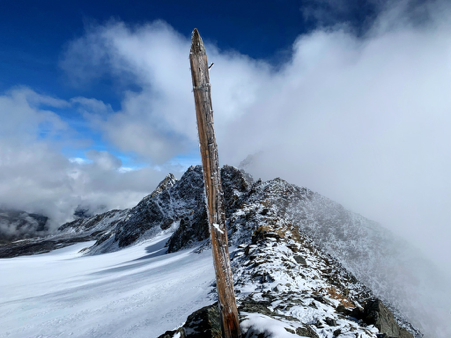
I bent down to remove my crampons and Robert brushed at the ground in front of me. He revealed a flat stone plaque, fixed by iron clamps. Carved on the plaque were the letters ‘I’ and ‘Ö’: Italia and Österreich. The ‘I’ sat within an arrow, two lines pointing up like a child’s drawing of a roof. But this was not just a symbol. This was the exact location and route of the border. We were standing on the watershed, on the reality of the line.
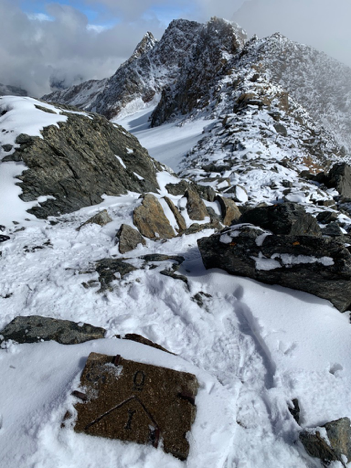
Robert told me that the plaques were constantly having to be replaced. Not because of the extreme conditions, but because of vandalism. The enduring legacy of a century ago when, in one of the many carve-ups following the First World War, this stretch of Alpine ridgeline became, for the very first time, the border between Austria and Italy. Periodically, the plaques are defaced, scored through, or shattered into pieces. The ‘materiality’ of the border attacked by those who still object to ‘their mountains’ being split in two…
The Edge of the Plain by James Crawford is published by Canongate and is available for £20.
Watch James introduce his new book:

Join us at Stanfords London on Thursday 11th August 19:00 as we welcome James Crawford to talk about The Edge of the Plain in conversation with Tim Marshall.
Tickets available here.