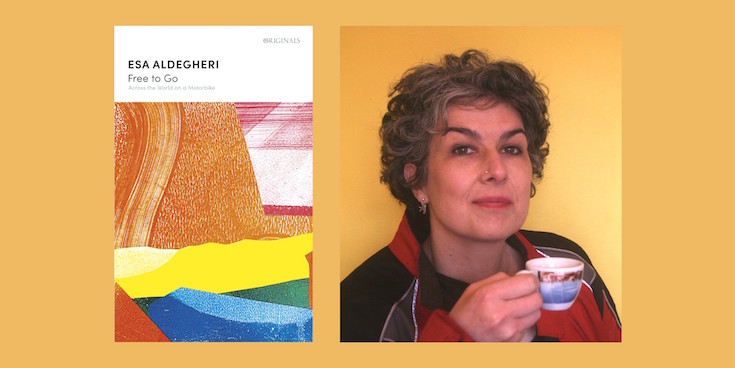
When Esa Aldegheri and her husband left their home in Orkney, Esa didn’t know that their eighteen-month motorbike adventure would take them through twenty international frontiers – between Europe and the Middle East, through Pakistan, China and India – many of which are now impassable.
Charting a story of shrinking and expanding liberties and horizons, of motherhood, womanhood, xenophobia and changing geopolitical situations, Free to Go examines the challenges of navigating a world where many assume that women ride pillion, both on a motorbike and within relationships. Part around-the-world adventure, part-literary exploration of womanhood, Free to Go is about the journeys that shape and transform us.
Here is an extract from Free to Go: Across the World on a Motorbike by Esa Aldegheri:
Many travel stories open with a clearly defined event, often dramatic, which catalyses the journey. Somebody dies, someone comes of age, a transformative encounter happens – and so the quest begins. Not so this tale.
Life was comfortable: I was not long married, moving through glad months filled with love and work and friends. When I was eighteen, I had met a man with crinkly blue eyes and knew he was the one for me, but conflicting desires and distances had kept us apart for years. My work and joy grew in building connections between people, in learning and speaking the languages of warm, thickly populated parts of the world. He gravitated towards remote islands and cold, thinly inhabited places. I thought that finally being together and married was the happily ever after, the end of a journey; our gladness felt like a shining lake. It took me a while to realise that something unsettling was moving beneath the surface, and that it was not a monster: it was me, it was us, a restlessness within. There was no dramatic catalysing event, but a vague sense of unease grew from deep down: careful, its note of warning sounded out, careful, this is not what you need to be doing.
Instead of listening, I took on extra work, began a masters degree and started training for a half-marathon, but the discordant feeling was still there. I saw it reflected in my husband’s eyes, in the increasing frequency of his solitary walks and short-term jobs on distant Scottish islands. We were happy together, but we needed something different. I didn’t want to ask exactly what that ‘something’ might be: I feared that the answer would involve more incompatible desires, the ruin of our hard-won life together.
The unease surfaced in an Edinburgh club, bubbling up into clear questions amidst the thumping music, like air from lungs forced too long underwater: ‘Is this enough for you?’, we shouted to each other. ‘Is this the life you want?’ We walked out under the pellucid sky of a Scottish summer night washing into dawn, found a pub where we could hear each other speak, and finally, deliciously, all the unresolved fears came up for air. One by one, they were revealed as being shared, and unfounded, and useful. We wanted to leave, but not leave each other; we wanted to go away, but not separately.
With an ease that didn’t feel reckless, we sketched out a journey together, and it was like a decision made long before. We would quit our jobs and spend our savings on a journey overland to the opposite side of the planet: New Zealand, where we had both long wanted to go. It was as if this plan had been biding its time to emerge, fully formed, once we knew how to find it. I understood what Patrick Leigh Fermor meant when he wrote that his plan to walk across Europe unfolded in his mind ‘with the speed and the completeness of a Japanese paper flower in a tumbler’.
Deciding how we would travel turned out to be as simple as a list of pros and cons sketched on a pub napkin. ‘Looks like we’ll be going by motorbike,’ I said.
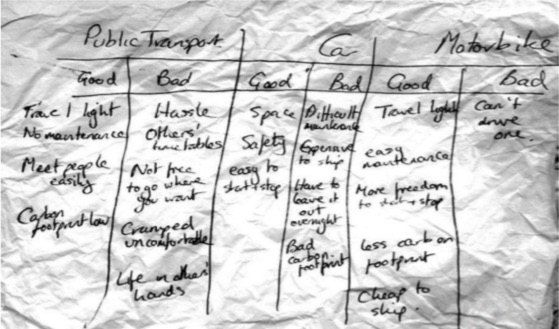
So began the alchemy of action, hope and obduracy that transforms scribbles on a napkin into events. No plan is perfect, but this one held such enormous imperfections that all I could do was laugh and order another drink. The first flaw in our plan: neither of us could ride a motorbike. The second: we didn’t own one. The third: had we owned one and been able to ride one, we had not the slightest idea how to fix anything that might go wrong with it. But in that electric moment, no such concerns mattered. I raised my glass for a toast, and grinned: ‘Minor, insignificant and temporary details.’
Free to Go: Across the World on a Motorbike by Esa Aldegheri, published by John Murray Press is available now from Stanfords for £14.99.

Join us at Stanfords on Wednesday 10th August 2022 at 18:30 as we welcome Esa to talk about her new book. Tickets available here.