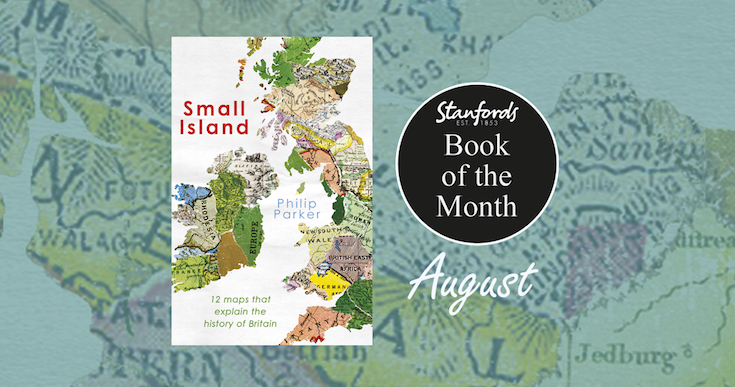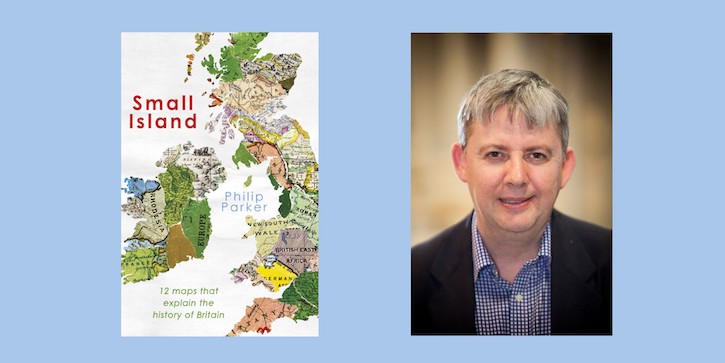
To celebrate the launch of Small Island: 12 Maps that Explain the History of Britain , here, the author Philip Parker briefly explains some of the changes Britain has gone through since 500,000 BCE.
As queues of cars and lorries snaked towards Dover last week, turning much of Kent into a gigantic traffic-jam, it at least seemed clear, for all the rhetoric about who was, or should be, in control of Britain’s borders, where those borders lay and what constituted the Britain that so many holidaymakers were frustrated in their desire to depart. Yet such certainties are deceptive; the nation we know as Britain (or more correctly the United Kingdom) is a relatively young one, having been born only in 1922, when the Republic of Ireland gained its independence, and it has been through many iterations in its long evolution to reach the patched quilt of devolved countries, local loyalties and constitutional ambiguities which we know today. Through all that time Britain has been something of a work-in-progress, from the first tentative foothold by human ancestors around Happisburgh in Norfolk around 500,000 BCE – their descendants soon chased out by the profound cold of the Ice Age before the definitive settlement of these island when warmer times returned just 12,000 years ago) – to the current debate about precisely what sort of Britain we all want in the post-Brexit era. Britain has been tiny – its smallest extent arguably the few sodden fields which King Alfred the Great could command when as he skulked in Athelney Marshes in Somerset in 878, a refugee from the Viking armies that had overrun his Wessex kingdom. And it has been huge: in 1919 after acquiring great tracts of formerly German East Africa in the aftermath of the First World War, it encompassed more than a quarter of the land surface of the globe.
At times Britain has not even been an island – the Channel was only formed after a devastating tsunami flooded it 180,000 years ago – and for centuries it was in large part a European power, the holdings of its Plantagenet kings straddling the Channel until a hapless King John lost nearly all his French possessions in 1214 and Joan of Arc helped stifle the revival that seemed in prospect after Henry V’s victory at Agincourt two hundred years later.
In modern times, Britain has been a unified monarchy – or at least an uneasy conjoining of its constituent nations of England, Scotland, Wales and Northern Ireland. At others – in the 6th to 8th century, it was a fractious mosaic of contending states – Wessex, Mercia, Northumbria in Anglo-Saxon England, together with bit-players such as Elmet, Lindsey, Dumnonia and Gyrwe (the quaintly named “land of the mud people”), with a matching cast of contending kingdoms in Wales such as Powys and Gwynedd, a Scotland divided between Picts, British, Scots, Vikings and Angles and an awesomely balkanised Ireland. Britain has been a world-empire, from its first tentative outposts in North America and India in the 17th century, to the global leviathan of the Victorian empires, but it has also itself been an occupied province of another empire – the Roman – which ruled its as Britannia from AD43 for over 350 years.
Nothing about today’s Britain was predetermined or inevitable. On several occasions, it looked possible that there might be two “Englands”, one based in the North, around York, the other in the South (though quite possibly not at London, for Winchester was long the capital of Anglo-Saxon Wessex). The joining of Scotland to England after centuries of war (one of which in the early 13th century actually saw a Scottish army reach as far south as Dover) came about not through conquest, but the dynastic accident that Queen Elizabeth I chose not to marry and so had no direct heir.
The Britannia, the Wessex, the England (or Scotland) and the Britain to which successive generations have felt (on the whole) loyalty has never stood still and today’s United Kingdom is no different. Having turned aside, at least for the moment, from a destiny as part of the European Union, Britain now faces a new phase of discovering what it means to be British. One thing is certain. It won’t be quite the same as the past – seeking to return things to precisely the way they were – or we imagine they were – is as futile as defending a sandcastle from the advancing tide. The most that we can do is reflect on the fact that we have been here many times before, each twist in the map of what constitutes Britain, each turn in our constitutional arrangement helping shape our national identity and our consciousness of our homeland.
If nothing else, those long queues on the way to Dover will give us ample time to reflect on the road we are now, as a nation, travelling.
Philip Parker is the author of Small Island: 12 Maps that Explain the History of Britain