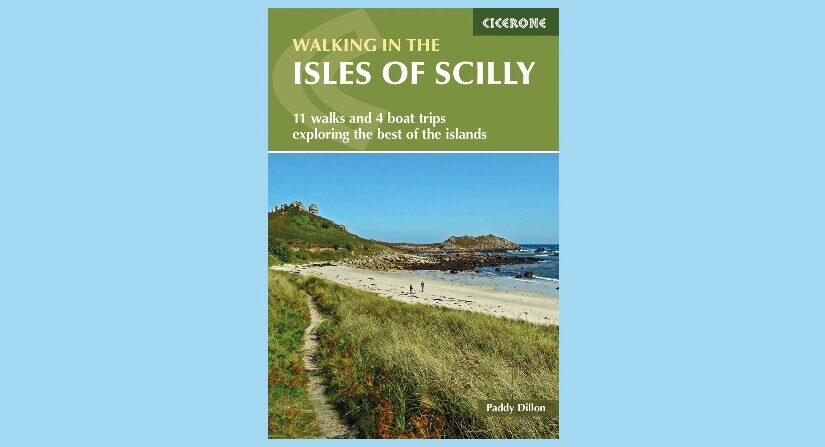
-by Paddy Dillon
Of all the British Isles, the Isles of Scilly are the most blessed. Basking in sunshine, rising green and pleasant from the blue Atlantic Ocean, fringed by rugged cliffs and sandy beaches, these self-contained little worlds are a joy to explore. They are as close to a tropical paradise as it is possible to be in the British Isles, with more sunshine hours than anyone else enjoys. There are no tall mountains, but the rocks around the coast are as dramatic as you’ll find anywhere. There are no extensive moorlands, but you’ll forget that as you walk round the open heathery headlands. The islands may be small in extent, but the eye is deceived and readily imagines vast panoramas and awesome seascapes. Views to the sea take in jagged rocks that have ripped many a keel and wrecked many a ship. The islands are clothed in colourful flowers, both cultivated and wild, and attract a rich bird life, including native breeding species and seasonal migrants. And always, there is the sea.
The Isles of Scilly form the smallest of Britain’s Areas of Outstanding Natural Beauty, and their historic shores have been designated as Heritage Coast. The surrounding sea is protected as a Marine Park of great biodiversity. Archaeological remains abound, not only on the islands, but also submerged beneath the sea. The Isles of Scilly are special, revealing their secrets and charms to those who walk the headlands, sail from island to island, and take the time to observe the sights, sounds and scents of the landscape. While the walks in this guidebook could be completed in as little as a week, a fortnight would allow a much more leisurely appreciation of the islands, and leave memories that will last for a lifetime.
WALK 2 The Garrison Wall
Start Garrison Gate in Hugh Town, SV 901 106 Distance 3km (2 miles)
About this walk
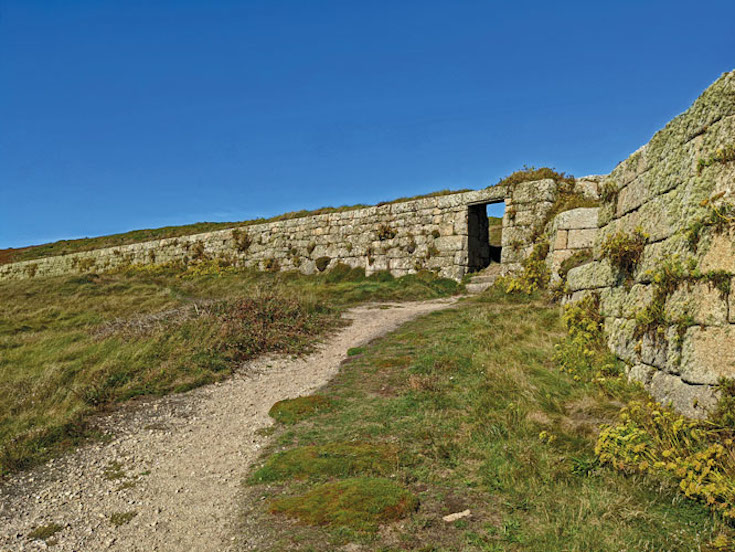
The promontory to the west of Hugh Town is almost completely encircled by a stout, granite defensive wall bristling with batteries and cannons. The Garrison was developed in stages over three centuries, but the most significant starting date is 1593, when Governor Francis Godolphin built the eight-pointed Star Castle. Additional walls and batteries were built around the promontory, with more appearing during the Civil War. The Garrison held out as a Royalist stronghold until 1651. Other islands holding out to the bitter end included Jersey, in the Channel Islands, and Inishbofin, off the west coast of Ireland. The Garrison came to resemble its present form during restructuring associated with the Wars of the Spanish Succession and the Napoleonic Wars. During the two world wars, there were few alterations, except for the positioning of pillboxes into some of the batteries. Even while it was manned by soldiers, the Garrison Wall provided a leisurely walk for 18th- and 19th-century visitors, and it still does so admirably today. English Heritage produces an excellent leaflet map and guide to the Garrison, and a visit to the Powder Magazine Exhibition is highly recommended. Accommodation is available within the Garrison Wall at two remarkably different locations. The Star Castle Hotel is one of the more exclusive hotels in the Isles of Scilly, offering some rooms in the castle and some in the adjacent garden. The hotel also has a Dungeon Bar! Standing high on the headland is the Garrison Holidays campsite, the only campsite on St Mary’s, and one of only four campsites available around the Isles of Scilly.
Walk description
A steep, narrow road climbs from Hugh Town, beside Tregarthen’s Hotel, to reach the Garrison Gate. Look for the date 1742 carved in stone above the moulded archway, below a little bellcote. The Guardhouse and Gatehouse Cottage stand just inside the archway. Visit the Powder Magazine Exhibition straight ahead, if an in-depth study of the fortifications is desired, otherwise turn left to start walking clockwise around the walls. A narrow road rises to the Higher Battery, where there is a view over the rooftops of Hugh Town. Walk to the Garden Battery, which is in front of Hugh House, the Duchy of Cornwall office. A little further along, the road passes over a Sallyport: a narrow, low-roofed passageway beneath the wall. It is worth taking a peek under the wall at this point, but beware of the low headroom. The next battery is the Upper Benham Battery, which overlooks Porth Cressa Beach.
Continue along a stony track parallel to the Garrison Wall, passing the Upper Broome Platform. Trees flank the track as it passes the Lower Broome Platform. At this point the wall takes a slight step back from the cliffs, and the line of an older breastwork can be distinguished along the cliff-top. The Morning Point Battery occupies a rocky promontory with sweeping views; its cannons had clear lines of fire to the north, east, south and west. While walking around the southern portion of the Garrison Wall, the wall is again a step back from the cliff and the line of another older breastwork can be seen.
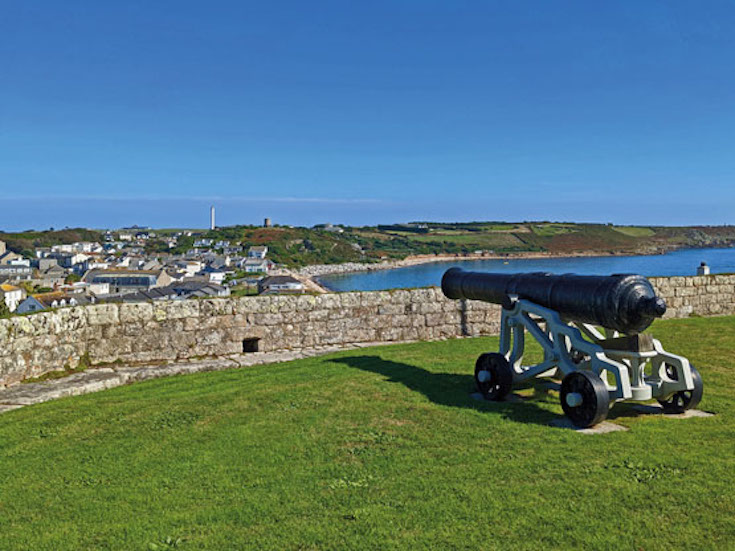
The Woolpack Battery stands on another rocky promontory offering a good range for cannon fire. Two big cannons here were salvaged from a wreck. Views across St Mary’s Sound take in Gugh, St Agnes, Annet and the distant Bishop Rock Lighthouse. Walk to Bartholomew Battery and up past Colonel George Boscawen’s Battery. Look out for a peculiar structure partly buried underground; this was an engine room that generated power for a series of range-finding searchlights in the early 20th century.
Further along the track there is a fork, and walkers can go either way. Following the track uphill to the right leads quickly and easily past some wind-blasted pines to reach the Star Castle. Following the line of the Garrison Wall, however, it ends quite suddenly below the Steval Point Battery. Drop to the coast, turn right and continue along the cliffs, looking at the breastwork and batteries that preceded the Garrison Wall, dating from the Civil War period. The course of the wall resumes at the King Charles’ Battery, and can be followed to the Store House Battery in front of Newman House.
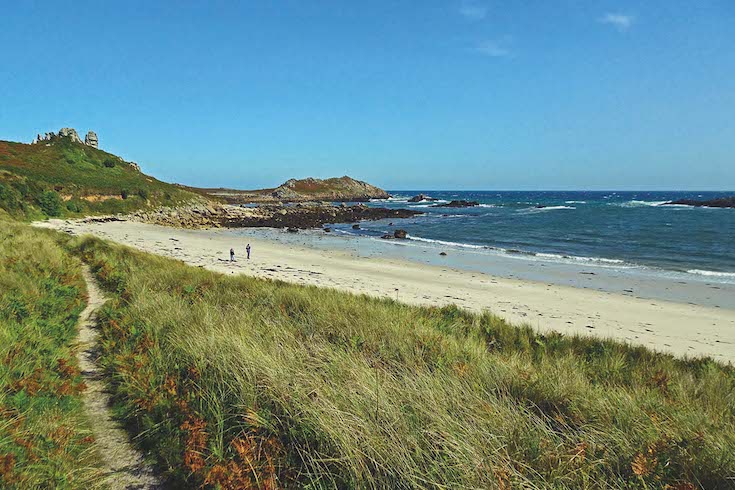
Although the Garrison Wall continues along the cliffs from Newman House to Hugh Town, walkers have to leave it and head uphill to return to the Garrison Gate. To visit the eight-pointed Star Castle, turn sharply right just before reaching the Garrison Gate and follow the road uphill. The castle has been a hotel since the 1930s and is one of the most unusual places you could choose as an accommodation base in the Isles of Scilly. There are further wanderings that can be made on the high ground within the Garrison. There is a campsite, a signal tower and an early 20th-century hilltop battery. The Garrison Field claims to be ‘home of the smallest football league in the world’. When explorations are complete, simply walk back through the Garrison Gate to return to Hugh Town.

Walking in the Isles of Scilly
by Paddy Dillon contains 11 walks and 4 boat trips and is available to buy now for £8.95
Published by Cicerone