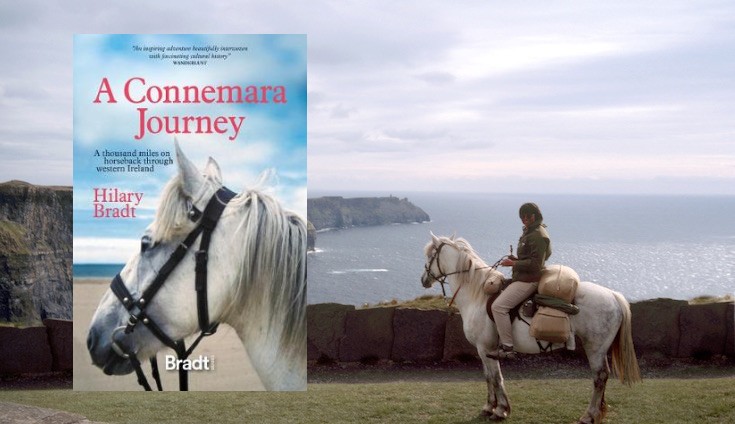
A Connemara Journey is Hilary Bradt’s classic account of a journey through Ireland on horseback in the 1980s published for the first time in a single volume.
In 1984, Hilary Bradt achieved an ambition from her pony-mad childhood to undertake a long-distance ride. Using her experience of horsepacking in Peru with saddlebags imported from America, she and her pony set forth with no decent maps, and only a vague idea of the route. The book is also a portrait of a vanished rural Ireland before the Celtic Tiger era, built up from descriptions and conversations with local people.
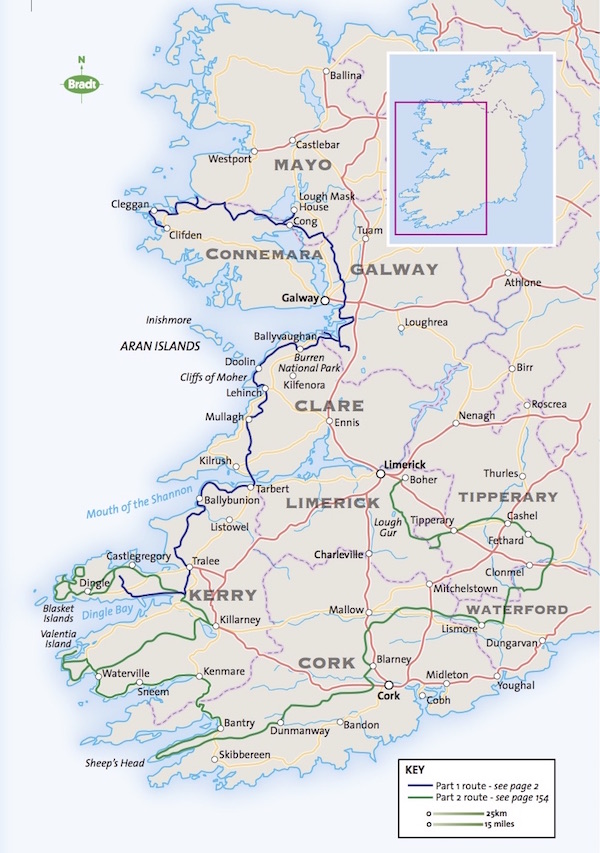
The journey takes Bradt a thousand miles south from county Mayo, around the peninsulas of Kerry and Cork, and inland towards Waterford.
-by Hilary Bradt
From my horsey childhood growing up in the 1950s and addicted to pony books, I had dreamed of having my own pony and going on a long-distance ride. No more riding-school hour doing a circular hack, but days out exploring the countryside with my perfect pony. This finally came to pass in 1984 when I found myself single again and ready to embark on this greatest of all adventures.
First I had to decide where to go.
I know, Iceland! It had all the requirements: lovely scenery, a tough breed of native pony and friendly people who generally spoke English. I’d been there and loved it. I tried out the idea by rather casually mentioning in my Christmas letter that I was going to buy a native pony in Iceland and do a long-distance ride. I received a reply from a horsey friend: “Ireland! What a great idea. A Connemara pony would be strong enough and it’s such a beautiful country. And they love horses.” Oh. My handwriting… well, let’s think about Ireland then. It had never come into my reckoning, perhaps because of a very wet family holiday there where we children had sulkily squelched up Ireland’s highest mountain in mist and rain. But now, suddenly, everything fell into place. Ireland was an ideal choice. Scenic, safe, English-speaking … perfect!
The first challenge – after heaving all the horse tack including a saddle, plus a tent and my other trekking requirements — across Britain and Ireland by public transport, was buying a suitable Connemara pony. All enquiries led to one horse dealer who also ran horse treks across Connemara: Willy Leahy, in Co Galway.
I’d arranged to meet Willy Leahy that morning in Loughrea. He met me off the bus and I explained my plans over a glass of Guinness, before heading out in the drizzle to look at some horses which had spent the winter in a spacious field. Willy had picked out two grey mares that he thought would be suitable. One was a very pretty dark dapple grey with a small head and slender legs – typical of the lighter build of Connemara pony that are popular now. The other was also Connemara but the old-fashioned type: heavier, stronger, and not so elegant. But I’d admired her general bearing and action as she trotted round the field, intent on escaping capture.
Next day it was time for my eagerly-anticipated try out on the larger of the two mares. I ran what I hoped looked like an expert eye over her and my hand down her legs, trying to remember choice bits of Buying a Pony advice from my childhood books. “The pony should have a nice wide forehead and large kind eyes,” – tick that one off – “a broad chest, sloping shoulders, slanting pasterns and round hoofs.” OK for these too. “Avoid a horse with a neck like a plank of wood.” OK as well: this pony, had a powerful arched neck like a Leonardo da Vinci horse, and with her white coat, dappled grey on the quarters and abundant mane and tail, she fitted her name: Belle. She also had a rather endearing military moustache.
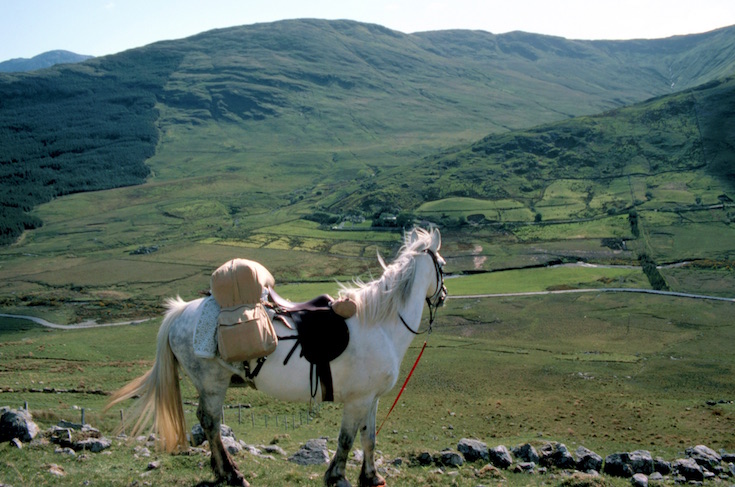
I rode nervously out of the yard; it had been at least ten years since I’d been in charge of a horse and several months since Belle had been ridden. Everyone had advised me that I must buy a fit pony or it would be prone to saddle sores and other health problems. They had also told me to get myself in shape for riding or I would suffer a similar fate. I reckoned Belle and I would just have to get fit together. I was already thinking in terms of “we” after only about half a mile. Belle was very fresh from her months of inactivity. She walked briskly, ears sharply pricked, eyes wide, nostrils dilated, ready to shy at any strange object. But when a car came, she passed the most important test of being quiet in traffic. She had smooth, comfortable paces and was responsive to the aids. I also tested her willingness to stand quietly when tied – a very important point – while I went into a shop to get something to eat. She was also the right height, given all the mounting and dismounting I was going to do: about 14.2hh.
Willy was preparing for his first trek of the season and was hard to pin down to the all-important discussion about price.
My heart pounded as I said that I wanted to buy Belle (he already knew that) and what would be the price. “I’ve already told you it would be somewhere between 700 and 800 (punts or Irish pounds).”
“Did you?” I couldn’t remember having that conversation. “Would you, um, consider 600?” Willie turned to look at me. “I can get more than that in the market.” he said. “For horse meat.” Of course that concluded the conversation, as he knew it would. “I can’t possibly sell for less than 775 with the new set of shoes”. I agreed. What else could I do? Translated into sterling his price was about £650, which didn’t sound so bad, though it was well over the £500 I’d given myself as a ceiling.
So on May 6 1984 I finally became the owner of the pony of my childhood dreams. I rode exultant down the narrow Irish lanes and all those birthday cake wishes crowded together as I said aloud “You’re mine! You’re mine!”
I couldn’t quite believe that I was a horse owner again after 24 years. I kept visiting Belle in her stable to make sure she was real. And I asserted my ownership by changing her name. She was now Mollie, named after the vain pony in Animal Farm who hides ribbons in her stall, runs away from the fighting and finally defects from the cause. Since this was 1984 a nod towards George Orwell seems appropriate and there was a touch of vanity about her: she obviously dyed her mane – why else would the roots be dark?
The weeks went by and Mollie and I gradually got to know and trust each other. She certainly has her foibles and no doubt felt the same about me.
Mollie clearly believed in leprechauns. We could be slopping along happily lost in our own thoughts when suddenly her head would go up, her ears prick and she’d snort and jump at every sound or movement. She’d keep it up for a mile or so, then get bored and slump back into an even plod. By the evening I swear that if she could have found a way of crawling on hands and knees she would have done.
It was raining again in the morning. “Grand soft morning!” went the greetings. I wouldn’t be surprised if the weatherman announced “Grand soft weather spreading from the West”. Mollie was fresh after those acres of green grass and found the road full of life-threatening situations; there was a fierce sparrow, an ominous puddle, a lethal plastic bag, a terrifying flock of geese, a horse-eating terrier, and an ogre of such horrifying aspect that the poor woman had to remove the raincoat held over her head before Mollie would go past.
I’d discovered during our early acquaintance that Mollie didn’t know what to do with a titbit. I’d tried her with apples, carrots, barley sugar, Polo mints and sugar lumps, all thoughtfully purchased from shops along the way. She’d inspect each one, smelling it carefully with a look of astonishment on her face, then throw her head up with a “you can’t fool me” gesture and refuse to have anything more to do with it. She liked recognisable food in a recognisable container and no messing about.
Providing her with sufficient water was also a challenge. She was quite maddening: except when desperate she’d only drink from natural water sources. Helpful housewives would come running out of their homes in slippers slopping full buckets of water and she’d just turn her head away.
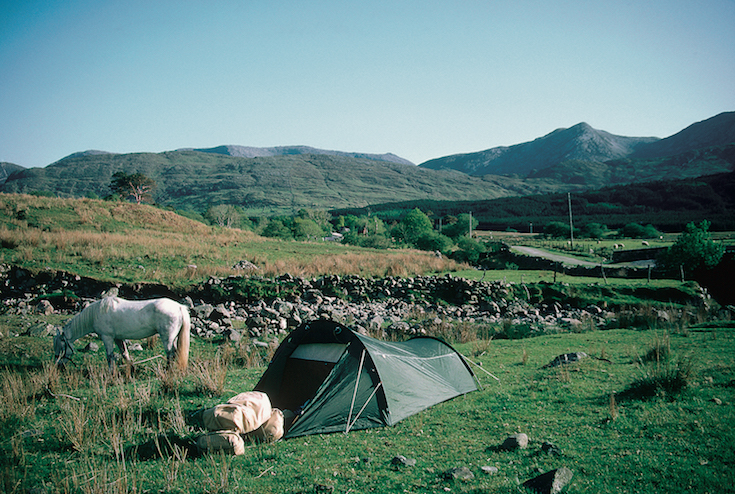
She was also less excited about each day’s journey than I was, and well into the trek was difficult to catch.
As I packed up the next morning Mollie strolled around waiting for me to notice that she didn’t intend to be caught but by the time I was finished she was bored and allowed me to come up to her and clip the lead rope onto her head collar. That was a sort of break through, but paled beside the event later that day. As always, I had offered her my apple core at lunch time, but this time, instead of turning away disdainfully, she absentmindedly ate it. I laughed out loud at the shocked expression on her face as she chomped it with her lips drawn back and foamy apple juice dripping from her teeth. “Hey, it’s good!” With pricked ears she nuzzled my pocket for more. I stopped at the next shop I came to and wheedled a free carrot out of them. And she ate it. She learned fast, and soon became quite tiresome, stopping dead outside grocery shops and peering into the doorway in the hopes of a treat.
A Connemara Journey by Hilary Bradt is available to buy now for £12.99.
To celebrate the publication of A Connemara Journey Bradt are holding a live talk on 28 April with Hilary Bradt. Tune in to hear Hilary chat about the highs and lows of her epic horseback journey through Ireland in the 1980s. Get your tickets here.