
Read an extract and enjoy a recipe for spicy meat dolma from the wonderful Samarkand: Recipes & Stories from Central Asia & the Caucasus ahead of our event with the authors.
 It is 6am and the sun is bleaching the mountains around the Tajik capital Dushanbe. The driver of our shared taxi heading west, finally satisfied that every seat in his Mitsubishi Pajero is full, lights another cigarette and noses out of the capital. For the next undisclosed number of hours (‘maybe eight, maybe 12’, I am told) we will bounce our way through the remote and desolate Fan Mountains to Penjikent, a place of windswept ancient ruins, which will serve as our fifth-century pitstop.
Penjikent, known as the Pompeii of Central Asia, is a ruined ancient city where remarkable frescoes were excavated. From here, a two-hour journey, and iffy border crossing, will take me to Uzbekistan and finally, to the city of Samarkand. The anticipation rises. My mind fills with images of turquoise tiles, towering madrassas and Tamerlane’s marauding horsemen.
We travel not for trafficking alone;
By hotter winds our fiery hearts are fanned:
For lust of knowing what should not be known,
We make the Golden Road to Samarkand
Throughout its long history, Samarkand has inspired poets to write, and these famous lines by James Elroy Flecker are on my mind as the journey begins. So too is breakfast. A quick rummage in my bag tells me that once again the romance of the road has got in the way of sense and I realise, stomach rumbling, that I haven’t packed a ration of survival food. As our car kicks up dust on hairpin bends, nothing we pass is edible. Spotting our car, women wearing psychedelic paisley-print headscarves offer us the nomadic snack of qurut. I decline glumly, for these brackish dried yogurt balls are dehydrating salt bombs that make a decent partner for beer, but are not much good for breakfast. Rivers curl between deep valleys and peaks rise higher than the Alps. It is a nettlesome but spectacular journey.
Three hours in and my eyes sting with tiredness. Sleep had not come easily at the Hotel Vakhsh in Dushanbe where I had spent two days waiting for my Uzbek visa. Once occupied by mujahideen rebels, today it is a Soviet-style hotel where you deposit your jewellery to reserve a room and sleep under itchy sheets. Grim faced ‘floor ladies’, their hair dyed cherry-red, keep a watchful eye on those coming and going, mainly drunk businessmen. I had been glad to leave.
Ravenous now, we roll into Penjikent at dusk. A pink glow hovers over the ruins that mark a former major city on the Silk Road. Only grasstufted foundations are visible today, but once a palace stood here with columns in the shape of
dancing girls.
My fixer in Dushanbe had hooked me up with Firdauz, a local man who runs a homestay. As promised, he is there to meet me and leads the way to his low-slung house set around a courtyard and small orchard. As I finish unpacking a few essentials, Firdauz motions me into their dining room. There is little furniture. Red and orange Bukharan rugs cover both floors and walls. In the corner, video footage is showing a Tajik wedding. Two Spanish travellers sit, watching the film. What my hungry eyes fix on in the scenes of celebration is a bubbling kazan of plov, big enough to feed several hundred.
Then, in comes Firdauz’ wife, Fatima. Cue shakarob! Cue shurbo! Cue vodka! The shakarob – a simple salad of flaky fatir flatbread, onion, tomatoes and yogurt – has all the thirstquenching benefits of an energy drink. I hoover it up with the steaming shurbo, a potato broth laced with herbs, as plates of sizzling shashlik are ferried out from the kitchen. I laugh and exchange travel tales with my hosts and the two Spaniards. We toast everything from ‘friendship’ to ‘Samarkand’. The vodka and conversation flow. Worn out and sated at long last, I almost wept.
Note: Sadly the Penjikent-Samarkand border crossing is currently closed to foreigners. Border crossings in Central Asia change like the wind, so always check before you set out. The best website with up-to-date information is
caravanistan.com
Spicy Meat Dolma
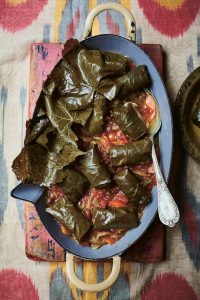
Stuffed vine leaves are popular from Central Asia through to Turkey, the Mediterranean and Eastern Europe. Typically, the filling is a mixture of meat and rice, while the parcels can also be made using cabbage leaves or even hollowed vegetables. In Tashkent I tried a sophisticated version where vine leaf parcels were filled with spiced meat and no rice, making a more elegant addition to a shared table rather than a substantial main meal.
Makes 12
200g minced beef
1 shallot, finely chopped
1 red chilli, deseeded and finely chopped
1 tablespoon barberries or dried unsweetened cranberries
1/2 teaspoon paprika
1/4 teaspoon cayenne pepper
1/4 teaspoon ground cumin
2 tablespoons finely chopped flat-leaf parsley leaves
16 vine leaves, in brine or fresh
2 tablespoons olive oil
1 onion, sliced
1 carrot, sliced
4 tomatoes, diced
sea salt and freshly ground black pepper
Greek yogurt, to serve
Mix the minced beef with the shallot, chilli, barberries, spices and parsley. Season with salt and pepper. Set a small amount of the mixture aside, then use your hands to shape the rest into 12 sausage shapes.
Put the vine leaves in a colander and pour over hot water to rinse off the brine (or blanch fresh leaves in boiling water for 30 seconds to soften). Choose the 12 largest vine leaves and remove the stalks. Lay a leaf on the surface with the stalk end towards you. Sit a sausage on top, roll up the leaf to just cover the filling, then draw in the sides and continue rolling to make a neat parcel. Repeat with the remaining leaves.
Select a casserole pan that will accommodate all 12 dolmas snugly in a single layer. Heat the oil and add the reserved meat mixture – it will help give flavour to the stock. Cook over a medium heat until golden, then add the onion and caramelise. Add the carrot and tomatoes and cook for a further minute or two until beginning to soften. Season with salt, then lay the dolma, on top, seam-side down. Add enough hot water to the pan to come three-quarters of the way up the dolmas. Cover with the remaining vine leaves – broken ones unsuitable for stuffing are perfect here – then use a plate a little smaller than the pan to weigh the stuffed leaves down. Bring to a gentle simmer and cook the dolmas for 40 minutes. Leave to cool in their cooking juice.
Drain and serve at room temperature with Greek yogurt.
Taken from Samarkand by Caroline Eden & Eleanor Ford published by Kyle Books, priced £25. Photography by Laura Edwards.
Don’t miss our event with the authors on 9th June, 2016, at our Long Acre shop.
Follow Kyle Books on Twitter (@Kyle_Books) and Instagram (@kylebooksuk)