 John Waller is author of Greek Walls, Corfu Sunset, Corfu Sketches, and Corfu Town Walks. He spends much of his year in Corfu and here, in an interview with John McCarthy originally aired on BBC Radio, John entices us further with tales from this beautiful Greek island…
John Waller first arrived on Corfu in the 1960s and the island cast a spell on him; so much so that he built a house there. He has recently produced a book with local artist Theresa Nicholas called Corfu Sketches.
John, how much time do you spend in Corfu?
Spring and autumn. In the spring the flowers are unbelievable; in the autumn we have a second spring with cyclamen coming out. And of course the sea is warm for swimming…
You already paint a lovely picture; what was it that you really fell in love with on those early visits?
It must be the people – the Greeks are a wonderful people – they are very hospitable. Also the countryside; Edward Lear wrote about that wonderful countryside: something incredible with three million olive trees. The beaches in those days were empty, and being a keen swimmer, we went to many of them. Finally the villages; the villages are an unknown secret – there are 104 of them. They are quaint; they are lived in; and they are worth visiting.
You mentioned that when you first went there, the beaches were empty. How has the island changed in those 40 years?
With the beaches there is obviously development, but thank goodness, one of the laws is that no building can be over four storeys if it is commercial and three if it is private. There is not the major development as in other locations. On the beaches, the sand is still there and when the sun goes down, there are not so many people on the beach and when I am having my glass of white wine and my plate of fried fish, it is wonderful.
Tell me about the links with Britain and the British.
The British were on Corfu from 1814 to 1864. We built the roads and the waterworks. We also introduced cricket and ginger beer.
Ginger beer?
Yes, ginger beer. It is now the only place you will find real ginger beer made with just ginger, lemon, sugar and water; nothing else. It’s an excellent brew! I can really recommend it.
Edward Lear, you mentioned. In the front page of your book you have a limerick:
There was an Old Man of Corfu
Who never knew what he should do:
So he rushed up and down
Till the sun made him brown,
That bewildered Old Man of Corfu.
You have been giving us lots of things; you are not a bewildered nor old man from Corfu. Why was he there in the first place?
His health; he kept on talking about ‘that grey London’. From 1856 to 1863, just before the British left, he spent most winters there, wandering the island and painting the landscapes. We know him as a limerick writer, but he was also a wonderful landscape painter.
Was he involved with the cricket?
I’ll be honest with you – I read his letters and he never mentioned cricket once. He wasn’t into that side of things – he was into the countryside.
Is it a strong feature of Corfu life?
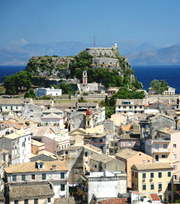
We were over there last month and the Lords and the Commons turned up to play cricket and I am proud to say we, that’s the Greeks, got a tie. It is still played in the square – the plateia – which is surrounded by the wonderful British Palace, the French Liston and the Venetian Fort. A gorgeous setting and a fair result.
And of course it’s a World Heritage Site?
Two years ago Corfu Old Town was made a World Heritage Site. And that, along with the European Union summit, has changed the town from a bit of a Balkan backwater to one of the most beautiful places to walk.
Thinking of the walks, your passion is for walking. Apart from walking around the Old Town, you have been up and down the length of the island. Describe a bit more of the island and one of the favourite villages you discovered.
We started right in the south, in Kavos, famous for the 18-30s. As soon as we left that town, we left civilisation. It was just like it was 50 or 60 years ago; even as though it was 100 years ago because it was as Lear wrote about it. We walked for eight days, up the west coast, then across the north. Throughout that time, we were measuring scenery, tranquillity – which always scored a high point – and development: of which there was almost none in that walk amongst three million olive trees, which, because we have passed a law, must NOT be cut down.
When you are walking along this tranquil landscape and you come to a little village, what is the atmosphere like?
You will always find a café bar for the men in the evening; and you will probably find a mini-store. It is very peaceful until the festivals – the panayiri – when they all come out and dance and music is played. The architecture is gorgeous: the archways and the narrow alleyways, with restricted access for cars as well.
Are the local Corfiots tolerant or resentful of the visitors and ex-pats that go there?
They are very proud if a foreigner moves to their village – they are welcomed.
Are you happy that tourists should keep going, should fewer or more go?
Everyone who has been, has got to go back to see the World Heritage Site and the countryside. They are so superb. You must go back. You will love it and you will go again and again.
Finally, what is your favourite Corfiot dish?
Bourdetto and Bianco are the two fish dishes: one red, one white; one hot, one garlic. Fantastic.
 This interview is John Waller’s transcript of an interview that was originally broadcast on BBC Radio’s Excess Baggage.
Corfu Trail: Friends, Flowers and Food – from Kavos to Agni in 8 Days is due out in spring next year. Stanfords currently stock John Waller’s Greek Walls, Corfu Sunset, Corfu Sketches, and Corfu Town Walks.