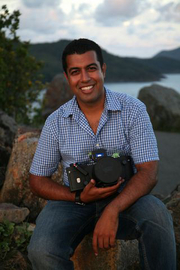
 Jaspal Jandu is an acclaimed British photographer who travels extensively around the world in search of the perfect combination of timing and light. With a renowned passion for natural conservation, his latest release – Natural Wonders: A Panoramic Vision – presents awe-inspiring photography from over 20 of the world’s precious natural wonders.
What is your background?
Through various studies and jobs, I have been involved in and surrounded by fine art and music throughout my life. Apparently, it is often said, that playing music creates new pathways in your brain that stimulate creativity.
More formally, I majored in economics and it’s something which I still enjoy to this day. There’s a great quote from Leonardo da Vinci which states that one should aim to “…study the science of art and the art of science”. I guess in this vein, it’s healthy keeping one part of my brain active with photography and the other with something completely different now and again.
Why did you choose to be a landscape photographer?
My father was a prominent architect and I clearly remember being fascinated by the bewildering blend of art and science in his study room. After contemplating a similar career myself, I eventually chose to pursue a different discipline which could provide me with an equally rewarding mix of art and craft.
Eventually, as I began to travel with my camera I started to mature, both personally and professionally. My previously embarrassing attempts at photography were soon crystallising into something more solid and the ratio of ‘keepers’ to ‘losers’ was increasing dramatically.
It was during this growth spurt that I began to realise how important and overlooked landscape photography is to the environmental debate. Returning to countries again and again, I would compile almost time-lapse images of, for example, glacial retreat and desertification. Given the resonance of such images with the general public and art editors alike, I eventually resolved myself to a career in landscape photography.

Why panoramic?
I have always been absorbed by the intrinsically epic panoramic format. For example, I’m sure if you watched Lawrence of Arabia or Lord of the Rings in a square aspect ratio, you would inevitably lose some of the sweeping cinematic experience contained within. The panoramic frame – especially when printed large and viewed close – requires the eye to scan from side-to-side and this perfectly complements the way the brain works in real life.
What is your current project?
My main focus at the moment is publication of a new book entitled ‘Natural Wonders: A Panoramic Vision’. It covers over 25 countries on earth and highlights the fragile state of the world’s ecosystem and our shared destiny within it. It has taken over four years to complete and all the images are presented in my preferred panoramic format.
Did you have to prepare yourself for this journey, if so for how long and how?
The journey itself has taken around four years with the single continuous stretch of around one-and-a-half years.
Being based in England, it has been relatively easy to take cheap flights to, say, Scotland or the Alps. Given that everything is so accessible in Europe, I often find that there is not really that much to prepare for.
Most of Africa was completed in one rather long and adventurous visit. Starting in Tanzania for Mount Kilimanjaro and the Ngorongoro Crater, the voyage went on to the Serengeti (Kenya), Drakensberg (South Africa), Sossesvlei (Namibia) and Victoria Falls and Mana Pools (Zimbabwe). As I was also shooting digitally by this stage, my main worry was battery power and memory storage. I was also concerned about camera safety and sand/dust but in the end both of these issues proved to be easily surmountable.
The long continuous trip of 18 months was much more difficult because of the geographies and climates involved. It took about two months to agree the schedule and organise the gear (packing swimming trunks alongside snow crampons was interesting). I ended up producing a huge hand-drawn map with all the natural wonders accompanied by the seasons, visa requirements, flight time tables and the like. By the time it was time to leave for the trip, I honestly felt equally exhausted as I did excited.
How did Stanfords help in the process?
Simple – whenever I needed my ‘fix’ of adventure and travel I would always go to Stanfords!
I always found it quite amazing that I could literally navigate the world amongst the bookshelves and displays of my local Stanfords in Covent Garden. On the aesthetic side, I purchased numerous volumes on specific locations and avidly noted the most favourable times for photography (Denali in autumn, for example). On a rather more technical note, the selection of detailed hiking and climbing maps proved to be literally life-saving purchases – whether I’m leading a group or out in the field myself, there are absolutely no compromises on the best quality, physical maps you can buy.

What was the biggest catastrophe and what was the happiest moment on the trip?
The single biggest set-back occurred in Venezuela. As I was attempting to capture the grandeur of Angel Falls, a rumour began to spread that I was a journalist from National Geographic who was overtly photographing local people without the necessary permits. Needless to say, having the Minister for Indigenous Affairs and four armed guards pounding on my bedroom door at 4am in the morning wasn’t the most pleasant of experiences. After a fairly heated debate, I managed to get all of my camera gear back but by then I had lost crucial shooting time in my very short stay in the country.
My fondest memories are of touring the American Southwest. Hiring a camper van and traipsing though such awe-inspiring scenery such as Canyonlands and Monument Valley should be standard rites of passage for everyone. Not only did it yield some literally jaw-dropping pictures but it also convinced me that the best photographs are made when the connection with the land is at its strongest.
What are your expectations now?
Unfortunately, one of the burdens of being a perfectionist is that I always set my expectations impossibly high. I am striving to release a new book on London fairly soon and also embarking on the sequel to ‘Natural Wonders’; heading off again on another voyage to capture the world cloaked in beauty and fragility.
Separately, I am also cognisant of the relentless advances in photographic technology. Although I’m not sure if I’ll end up shooting the next volume in something ridiculous like holographic format, I do have hopes of remaining at the forefront of this wave.
What reaction would you like to receive from your viewers?
To have inspired others into both photography and environmental conservation would be an honour. More rudimentarily, given the sacrifice behind some of the pictures, a plain old-fashioned ‘wow’ would also be nice!

What gear did you use, and film stock?
I’m not really a ‘gear-head’ and am always at pains to point out that a camera is ultimately a tool which helps us to communicate our hopes, thoughts and desires to others. However, having said this, I am also cognisant of the fact that photography is a craft and therefore relies heavily upon the tools of the trade.
To this end, my primary camera is the Linhof 617 SIII. In terms of ruggedness, usability and sharpness, I have found nothing comes close. Although I tend to favour the use of both the Super Angulon 90mm and 72mm lenses (~19/15mm in 35mm terms), I also use the 180mm lens for more telephot
o / abstract work. Fuji Velvia 50 (both 120 and 220 formats) is the colour film of choice with Tmax 100 used for black and whites. I have tried the new Velvia 100 Professional and found it not to my liking (particularly its handling of the red spectrum), so I am currently using the new Velvia 50 II. A Sekonic light meter, Lee filter set and Manfrotto tripod round off the main tools.
Latterly, I have also begun using Canon digital cameras. A variety of lenses accompany me including the 14mm, 17-40mm, 24-105mm and 100-400m. Having both the Linhof and the Canon is really a dream combination. Whilst the former handles epic landscapes in its stride, the latter comes into its own with fast moving and/or variable ISO scenes. Covering every known biome – forest, aquatic, desert, grassland and tundra – in the course of my journey, I can personally vouch for how good modern cameras have become.
What is your favourite ingredient for a good photo?
Light is the most important ingredient for the good photo, period. In this regard, my most favoured condition is the fleeting glimpse of golden light which sometimes occurs through a slit in the clouds at sunset or sunrise. The resulting contrast of rich foreground with brooding blue and ochre clouds is pure photographic manna from heaven, in my opinion.
What future events can we expect?
I am currently promoting my work via exhibitions and corporate tie-ins (recently holding a collaborative with Porsche, AG) whilst continuing to shoot new material. The website – www.jaspaljandu.com – is doing extremely well and the ultimate aim is to tie this in with a dedicated gallery of my work in the not-too-distant future.

During the course of my journey, I have been blessed to encounter many like-minded individuals and organisations who are dedicated to the preservation of our areas of outstanding natural beauty. They are too numerous to mention, but World Heritage bodies, environmental organisations and National Park authorities all command my total respect for the work they undertake. Irrespective of where they are based, they have all highlighted to me that man has just as much power to solve problems as he does to create them.
Lastly, I am often asked about the genesis of this project. Why would one commence the long journey to document the natural wonders of the world? In a twist on Mallory’s famous quote, my instinctive answer is: “…because in the future, they may not be there”. I hope this can serve as the salutary ethos behind my body of work.
