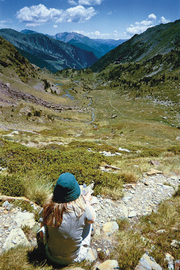
 Conquer a summit close to home: Cicerone’s new trekking guide by Carl McKeating and Rachel Crolla showcases the best peaks to bag on the continent.
Pic de Coma Pedrosa
Western Andorra
Why? To peak-bag in the Pyrenees.
Height: 2942m.
How long? 3-4 nights. Climb: 4.5 hours ascent 3 hours descent.
Tucked into the heart of the Pyrenees, Pic de Coma Pedrosa is a picturesque mountain which rewards hikers with a variety of terrain from meadows and hanging valleys to the arid rock and mineral-rich lakes of its upper reaches. Views from the summit are spectacular. While Andorra’s streets bustle with French and Spanish day-trippers in search of tax-free goods, Coma Pedrosa provides a fitting counterpoint to all that by lifting you above the throng into a serene tranquillity. The mountain is popular but not swarming with people; we encountered few hikers after passing beyond the chairlift area of the Refugi Coma Pedrosa. In summer Coma Pedrosa can be climbed as a good day hike and provides no technical difficulties beyond very easy scrambling and a short section of snow walking.
Getting there:
Several airlines fly to Barcelona and Toulouse. There are good coach links from these cities to La Vella. Regular buses run La Vella-Arinsal.

Moldoveanu
Romania
Why? To travel back in time.
Height: 2544m.
How long? 4 nights. Climb: 4.5-6.5 hours ascent, 4-6 hours descent.
The Fagaras range (Transylvanian Alps) in Romania is one that rewards wayfarers with stunning vampire-toothed ridges, sweeping hillsides and cold ancient tarns. Moldoveanu, the highest point of the range, is justifiably popular with Romanian and Eastern European climbers but is far quieter than other national high points in the region. The mountain’s massive proportions and remote setting make it a challenging hike which keeps the number of summiteers down and trekkers will be delighted to find plenty of space to explore the wealth of different trail-marked routes available (if you can get hold of a decent map). Unless you have a four wheel drive vehicle, there is no quick and easy way up and this is most certainly a good thing because like a fine wine, Moldoveanu should be savoured. While much of Romania was subjected to a Stalinist-style industrialisation during the twentieth century, ravaged by Ceausescu’s regime and now clambers towards the unrestrained capitalism of the EU, these Transylvanian mountains are still characterised by ancient rural traditions and hallmarks such as scythe carrying locals who stop to stare at the traffic and who could quite easily fit into 7th century life without causing a murmur. The area, with its occasional gothic castle, will send chills up the spine. We found it an absolute delight.
Getting there:
Fly to Bucharest. It is easiest to take the northern route up the mountain from Victoria if arriving by public transport. To get there go to the train station at Ucea de Jos on the Sibiu – Brasov line. Continue to Victoria by bus.
Vaalserberg
Dutch, German and Belgian border near Aachan, south Holland
Why? To prove that Holland has hills.
Height: 321m.
How long? 20 minutes.
Holland is well known for being as flat as the proverbial pancake, but in fact its high point is far loftier than those of some other European countries such as Denmark and Lithuania. Vaalserberg, a busy hill with a road up it, is not without interest as an oddity. On its summit is Drielandenpunt’ (Three Countries Point) where Holland, Belgium and Germany’s borders all touch. This was once Four Countries Point as the tiny neutral country of Moresnet (1815-1919) also used to converge here. Moresnet is now part of Belgium. We describe the route up from the Dutch side. The highest maze in Holland is to be found on the summit along with cafes, restaurants, a playground and a viewing tower.
Getting there:
Aachen is well served by bus and train links. From here it is possible to catch a trans-border bus to Vaals to begin your ascent.

And the rest…
Europe’s summits come in varied shapes and sizes – here’s a list to get your feet itching…

Disputed high points
Azores – Mt Pico (2351m): not mainland
Canary Islands – Mt Teide (3718m): not on mainland
Faroe Islands – Slaettararindur (882m): dependency of Denmark
Turkey – Mt Ararat (5,137m): in Asia.
For full details on the climbs, see Europe’s High Places.