 Caroline Bowler, manager of Stanfords Bristol, and husband Tony D’Arpino trekked in the Indian Himalaya, finding it just as stunning as the more popular Nepal trekking routes, if not more so, and certainly freer of crowds…
We recently returned from a two- week Himalaya trek in northern India. Led by Mark Butterworth of Essential India, it was a journey into a land of light and unworldly vistas. The Garwhal Himalayas of the Uttaranchal district, unlike areas of Nepal, are relatively unknown. We met no other westerners during our time trekking on these ancient trade routes.
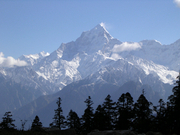
First you have to get there. From New Delhi we travelled by train to Haridwar, then by small bus across many of the prayags, the sacred confluences of rivers that drain into the Ganges, to the village of Mondoli, where the last road ends. We camped that first night in a mountain field shared with the ponies that would carry our supplies. As the sky cleared at sunset, the great peak of Trisul was suddenly visible.
The first day’s trek was long, sunny and hot, and we passed many villages with their terraced farms rising far above and below us. The rhododendron trees, larger than the largest English oaks, were in full scarlet blossom. Our trek was literally garlanded with the fallen flowers. We camped near the village of Wan, at one of explorer Eric Shipton’s old campsites, below a forest of Deodars – cedars the size of California redwoods. The Himalayan Griffon Vulture was a common sight and one day we were thrilled to see a Golden Eagle gliding in the thermals.
This was also a singing trek organised by Candy Verney, a community choir leader from Bradford-on-Avon and Sue Glanville www.allaboutthejourney.co.uk. We sang every night under the bright Himalayan stars, and were often joined by the local villagers who shared their songs with us. It was a wonderful example of communication, with song our only common language. Other highlights of the trek included the Aarti Ceremony on the River Ganges in Haridwar, in which floating candles in flower leaves are released with a prayer; and the stunning sight of Nanda Devi herself, the highest mountain in India, surrounded by the double circle of sanctuary peaks.
The best map for this area is still Garwhal Himalaya East published by The Swiss Foundation for Alpine Research (scale 1:150,000) . Two excellent background books on the area are Nanda Devi: A Journey To The Last Sanctuary by Hugh Thomson (Phoenix), and Garwhal and Kumaon: A Trekkers and Visitors Guide by K P Sharma (Cicerone).
Author: Caroline Bowler