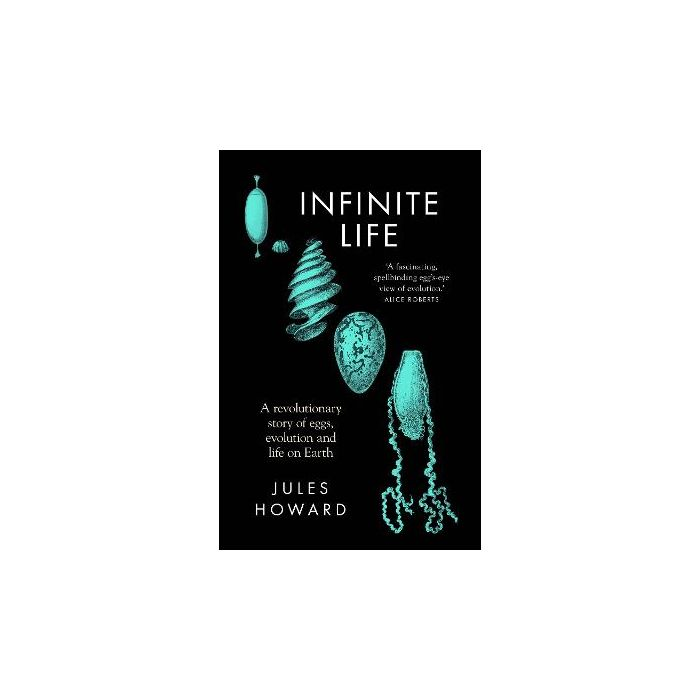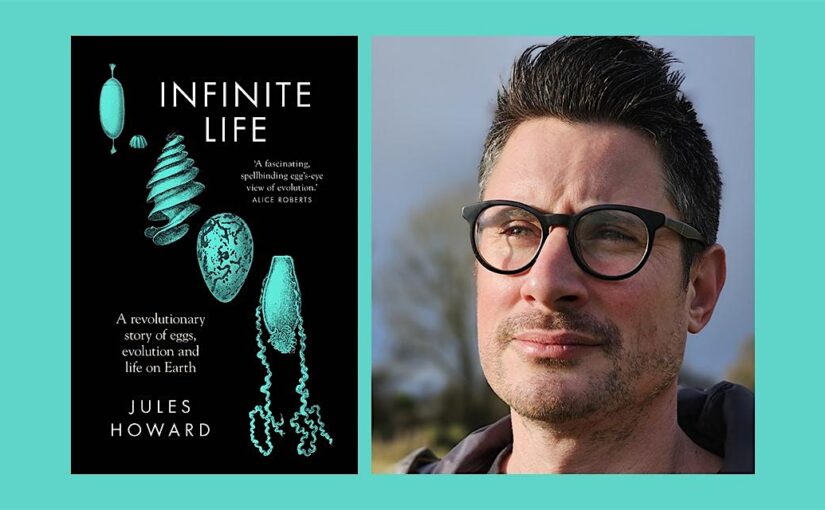
In Infinite Life: Revolutionary Story of Eggs, Evolution and Life on Earth, zoology correspondent Jules Howard takes the reader on a mind-bending journey from the churning coastlines of the Cambrian Period and Carboniferous coal forests, where insects were stirring, to the end of the age of dinosaurs when live-birthing mammals began their modern rise to power. Eggs would evolve from out of the sea; be set by animals into soils, sands, canyons and mudflats; be dropped in nests wrapped in silk; hung in stick nests in trees, covered in crystallised shells or secured by placentas.
Here is an extract:
Under a winking strip light in the corner of my middle infant classroom, a fish tank had been placed upon the dingy, cork covered worktop. I can see this new addition now, in my mind’s eye, from across the room. We lined up like normal that day, then planted our bottoms on the floor. As usual, the register was taken and the teacher told us about our day, yet at no point did my eyes leave the thing behind the glass: the great globule; this gelatinous dropping. This was my first encounter with frogspawn and I had never seen anything like it in my life. This mass of eggs was so strange that if you had told me an extraterrestrial visitor had broken into the class in the night and dropped this germ into our midst, I might have believed you. In the weeks that followed, I would take it all in: the dots; the twitching embryos; these assembling protoorganisms. The gathering of tiny tadpoles on the surface of the slime blob; their first lap of the tank; their second and third. The fog of my eager commentary condensed upon the glass each breaktime. Each day, my tacky fingerprints peppered the glass surface; each night, someone’s job must have been to wipe them off. My quaint, rundown primary school never repeated this activity again while I was there. Probably, the teachers cursed the cleaning that having a tank of frogspawn required, as well as the smell that belched from it.
But I am extremely grateful to whoever it was who said back then, in the cigarette fog of the dingy staffroom, that it might be something worth trying. I still think about those eggs today.
When you think of an egg, what do you see in your mind’s eye? A chicken egg, hard-boiled? A mermaid’s purse, the egg of a shark or ray, entangled in seaweed thrown onto shore? The eggs of headlice, perhaps, being scraped off a nit comb? Perhaps you see a human egg cell, prepared on a microscope slide and telegraphed onto a TV screen in a laboratory? Or the majestic marble-blue eggs of the blackbird? Each egg is unique, and that is one of the finest things about them. Each egg on Earth has its own charisma, allure and evolutionary backstory, easily (I have learned) as diverse and interesting as the animals that hatch out of them. Every egg there has ever been is an emblem of survival; a product whittled, chiselled and crafted by the unthinking forces of natural selection for the purpose of passing genetic lineages forwards in time – days, weeks, months, sometimes years. Eggs have an evolutionary depth to them that animal-lovers don’t consider enough. And so, Infinite Life is a biography, of sorts; a true history of the egg – the most unifying, resilient life structure that Earth has ever cooked up.
In the chapters of this biography, we journey through the Cambrian explosion, when animal life surged into the lineages we recognise today, when eggs were first nursed and cradled; we chart
the egg’s magnificent assault on the land, first through the ancestors of spiders and scorpions, then insects, then fish that first walked the shores and, later, the forests. Our journey takes in Triassic ponds, brimming with mating amphibians; the rise of maggots and other insect larvae; the marsupials thriving in newly evolved pouches and the rise of the most diminutive egg of all – the mammal egg as you and I know it. A single cell, the width of a hair, from which every human alive has passed. There is, naturally, a special place in our story for the eggs that encapsulated themselves in a layer of crystalline calcium and became the shelled eggs of some dinosaurs and, later, birds – a model example of how natural selection can modify egg shape, structure, colour and form and how beauty can manifest itself upon nature without design or deity. But the evolution of the bird egg is just one story among hundreds of others that feature here.
As a child and as an adult now, the joy of eggs is that they sit between the boundary lands of life and death. They represent potential. That’s what I see in frogspawn each year to this day – an exciting, dizzying, extreme form of potential. And so, for me, the egg will always be what I saw in that school tank all those years ago. Something to smear a nose up against; to question; to express wonderment at; to find new perspectives of life in. Eggs are, I now realise, the mechanism through which animal
lineages are propelled forwards through time, like threads woven into a giant tapestry. Eggs are the stitches. Eggs hold together life generations and lineages; they bind the animal narratives known to us today, allowing us to marvel both at the big picture and the intricate needlework of life. Told from the perspective of the egg, there are surely things we can learn about what it is to be alive.
This is an edited extract from Jules Howard’s Infinite Life: Revolutionary Story of Eggs, Evolution and Life on Earth (Elliott & Thompson).