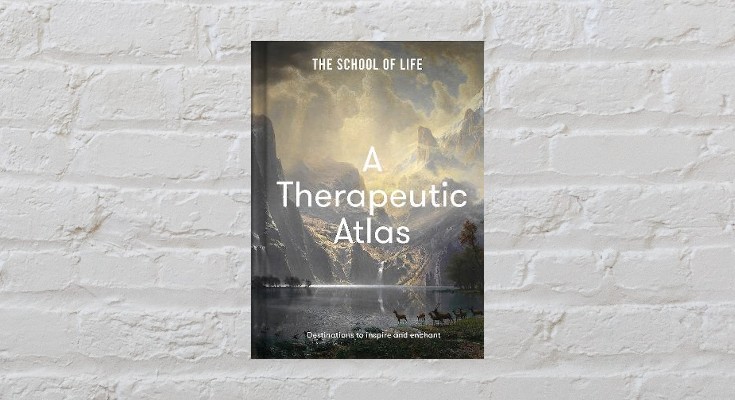
From the Malverns to Manhatten, from Seoul to Sicily, A Therapeutic Atlas invites you to revel on the tops of mountains, or solitary cliffs, discover elegant cities and encounter some unexpectedly therapeutic locations: airports, hydroelectric stations, meteorite craters and elaborate highways. But these places aren’t just beautiful in themselves – they can also help us deal with the difficulties of being human. Here, The School of Life, give some examples of surprising therapeutic locations, not so far from home.
Ideally, we would never have to leave the house, or even our bed. It would all be to hand – everything one desired, needed and hoped for would be within immediate reach, as it might have been when one was very small and at peace in a comforting cradle.
But as we mature, our needs invariably develop in more complicated ways and so the ability of a single environment to meet them must falter. We start to dream of ‘elsewhere’; we want to go places; we crave a change of scene.
We really don’t need to travel far to reap the benefits of travel. Here we offer a few locations not so far from home with extreme therapeutic power.
The planet offers us so many places in which we can find healing. We should not neglect the one that we are (hopefully) already cosily ensconced in – or not too very far from.
The Train Journey
Ostensibly we might be on a journey to a provincial capital or a coastal town. But really, we’re on a journey around unfamiliar and neglected parts of our minds. Wherever the train might happen to be taking us, the incidental – though paramount – benefit of the trip is that it may help us to work out what we think.
Ordinary life goes by far too fast for most of what we have experienced to be adequately processed. There can be enough material in a five-minute exchange with a colleague to power reflections that could last many hours; a 300-page novel could be written in about a half hour inside our minds. Most of the time, we cannot begin to get to grips with the sensations coursing through us; we have no opportunity to notice more than a fraction of what we have lived through. No sooner has one event impacted on us than we are forced to move on to another, yet more turbulent or provocative one.
Now, at last, we’re on the train – which doubles as a well-disguised machine for self-understanding. We were hoping that the carriage would be empty and we are in luck. There are just a couple of people at the rear; to all intents, we have the place to ourselves. So we take a seat at a window in one of the centre sections, bring out a pad and pen and fall into a reverie. There’s no agenda. We’re free associating, letting our thoughts come to us as they will, helped along by the rhythmic clicking of the rails and the passing views onto fields and forests.
Thinking is so hard because we are never far from a risk of stumbling into the clutches of an intensely uncomfortable thought. We might, for example, realise that we should leave our partner, that we are furious with someone we’re meant to love or that we need to try to find a different sort of work, though we have invested so much in the existing path. With such disclosures waiting for us, no wonder not-thinking can feel like such a priority; how understandable it is that we lean on opportunities for distraction in order to delay, possibly forever, the necessary moments of reckoning.
After hours of train-thinking, we may feel lightened, understood and purged of our previous anxiety and fear. The train’s claims have been too modest; it has not only carried us to our destination, but also led us back to key bits of ourselves.
The Kitchen Window
Fortunately, we don’t need to go to one of the world’s finest observatories – in the Atacama Desert in Chile, Mauna Kea in Hawaii or Mount Teide in Tenerife – to benefit from the wisdom of their powerful lenses. All we need is a well positioned window ledge and a little patience.
The night sky doesn’t address us in words. It doesn’t argue with us. It appreciates that at times we need to see, rather than be told. The soothing message of the night is encoded in sensory elements. It bypasses our logical minds and stimulates hope in the emotional parts of our being. Like the smell of newly cut grass or the earth after rain, it affects us by bypassing our understanding.
The night reorients us. If we sleep, our dreams will be usefully unsettling and strange. The certainties of the daytime world will be upset. We’ll learn that we still miss someone we were supposed to have forgotten a long time ago. Or that we’re attracted to an enemy, or that we are more vulnerable than we had supposed. And if we can’t sleep, under the light of the stars, we’ll be able to come at our dilemmas from new and unfamiliar angles. The difference between hope and despair is often just a different way of telling stories from the same set of facts.
We don’t need to wait until we have built our own observatory to participate in eternal totality. Tonight, our own window ledge will be more than enough.
The bed
There are many places on the planet that offer us a therapeutic effect, but perhaps none that are, in the end, as much use to our psyches as this one. Our bed deserves to be recognised as the supreme location of reassurance, mental reorganisation and consolation. Were we unable to travel any distance beyond its limits, we would still have a world of reassurance at our fingertips.
A bed does not – of course – carry any overt glamour. We don’t earn respect or interest for revealing that we have, once again, spent the weekend, or even the whole holidays, sleeping and reflecting under the duvet. A bed lacks the grandeur of the desert or the edifying ancientness of a past civilisation. And yet it may, at points, be exactly what we need to dampen our mania or make sense of our sadness.
A bed offers ideal conditions in which to think. It can be hard to do so properly at a desk. The mind may release its better thoughts only when we are horizontal and under little pressure to produce very much. It is then that our wilder, odder, more valuable ideas dare to make themselves felt.
Thinking in bed, we can go back over a relationship, we can question our worries, we can push back against our self-doubt and impulses to self-sabotage.
Often, we’re brittle and desperate not because the problems are truly too large, but because we’re simply too tired. The distinction is easy enough to observe in the case of children. A 3-year-old who throws their bowl of animal pasta on the floor and declares that they ‘hate Mummy’ isn’t a monster, they’re just exhausted. After a good night’s sleep, they’ll be a delight. We should extend the same kindly insight to our adult selves.
We can, in addition – at quieter moments – use our beds as tools of travel. They may be physically weighty, but they are nimble at carrying us back in time to journeys we have made and, without necessarily knowing it, minutely stored in our memories. When sleep refuses to come, we can journey back to summer evenings in the Mediterranean or to a friendship that we made in a foreign city. Far more remains than we might have imagined; as our bed teaches us, we don’t always need to move our physical selves back to a place in order to feel as if we had returned to it.

Extracted from A Therapeutic Atlas by The School of Life available for £22.
The School of Life is an organisation helping people lead more fulfilled lives. Learn more: www.theschooloflife.com